
Avata 2 in Extreme Forest Temperatures: A Field Method That
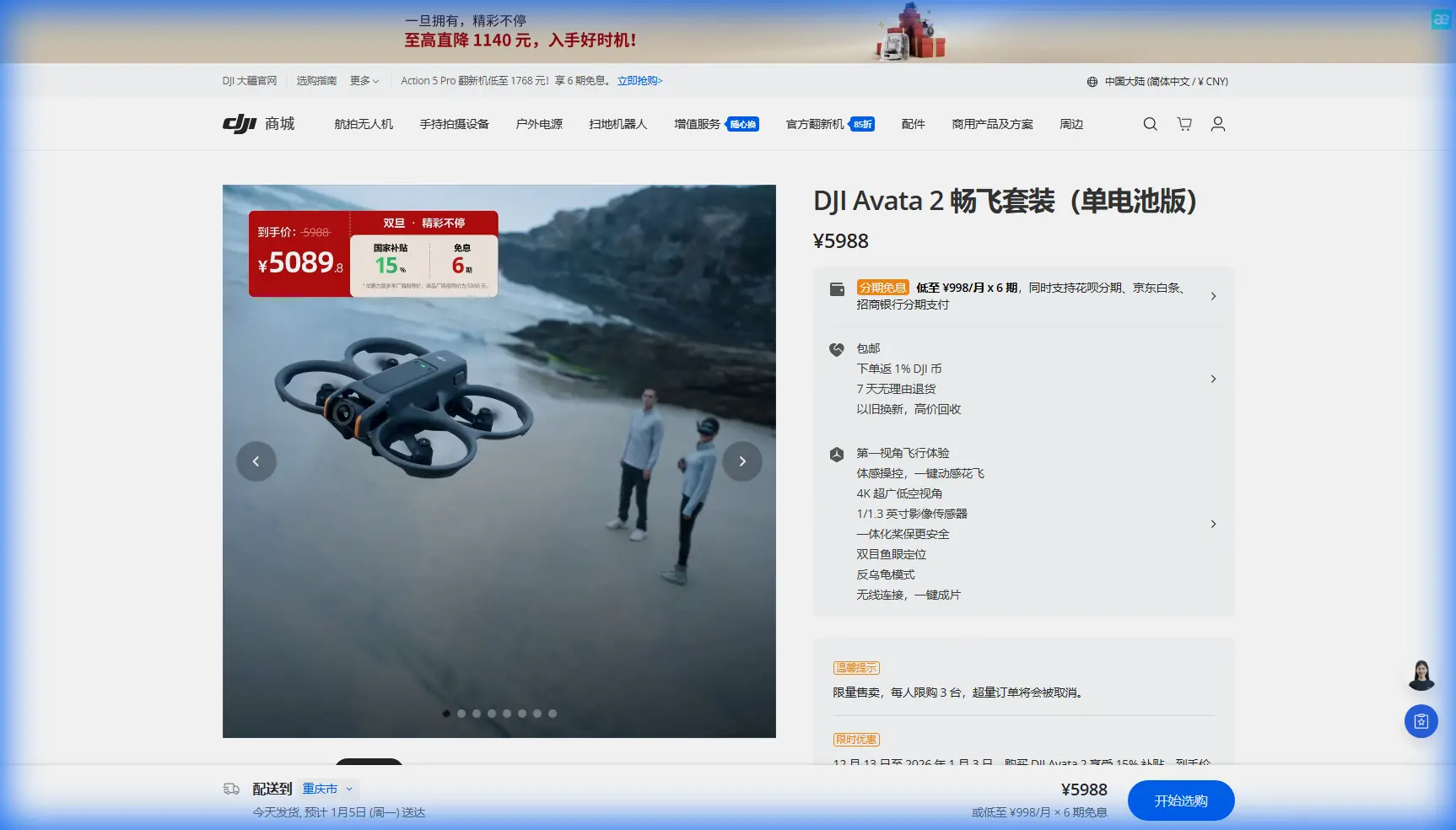
Avata 2 in Extreme Forest Temperatures: A Field Method That Prioritizes Stability Over Hype
META: A practical expert guide to using DJI Avata 2 for forest filming in extreme temperatures, with a focus on stability, vibration control, flight discipline, obstacle awareness, D-Log workflow, and reliable capture.
Cold forests and heat-soaked woodland can make a capable drone feel unpredictable fast. Battery behavior shifts. Sensors get noisy. Prop wash behaves differently around trunks, ravines, and broken canopy. If you’re flying the Avata 2 in these conditions, the real question is not whether it can produce striking footage. It can. The question is how to keep the aircraft stable and the footage usable when the environment starts stacking small problems on top of each other.
That is where a design lesson from rotorcraft research becomes surprisingly relevant.
A university hex-rotor design study from Harbin Institute of Technology centered on a simple truth: aircraft performance in the real world depends heavily on how well the control system deals with vibration and disturbance. In that work, the aircraft used six rotors arranged in 3 coaxial groups, and the researchers validated controller performance through hovering accuracy tests, anti-interference tests, and signal-tracking experiments. They also proposed a complete approach to reducing gyroscope and accelerometer noise caused by vibration, combining mechanical anti-vibration measures with a digital alpha-beta filter.
That may sound far removed from a compact FPV platform like Avata 2, but it maps directly to forest work in extreme temperatures. The operational lesson is clear: stable footage starts before you press record. It begins with how the aircraft senses motion, resists vibration, and holds its intended path when the environment is messy.
Why Avata 2 makes sense for forests when conditions get difficult
Avata 2 occupies an unusual place in the current drone landscape. It is more immersive and more agile than a typical camera drone, but it is also easier to manage in constrained spaces than many traditional FPV builds. That matters in forests, where tight gaps, uneven light, and sudden elevation changes punish aircraft that either drift too much or demand constant pilot correction.
Compared with many custom FPV setups, Avata 2 gives civilian operators a more integrated route to dependable capture. You are not piecing together vibration isolation, tuning, camera settings, and transmission behavior from separate components. In a forest under temperature stress, integration is not a convenience. It is a safety and consistency advantage.
And compared with larger photography-first drones, Avata 2 can move through tree-lined corridors with less visual bulk and with a more natural sense of flow. For a photographer working in winter pines or in summer forests with rising thermal currents, that blend of compactness and controlled motion is often more useful than chasing maximum sensor size alone.
The overlooked problem: temperature amplifies sensor and vibration issues
Extreme temperatures do not just affect batteries. They affect the entire feel of the aircraft.
Cold conditions can stiffen materials, change damping behavior, and make prop-induced vibration more noticeable in subtle ways. Heat can soften mounts, alter motor efficiency, and increase the strain of repeated acceleration in dense air pockets near foliage and terrain. In both cases, the flight controller has to interpret the aircraft’s state through onboard sensors while the frame is constantly being nudged by wind shear, branch turbulence, and your own control inputs.
The Harbin hex-rotor research is useful here because it isolates a core issue: gyro and accelerometer noise caused by vibration. In forest filming, noisy sensor data has operational consequences. It can lead to less precise hovering, less confidence during slow close-proximity work, and inconsistent tracking behavior when the aircraft needs to hold a line under disturbance.
You do not manually apply an alpha-beta filter on Avata 2 in the field, of course. The platform’s own control architecture handles stabilization internally. But the principle still shapes best practice: reduce vibration at the source, then fly in ways that help the aircraft’s control system work cleanly.
A practical pre-flight method for forest shoots
Before I fly the Avata 2 in harsh forest conditions, I run through a preparation routine that is less about speed and more about preventing compounding errors.
1) Inspect anything that can transmit vibration
Look closely at propellers, guards, mounting points, and camera housing. A tiny imperfection that seems harmless in open air can become very visible when you’re flying low through repeating vertical textures like tree trunks.
The research reference emphasized mechanical anti-vibration before digital filtering. That sequence matters operationally. If the airframe is physically cleaner, the flight controller has better raw information to work with. On Avata 2, that translates to steadier footage, more predictable attitude response, and fewer micro-jitters when threading a path along forest edges.
2) Let the aircraft settle before demanding precision
In cold weather especially, avoid launching and immediately diving into technical lines. Give the aircraft a brief period to stabilize and verify hover behavior in a safe clearing.
This mirrors the study’s hovering test for controller accuracy. In practical terms, a stable hover is your early warning system. If the aircraft wanders, shivers, or feels unusually reactive, do not assume it will improve once you enter denser canopy.
3) Test disturbance response in open space first
The study also used anti-interference testing for controller stability. For Avata 2 operators, the equivalent is a short disturbance check: small yaw inputs, modest pitch changes, and a controlled stop. You’re looking for whether the drone returns to composure cleanly.
That matters in forests because branches create inconsistent airflow. A drone that recovers well in open space is far more likely to remain manageable when a cross-current appears between trunks.
Flying method: use the forest, don’t fight it
The biggest mistake I see in difficult forest conditions is trying to force a generic FPV style onto terrain that demands restraint.
Avata 2 excels when you give it a path with intention. Think arcs, not frantic corrections. Think layered reveals, not pure speed. In a cold cedar forest, for example, the most effective shot is often a measured push along a natural corridor, then a controlled rise into a canopy break. In hotter conditions, especially in mixed woodland with shimmering air and uneven ground heating, smoother control inputs help the aircraft remain settled and help the footage retain shape.
This is also where Avata 2 compares well against many competitor-style FPV options. Some alternatives can be faster or more customizable, but they often require more pilot workload to achieve the same consistency in constrained civilian filming environments. Avata 2’s strength is not brute performance. It is the way it packages immersive movement with a control feel that remains approachable under stress.
Obstacle avoidance and route discipline
Forest shoots encourage overconfidence because the scenery is beautiful and the aircraft feels nimble. Don’t confuse nimble with invincible.
Obstacle awareness in woodland is not just about obvious trunks. Thin branches, deadfall protrusions, irregular slopes, and sudden openings can distort depth perception, especially in flat winter light or high-contrast summer patches. The practical role of obstacle avoidance on Avata 2 is not to replace judgment. It is to widen your margin when the environment becomes visually deceptive.
When I’m flying a route I haven’t seen before, I break it into three passes:
- A reconnaissance pass at safer spacing
- A shaping pass to refine entry and exit lines
- A capture pass for the final movement
That method aligns with the research idea of signal tracking. The study used signal-tracking experiments to validate the controller’s ability to follow intended behavior. In forest work, your “signal” is the route you want the drone to hold. The cleaner and more repeatable that route is, the more likely Avata 2 is to deliver footage that feels deliberate rather than accidental.
ActiveTrack, subject tracking, and when not to use them
There is a lot of interest around ActiveTrack and subject tracking for adventure, hiking, and cycling scenes in forests. These tools can be genuinely useful with Avata 2, but they are most effective when the terrain gives the system readable space.
In dense woods, I treat tracking as situational, not default. If the trail has clean separation between subject and background, and enough lateral clearance for a safe line, tracking can create elegant results with less pilot overload. In tangled understory or in forests with low hanging limbs, manual route planning is usually the better call.
The point is not whether the feature exists. It is whether the forest is offering the system enough visual clarity to remain reliable. Extreme temperatures can make pilots rush decisions. Resist that. The smart move is often to simplify the shot.
Use QuickShots and Hyperlapse sparingly in trees
QuickShots and Hyperlapse are attractive because they can produce polished motion with minimal setup. In forests, though, they need more skepticism than they would over open ground or water.
QuickShots can work nicely at clearings, along ridgelines, or above sparse canopy transitions. Hyperlapse is better reserved for forest edges, logging roads, and river corridors where the path and horizon stay legible. Deep inside dense canopy, manually controlled motion usually looks more intentional and carries less risk.
The best operators know when not to automate. That restraint is part of what separates usable field work from a memory card full of almost-shots.
D-Log in extreme temperature environments
For photographers moving into Avata 2 video, D-Log deserves attention because forests create punishing tonal contrast. Dark trunks, reflective leaves, snow patches, and bright sky holes can all exist in one frame.
In cold forests, snow or frost can fool your eye into underestimating highlight risk. In hot forests, shafts of light through canopy can clip fast while the understory stays heavy. D-Log gives you more room to preserve those transitions, but it also asks for discipline. Expose for the shot you intend to grade, not the one that merely looks vivid on location.
My approach is simple:
- Avoid abrupt exposure shifts mid-line
- Prefer stable paths where light changes gradually
- Use motion that complements the grade rather than fights it
A smooth forest run in D-Log is easier to shape later than a flashy route full of impossible contrast jumps.
Hover quality is your honesty test
One of the most useful insights from the hex-rotor design study is that hovering test results can reveal controller accuracy. That sounds academic until you are standing in a freezing clearing wondering whether one more battery is worth it.
Hover quality tells the truth. If the Avata 2 can hold itself cleanly, respond calmly, and avoid visible agitation in a controlled area, your odds of getting stable footage in the trees go up. If not, no creative ambition will rescue the next pass.
This is where many competitor comparisons miss the point. Spec sheets talk about speed, camera metrics, and cinematic modes. Those matter. But in forest work under temperature stress, the aircraft that feels composed at low speed, in close space, with minimal fuss often wins the day.
A sample cold-forest workflow
If I were guiding a photographer through a subzero conifer shoot with Avata 2, the sequence would look like this:
- Start in an open patch and verify hover steadiness.
- Inspect for any visible vibration cues in the live image.
- Fly a short disturbance test with gentle yaw and braking.
- Plan one route that uses natural spacing between trunks.
- Shoot the route manually first.
- Only consider ActiveTrack or a QuickShot if the terrain clearly supports it.
- Capture a second version in D-Log for grading latitude.
- End with a slightly higher safety pass in case the lower line proves too tight in edit.
That workflow may sound conservative. It is. Forests punish impatience, and extreme temperatures magnify small technical flaws.
If you want to compare notes on route planning or cold-weather setup choices, you can message a pilot-focused team here.
The bigger takeaway
The Harbin hex-rotor paper was not about Avata 2, but its findings land squarely on the same operational truth: flight quality depends on a control system’s ability to deal with vibration, disturbance, and intended path tracking. Their solution combined mechanical anti-vibration and digital filtering, then verified results through hover, anti-interference, and tracking tests. For an Avata 2 operator filming forests in extreme temperatures, those are not abstract engineering ideas. They are the backbone of reliable field practice.
So if you want better footage, stop thinking first about flashy maneuvers. Start with stability. Clean hardware. Honest hover checks. Controlled paths. Careful use of tracking and automated modes. D-Log when the light calls for it. That is how Avata 2 stops being just a fun aircraft and becomes a dependable imaging tool in one of the hardest civilian environments to film well.
Ready for your own Avata 2? Contact our team for expert consultation.