
Avata 2 for Power Line Delivery in Difficult Terrain
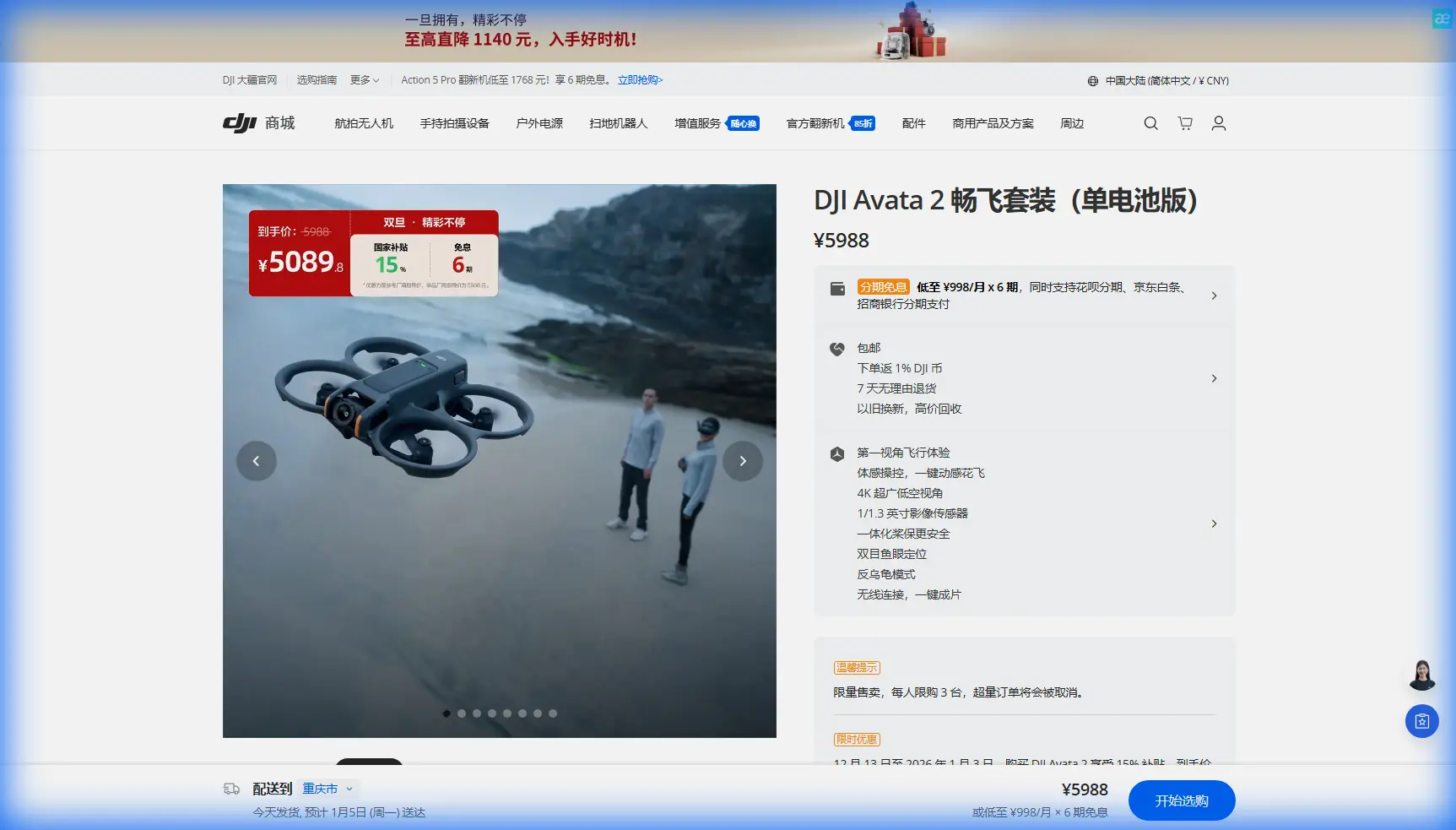
Avata 2 for Power Line Delivery in Difficult Terrain: A Technical Review from the Field
META: A practical expert review of DJI Avata 2 for power line delivery support in complex terrain, covering obstacle avoidance, low-altitude flight control, D-Log workflow, tracking limits, and why it changes site operations.
Power line work in rough terrain has always suffered from a visibility problem.
Not a paperwork problem. Not even a payload problem first. Visibility.
When crews have to move small line materials, inspect approach paths, or coordinate delivery points across steep slopes, forest edges, ravines, and uneven access roads, the hard part is often not getting airborne. The hard part is understanding the route well enough to move confidently and safely. Traditional camera drones can help from above, but they do not always give the pilot the kind of close, terrain-shaped perspective needed to read a narrow corridor the way a field crew experiences it on the ground.
That is where the Avata 2 becomes unusually relevant.
This is not a heavy-lift platform, and it should not be framed that way. For actual power line delivery operations, the Avata 2 makes the most sense as a route-proving, approach-validation, training, and visual coordination aircraft rather than a cargo workhorse. Used correctly, it reduces uncertainty before people commit vehicles, crews, or larger UAV systems to a difficult section of terrain. In that role, its design choices matter more than a spec sheet headline.
I say that from experience. Years ago, one of the most frustrating site days I had involved a mountain-side utility access route that looked simple from overhead mapping. On a standard drone, the top-down image was clean. The problem only appeared when we tried to understand the corridor at working height. Tree limbs pushed farther into the route than expected. A narrow saddle created misleading depth perception. The landing and handoff zone looked open on screen, but in reality it had a tight lateral margin because of slope and brush. We lost time because we were seeing the route like surveyors, not like operators.
An aircraft like the Avata 2 would have made that day easier.
Why Avata 2 Fits This Niche Better Than Many Conventional Camera Drones
The Avata 2 is built around immersive, close-environment flight. For utility-adjacent route work, that changes everything. Instead of treating terrain as a background under the drone, you treat it as a corridor around the drone. That sounds subtle until you are trying to judge whether a line of approach is actually usable between trees, poles, terrain breaks, and changing wind channels.
Its compact, ducted form factor is one reason it stands out. In power line support scenarios, especially in broken terrain, there are many moments when the aircraft is not operating in wide open airspace. It is slipping along edges, crossing contour changes, or peeking over rises to reveal what the crew cannot yet see. A platform designed to tolerate tighter proximity work has clear operational value here. That does not remove risk, but it changes the practicality of collecting the exact visual information you need.
Obstacle sensing is another major factor. The Avata 2 includes binocular fisheye visual positioning for downward and backward sensing, which is not just a brochure feature in this context. In steep terrain, backward awareness matters because utility route work often involves cautious reversals, hover repositioning, and controlled retreats after a forward look into a constrained area. Downward visual positioning also helps when surface texture, slope transitions, and low-altitude hovering become part of the job. These systems do not replace pilot judgment, but they do support more confident low-level work where terrain detail matters.
Then there is the FPV flight experience itself. For complex route assessment, the value is straightforward: immersive viewing helps a pilot read gaps, branches, embankments, and access openings in a more spatially honest way than a detached, floating camera view. If your mission is to determine whether a delivery path to a temporary work zone is realistic, that perspective can save an entire cycle of trial and error.
What It Actually Does Well for Power Line Delivery Teams
The phrase “delivering power lines” can mean different things in the field, so let’s narrow it to the civilian reality: moving or supporting the placement of small materials and equipment in utility corridors, often where terrain limits truck access and where larger drone deployment needs better route intelligence first.
In that environment, the Avata 2 is most useful in five practical ways.
1. Route preview before a larger operation
This is probably the strongest use case. Before a team sends in a larger UAV or commits a crew to a difficult approach, the Avata 2 can fly the corridor at the height and angle that matter most. That includes checking vegetation encroachment, terrain-induced blind spots, wire-adjacent access clearances, and practical approach geometry to a drop or handoff zone.
This is where obstacle avoidance has real value. You are not relying on it to “solve” flying in a utility corridor. You are using it as one layer in a cautious reconnaissance process where a close-range mistake could end the sortie before useful data is gathered.
2. Training utility crews to understand aerial delivery paths
There is a gap between drone teams and line crews on many projects. One thinks in air routes, one thinks in ground access. The Avata 2 helps bridge that. Because the footage feels more like traveling through the corridor than observing it from above, crews can review approach paths and discuss whether a location is viable for receiving materials, staging tools, or supporting a later UAV delivery.
This is where recorded footage in D-Log M becomes more useful than many people expect. D-Log M gives more flexibility in handling contrast-heavy utility environments: bright sky, shaded tree cover, reflective hardware, and deep terrain shadows in the same flight. That matters when the video is not just for marketing, but for operational review. A route discussion is more productive when details are visible in both highlights and shadows.
3. Low-altitude approach validation in uneven terrain
Topographic mapping may say an area is accessible. A close pass often says otherwise.
The Avata 2 can verify how a route behaves near the actual handoff area. Is there rotor disturbance risk near loose brush? Does the landing or hover zone visually collapse because of slope angle? Are there hidden branches on the final segment? This kind of close-in information is often the difference between a smooth operation and a canceled one.
For this job, stable low-level handling matters more than cinematic ambition. The aircraft’s design supports slower, more deliberate probing of problem areas. In practical field terms, that means fewer assumptions and better pre-mission decisions.
4. Producing reviewable site footage that crews will actually use
Many site videos are technically correct and operationally useless. Too high, too detached, too polished.
The Avata 2 can generate footage that is visually intuitive to people making ground decisions. QuickShots and Hyperlapse are not the core reason to use it in utility support, but they are not irrelevant either. Hyperlapse can help show terrain progression across a route in a compressed, readable form, especially when stakeholders need to understand how the corridor changes over distance. QuickShots are less central for technical mission planning, though they can still help document site context for presentations, training debriefs, or client reporting.
The point is not creative flair. The point is communication.
5. Capturing approach footage for remote consultation
Sometimes the person who needs to approve or refine the route is not on the slope with the pilot. In those cases, sharing immersive corridor footage can speed decisions. If your team needs a quick field discussion on route feasibility or a difficult access section, you can message our utility UAV desk directly and reference the recorded segment for faster technical feedback.
That kind of workflow only works if the aircraft can gather video that faithfully represents the problem. The Avata 2 often can.
The Tracking Question: Useful, but Not the Main Story
Because LSI terms like ActiveTrack and subject tracking come up often, it is worth being direct. On a power line support mission, these are secondary tools, not the center of the platform’s value.
Tracking can help when documenting a moving crew member, a support vehicle, or a route walk for training purposes. It may also simplify certain repeatable visual tasks around access corridors. But in utility terrain, obstacles, wires, vegetation, and variable elevation make autonomous or semi-automated tracking something to use conservatively. The pilot should think of these features as assistive options for documentation, not as core route-navigation logic.
This distinction matters. Too many operators evaluate drones by attractive consumer-facing features rather than by whether those features survive contact with a technical field environment. With the Avata 2, the real win is not that it can automate an eye-catching shot. The real win is that it lets a skilled operator gather route intelligence from the exact perspective that a difficult site demands.
What the Avata 2 Does Not Replace
It does not replace formal utility inspection aircraft for every mission.
It does not replace a properly selected heavy-lift platform.
It does not make wire environments casual or forgiving.
And it absolutely does not remove the need for disciplined flight planning, site assessment, regulatory compliance, and conservative standoff from energized infrastructure.
That limitation is not a weakness. It is what keeps the aircraft in the right role. The Avata 2 is strongest when used as a precision visual tool that informs a larger operation. If you treat it like a route-reading instrument rather than a universal utility drone, its strengths become obvious.
A Better Tool for the “Unknowns” Between Map and Mission
The reason I keep coming back to the Avata 2 for this kind of terrain work is simple: many power line delivery challenges are not caused by the known route. They are caused by the last 20 meters nobody truly understood.
That final segment may include a hidden lean in the trees, an awkward rise before the handoff point, or a deceptive opening that narrows at working height. On paper, none of that looks dramatic. In the field, those details decide whether a mission stays efficient.
The Avata 2 helps expose those unknowns early.
Its obstacle sensing supports careful close-range route reading. Its immersive flight profile gives operators a more honest view of access corridors. Its D-Log M recording is useful when reviewing difficult contrast conditions common in mountain and woodland utility sites. And while features like QuickShots, Hyperlapse, ActiveTrack, and subject tracking are not the headline for this use case, they can still support documentation and training workflows when applied with discipline.
If you work in utility support, especially where terrain turns every straightforward delivery plan into a corridor problem, that combination is not trivial. It shortens the gap between aerial data and operational judgment.
For teams that have struggled with blind approaches, uncertain handoff zones, or route plans that looked better on a map than they felt in the air, the Avata 2 is one of the more interesting tools available right now. Not because it does everything, but because it does one very specific thing very well: it shows the route the way the mission actually happens.
Ready for your own Avata 2? Contact our team for expert consultation.