
Filming Coastlines in Harsh Weather With Avata 2
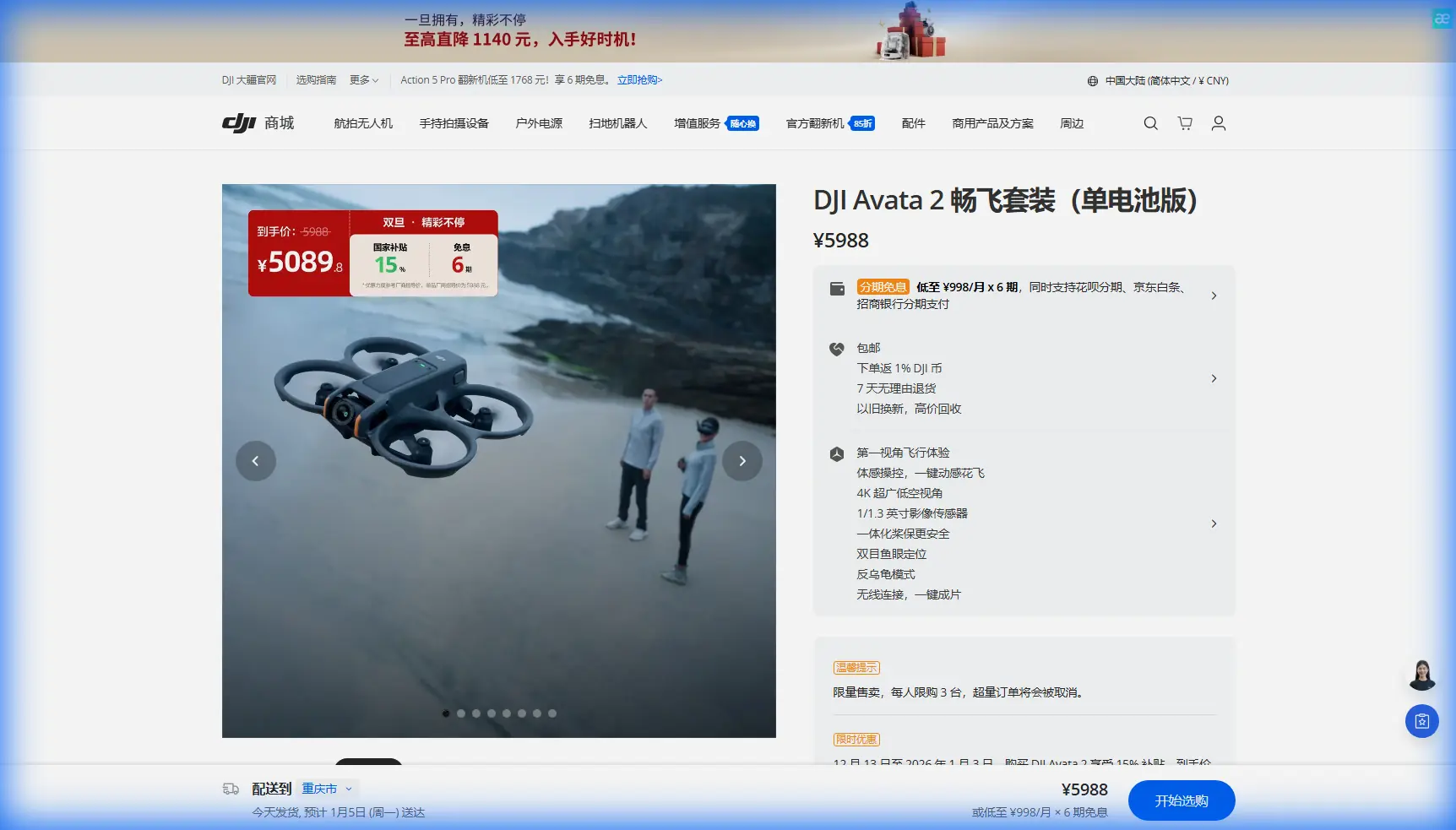
Filming Coastlines in Harsh Weather With Avata 2: What Actually Makes It Easier
META: A technical review of using DJI Avata 2 for coastline filming in extreme temperatures, with practical insight on obstacle awareness, tracking, D-Log workflows, and why vision-based flight control matters near GPS-challenging terrain.
A coastline looks simple from shore. In the air, it is anything but.
Salt haze softens contrast. Wet rock faces confuse depth cues. Wind folds back on itself as it hits cliffs, then spills into pockets that can unsettle a drone just as you dip for a low pass. Add extreme temperatures, and the margin for error narrows again. Batteries behave differently. Hands get slower. Judgment does too.
That is the context where Avata 2 starts to make sense.
I am not talking about the usual headline features in isolation. I mean the way this aircraft changes the workload for creators who need to capture dynamic shoreline footage without turning every flight into a hand-flying exercise in damage control. If you film coastlines regularly, especially in cold mornings or heat-soaked afternoons, the useful question is not whether Avata 2 is “powerful.” The question is whether it removes enough friction to let you focus on lines, timing, and image quality while the environment does its best to interrupt all three.
For me, that answer became clear after comparing this style of flying to older coastal shoots where I had to fight the scene more than I could shape it.
The old problem with coastline filming was never just wind
Years ago, one of the hardest things about coastal work was the constant split between navigation and composition. You would be threading through uneven terrain, reading gusts off a ridgeline, trying to keep a surfer, boat, or walker framed, and at the same time second-guessing whether the aircraft had enough reliable positional awareness to stay smooth.
That tension is not new in UAV research either. Back in 2013, work presented at IROS examined optic-flow-based control on a 46 g quadrotor in GPS-denied environments. On paper, that sounds far removed from a modern FPV-style camera drone. In practice, the underlying operational problem is very familiar to anyone flying near cliffs, sea caves, breakwaters, or steep coast roads: GPS is not always the whole story, and stable flight close to textured surfaces depends heavily on how well the aircraft interprets visual motion and nearby geometry.
Why does that matter for Avata 2? Because coastline shooting often moves in and out of the exact conditions where pure satellite confidence can be compromised by terrain, reflections, and abrupt directional changes. Any aircraft that is better at using vision and onboard sensing to stay coherent in those transitions gives the pilot more usable attention for the shot itself.
That is one of the strongest practical arguments for Avata 2 in this niche. It feels less like a platform that demands constant rescue inputs and more like one that supports deliberate flying in messy spaces.
Near cliffs and sea walls, obstacle awareness is not a luxury feature
A lot of drone buyers hear “obstacle avoidance” and think beginner safety net. That misses the point.
Around coastlines, obstacle awareness is a shot-preservation tool. When you are skimming parallel to a rock shelf or curving around a lighthouse approach, your job is to maintain a cinematic path with enough confidence that you do not keep widening every line out of fear. If the aircraft can better interpret proximity and help manage collision risk, you can fly tighter, smoother, and with fewer aborted passes.
That connects closely to another 2013 research thread from Robotics: Science and Systems on vision-based state estimation and trajectory control toward high-speed quadrotor flight. The important phrase there is not “high-speed” by itself. It is the pairing of state estimation with trajectory control. In real production work, especially over a coastline, the aircraft’s ability to understand its own motion relative to the environment is what makes fast, expressive movement look intentional instead of nervous.
Avata 2 benefits from that broader evolution in drone control philosophy. It is not merely about going fast by the sea. It is about preserving a clean path while the aircraft processes enough environmental data to remain trustworthy. For creators, that trust translates directly into fewer throwaway takes.
Extreme temperatures expose weak workflows fast
Coastal weather is deceptive because the visual beauty can hide a punishing operating environment. A bright shoreline in summer can mean heat radiating off stone, strong sun overhead, and long return paths with little shade for pilot or equipment. Winter coastlines create the opposite stress profile: cold batteries, stiff fingers, and faster decision fatigue when the wind cuts through your jacket.
Avata 2 does not erase those realities, but it does help simplify the workflow around them.
That matters more than spec-sheet enthusiasts often admit. In extreme temperatures, every extra control layer becomes a tax. If switching modes, recovering framing, or re-establishing subject position takes too long, you end up spending more battery and more mental energy than the flight plan can afford. Features like subject tracking and ActiveTrack become genuinely useful here, not as automation for lazy flying, but as tools that reduce repeated correction cycles when following a runner on a seawall path or a vehicle tracing a coast road.
The same is true of QuickShots and Hyperlapse. Used carelessly, they can feel gimmicky. Used well, they let you secure secondary sequences quickly before conditions shift. On a coastline, light quality can change in minutes as cloud bands move in from the water. If I can lock in a dependable orbit, reveal, or time-compressed shoreline movement without manually reconstructing the shot three times, that is not convenience for its own sake. It is risk management.
Why Avata 2 fits the creator who wants motion, not just hovering views
There are drones built to hover and observe. There are drones built to race. Avata 2 lands in the more interesting space between those poles for creators.
Coastline footage benefits from motion language. You want to sweep along the contour of a headland, dive gently toward surf lines, then pull up with enough control to hold horizon discipline. A drone that only feels comfortable in static compositions leaves a lot of visual potential untouched. A drone that feels too raw or unforgiving becomes tiring over a long shoot day.
That balance is where Avata 2 earns its place.
And here is where an unexpected reference from the source material becomes useful. One cited paper explored trajectory tracking control of a quad-rotor UAV, while another looked at frequency-domain system identification and simulation of a quadrotor controller. Those are not casual academic details. They point to the deeper truth that good flight footage starts long before the camera records anything. It starts with controllability, response tuning, and how predictably the aircraft follows a commanded path.
For shoreline filming, that predictability matters every second. Small overcorrections become visible in parallax-rich scenes. The coastline itself exaggerates mistakes because the eye can compare your drone line against strong natural geometry: cliff edges, horizon lines, wave bands, pier rails. If the aircraft feels uneven, the footage gives it away immediately.
Avata 2 is useful because it lowers that mismatch between pilot intent and aircraft behavior.
D-Log is especially valuable on coastlines
If you have ever exposed for white surf under midday sun while trying to retain shadow detail in dark volcanic rock, you already know why color profile choice matters.
D-Log is not just a post-production luxury in this setting. It is a practical way to survive scenes with aggressive contrast. Coastlines regularly combine specular highlights on water, bright sky, reflective wet surfaces, and textured shadows under ledges or vegetation. Standard profiles can look punchy right away, but they often leave less room when the shot includes both sunlit foam and darker landforms in the same frame.
With D-Log, you get a more flexible base for matching shots across changing weather windows. That becomes critical if your sequence spans a cold dawn, a brighter late morning, and a final overcast pass. The image pipeline needs to absorb those differences without forcing each clip into a separate visual world.
For me, this is one of the quiet strengths of Avata 2 as a coastline tool. It supports a shooting style where the environment can be volatile, but the final edit still feels coherent.
Tracking along the shore is easier when the drone is not the main problem
One of my past frustrations was following a moving subject on uneven coastal terrain while staying low enough to preserve speed cues. A jogger on a cliff path, for example, does not move through a clean corridor. The route bends, rises, dips, and often narrows beside brush, fencing, or rock. Every correction can cost the shot.
Avata 2 makes that easier because the stack of support features works together. Subject tracking and ActiveTrack reduce the burden of keeping the subject centered. Obstacle awareness helps when the edge of the frame is crowded with terrain. The aircraft’s overall handling makes it more feasible to maintain a line that looks cinematic instead of merely safe.
That combination does not replace pilot skill. It makes skill go further.
If you are planning serious shoreline work and want to compare setups or field strategies, you can message the flight team directly here.
What the research hints at that creators should not ignore
One of the more interesting source references discussed fault-tolerant control of an octorotor using LPV-based sliding mode control allocation. Avata 2 is not an octorotor, and there is no reason to force a direct hardware comparison. Still, the operational lesson is relevant: modern UAV performance is increasingly shaped by control resilience, not just propulsion or camera upgrades.
For coastal creators, that matters because the environment is inherently disturbance-heavy. Gust fronts, rotor wash interactions near rock walls, and rapid visual changes over water all test how well a drone handles imperfect conditions. The more robust the control logic and sensing stack, the more stable the platform feels when reality stops being cooperative.
This is exactly why a technical review of Avata 2 should not stop at image quality or speed. The aircraft’s value near coastlines comes from how much unseen control work it absorbs before the pilot even notices a problem developing.
The best use case is not reckless flying. It is efficient, repeatable flying.
There is a temptation with FPV-leaning drones to judge them by spectacle alone. That is the wrong lens for commercial or serious creator work.
The real win with Avata 2 on coastlines is repeatability. You can return to a sea arch, a harbor wall, or a cliff road and expect a more manageable process for rebuilding the shot. That consistency matters for documentary work, tourism content, resort visuals, environmental storytelling, and training-based creator production where conditions may only open briefly.
A dramatic coastline does not need a drone that constantly proves how extreme it is. It needs a drone that can carry out a planned visual idea with fewer interruptions from instability, framing drift, and environmental friction.
That is where Avata 2 earns trust.
It gives the pilot more bandwidth for the creative decisions that actually shape the final piece: altitude relative to the swell line, angle of reveal around a headland, pacing of a tracking run, and the choice to preserve highlights in spray while holding enough shadow depth for the land.
Those are the decisions viewers feel, even if they never know why the footage looks controlled.
And that is the core of my take after using this class of aircraft in difficult shoreline conditions. Avata 2 is not simply easier. It is more usable in the specific places where coastal filming tends to become chaotic: near terrain, in changing temperature bands, and during shots that demand both movement and precision.
Ready for your own Avata 2? Contact our team for expert consultation.