
Avata 2 in Thin Mountain Air: What DJI’s New Avata 360
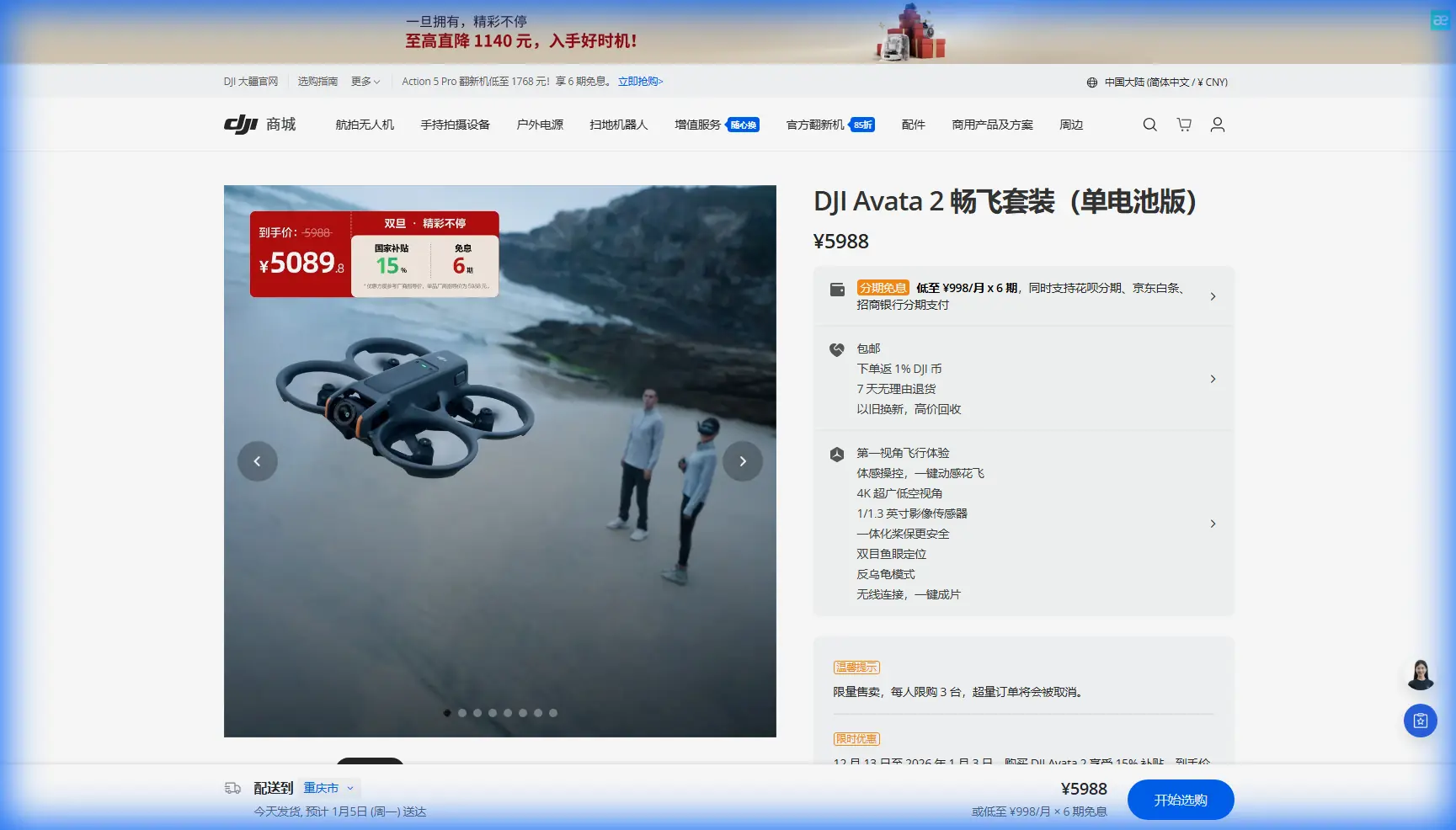
Avata 2 in Thin Mountain Air: What DJI’s New Avata 360 Means for Forest Filmmakers
META: A field-style case study on filming high-altitude forests with DJI Avata 2, and why the new DJI Avata 360’s 8K 360 capture, dual 1-inch-equivalent sensors, O4+ transmission, and omnidirectional sensing matter for real-world FPV creators.
I spend a lot of time thinking about what happens when a drone spec sheet meets a difficult landscape. Dense conifers. Broken ridgelines. Sudden wind shear. Light that disappears under the canopy and then blasts white across a snowy clearing. High-altitude forest work has a way of exposing every weak point in a flying camera.
That is why DJI’s newly announced Avata 360 is more interesting than a simple product launch headline suggests. On paper, the hook is obvious: an FPV platform that records 8K 360-degree footage. But for anyone already flying an Avata 2 in mountain forests, the more useful story is what this launch says about where immersive drone shooting is going next, and how today’s Avata 2 operators should adapt their workflow.
I’m looking at this through the lens of a photographer, not a spec collector. If your real assignment is following a trail through alpine timber, slipping between trunks, and coming home with footage that still gives you options in post, the Avata 360 announcement lands as a signal. DJI is putting serious weight behind immersive capture, and it is doing so with two details that matter immediately in the field: dual 1-inch-equivalent sensors and omnidirectional obstacle sensing, backed by O4+ video transmission.
Those three details are not abstract upgrades. They map directly to the problems high-altitude forest pilots deal with on every flight.
The case study: filming a high forest line with Avata 2
A recent shoot I handled involved a narrow conifer corridor at elevation, where the forest opened in fragments rather than clearings. The assignment was not cinematic in the broad, postcard sense. It was technical storytelling: move low through the trees, rise along the slope, reveal the ridgeline, and preserve enough tonal range to make the transition from dark evergreen shadows to bright sky believable.
The Avata 2 remains a smart tool for this kind of work because it combines speed with enough stabilization and automation to keep a complex run repeatable. Features like obstacle avoidance and subject-aware intelligent modes reduce pilot workload when your attention is split between line selection, altitude changes, and preserving composition. Add D-Log into the mix and you have more room to grade the contrast extremes that mountain forests throw at you. Hyperlapse and QuickShots are useful too, but on a job like this they are secondary. The real value is controllability under pressure.
What changed my own mountain workflow, interestingly, was not a new aircraft but a third-party accessory: an ND filter set tuned for fast light shifts. With an Avata 2, that accessory made motion rendering more consistent during transitions from open alpine light into shaded tree cover. In forest work, cleaner motion blur often matters more than people expect. It makes narrow-gap flying feel less brittle and turns borderline footage into something editorially usable.
Now place that experience next to the Avata 360 announcement.
DJI says the new model is built around 8K 360-degree FPV capture. For creators who regularly fly Avata 2 in forests, this is not just a resolution bump or a novelty format. It changes the risk equation. When a drone can capture the entire sphere around it, framing becomes more flexible after the flight rather than being locked to the split-second orientation you chose while dodging branches.
That matters enormously in the mountains.
Why 360 capture changes forest flying
Anyone who has flown an FPV route through a dense stand knows the basic tradeoff: commit to the line, commit to the frame. If you yaw left to avoid a snag, your composition changes. If you pitch to clear a rise, the horizon shifts. If the subject drifts, your shot may still be exciting, but it may not match the edit.
A true 360 workflow softens that penalty. DJI’s new Avata 360 records in 8K and captures the full environment, which means a pilot can prioritize clean flight path and safety during the run, then choose the most effective camera angle afterward. In practical terms, that can salvage shots that would otherwise be discarded. It also means one pass through a difficult forest corridor can serve multiple edits: a forward chase, a side reveal, a vertical social crop, or a horizon-stable scenic sweep.
For high-altitude shoots, where battery planning, weather windows, and pilot fatigue all compress your margin, that flexibility is operationally significant. You do not always get a second attempt in the same light, with the same wind, on the same line.
This is where the Avata 360 begins to speak directly to Avata 2 owners. Even if you are not upgrading immediately, the launch clarifies the future standard for immersive drone content: capture first, finalize viewpoint later.
The sensor story is bigger than it looks
The second important detail is the sensor setup. DJI pairs the Avata 360 with dual 1-inch-equivalent sensors. That phrasing should catch the attention of anyone who shoots forests, because forests at altitude are usually a contrast nightmare.
You may have deep shadow under the canopy, bright rock or snow nearby, and stray shafts of sunlight cutting through mist. Smaller imaging systems can make those scenes look brittle fast, especially when you are pushing FPV movement and do not have the luxury of perfectly controlled exposure every second of the flight.
Dual 1-inch-equivalent sensors suggest DJI is not treating 360 FPV as a gimmick camera. It is acknowledging that immersive footage only becomes truly useful when it holds detail and tonal separation. In real post-production, better sensor data means cleaner reframing, more confidence in highlights, and less damage when you need to recover texture in shaded greens and bark.
That matters to Avata 2 users because it reinforces a lesson many already know from working in D-Log: the flight is only half the job. The grade determines whether your mountain footage feels cinematic, natural, or thin. Better source material expands what is possible later, especially when you are balancing the cool cast of altitude haze against the dense saturation of evergreens.
O4+ transmission is not just comfort
The third operational detail in the Avata 360 launch is O4+ video transmission. That may sound like the least glamorous headline item, but in mountain forests it can be the difference between assertive flying and hesitant flying.
Tree density, elevation changes, and terrain occlusion are brutal on confidence. A strong video link does more than preserve image quality in the goggles. It affects pilot decision-making in real time. When transmission is robust, you hold your line longer, commit to reveals earlier, and spend less mental bandwidth second-guessing signal integrity.
With Avata 2, that same principle already shapes how pilots choose routes. Strong transmission performance expands the range of shots you can attempt safely. Seeing DJI push O4+ on the Avata 360 signals that immersive capture is being paired with transmission reliability, not treated as a studio-only feature set. That is good news for field creators, especially those working in forests where trunks, terrain, and moisture can interfere with clean signal paths.
Omnidirectional sensing has a different meaning in forests
Obstacle sensing is often oversimplified in drone marketing. In an open field, it sounds like convenience. In a high forest, omnidirectional obstacle sensing is workload management.
When flying among tall timber, the threats are not only in front of you. Branches creep from the side, dead snags rise behind a turn, and uphill terrain closes faster than expected. Omnidirectional sensing on the Avata 360 suggests DJI is trying to make immersive FPV more survivable in the real environments where creators actually want to fly.
For Avata 2 pilots, this reinforces the value of using every available safety system intelligently rather than treating them as beginner aids. Obstacle avoidance does not replace skill. It protects your margin when the environment is visually chaotic. In dense forest work, that margin protects both aircraft and shot list.
I tell photographers entering FPV the same thing I tell still shooters moving into wildlife work: tools that reduce avoidable error are not “cheats.” They are what let you stay creative while the environment gets complicated.
What this means for Avata 2 users right now
The headline says Avata 360. The practical lesson is about Avata 2 workflow.
If you are filming forests in high altitude today with an Avata 2, this launch points to three immediate adjustments worth making.
First, fly for edit flexibility. Even without 360 capture, build your routes as if you are collecting options rather than chasing a single heroic angle. That means cleaner entries, steadier exits, and deliberate altitude transitions that can support multiple cuts.
Second, protect dynamic range at all costs. Use D-Log when the scene justifies grading room, especially when you are moving between canopy shadow and exposed skyline. Forest color falls apart quickly when highlights clip or shadows block up.
Third, reduce controllable variables. A good third-party ND filter set, matched to your shutter targets and conditions, can stabilize the look of your footage more than another rushed battery ever will. That was one of the simplest upgrades I made, and it improved consistency immediately.
I would also add a planning habit that becomes more important as immersive formats evolve: scout with reframing in mind. Ask where the line gives you alternate editorial possibilities. A forest corridor is no longer just a corridor. It is a future top-down reveal, a side orbit, a forward chase, or a stitched panoramic moment depending on what the platform can capture.
If you’re comparing setups for this kind of terrain, I’ve shared field notes with pilots through this quick WhatsApp thread when a route or accessory choice needed a second opinion.
The regulatory backdrop is not background noise
There is another reason this week’s Avata 360 launch matters, even for creators focused purely on image-making. It arrived alongside broader industry conversations about who gets access to drone technology and how state-level legislation may shape drone use. That policy climate matters because it influences where and how advanced aircraft can actually be deployed.
The ACLU analysis highlighted how future regulation could shape who benefits from drones. Separately, Michigan advanced a broad legislative package touching foreign-made drones for public agencies and limits on flights over public property. Those stories are not specifically about Avata 2 or Avata 360, but they affect the ecosystem around both.
For creators filming forests, that means the technical ceiling keeps rising while the operational map may get narrower or more fragmented depending on jurisdiction. In plain language: your aircraft may be getting smarter, but your permissions strategy also needs to get smarter.
That is especially relevant for mountain and forest projects, where public land, trail systems, and mixed jurisdiction often overlap. The pilots who thrive over the next few years will not just be the ones with the sharpest footage. They will be the ones who can pair advanced capture methods with clean compliance planning.
Where Avata 360 raises the bar
I do not see the Avata 360 as replacing the Avata 2 story. I see it as extending it.
Avata 2 already made a strong case for compact FPV creation that does not force every pilot into a fully manual, high-risk workflow. The new Avata 360 pushes the next idea: creators want freedom after the flight, not just during it. That is why 8K 360 recording matters. That is why dual 1-inch-equivalent sensors matter. That is why O4+ transmission and omnidirectional sensing matter.
Together, those features point to a future where difficult environments like high-altitude forests become less about sacrificing control for immersion and more about preserving both.
For photographers and filmmakers, that is the real takeaway. The mountain forest remains unforgiving. Thin air still affects handling. Trees still punish sloppy lines. Light still changes too fast. None of that disappears because a new product launches.
But the gap between what you saw in the goggles and what you can finally deliver in the edit is getting smaller. And for those of us who work in forests, that is the kind of progress that actually counts.
Ready for your own Avata 2? Contact our team for expert consultation.