
Avata 2 for Mountain Power Line Inspection
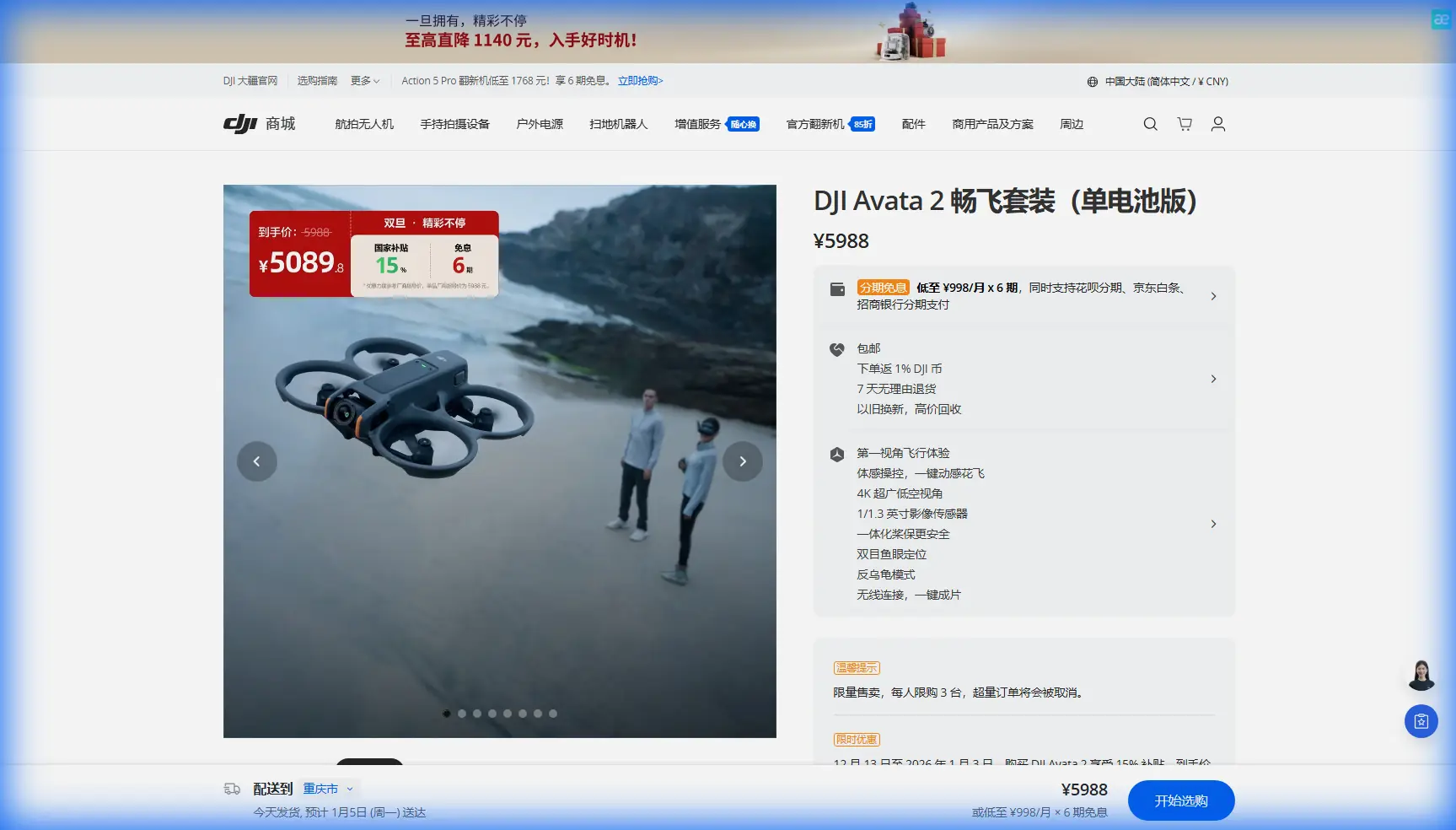
Avata 2 for Mountain Power Line Inspection: What the Railway Drone Playbook Reveals
META: A technical review of DJI Avata 2 for mountain power line inspection, using proven rail-monitoring workflow principles like live digital video return, thermal night operations, and orthomosaic post-processing.
Mountain power line inspection is not a marketing demo. It is a messy, high-consequence field job shaped by terrain shadow, unstable weather, narrow approach corridors, and the simple fact that crews often need eyes on assets before they can safely put boots anywhere near them.
That is why one of the most useful ways to judge the Avata 2 is not by looking at lifestyle FPV footage, but by comparing it against a serious infrastructure monitoring template already used elsewhere. A railway safety monitoring solution from Tianjin Tengyun Zhihang, a subsidiary of Hi-Target, lays out a practical stack for critical corridor inspection: fixed-wing and multirotor aircraft, a Sony A7r imaging payload, an iGCS-1 high-definition digital video transmission system, an iCam H3 infrared thermal imaging system, and Pix4Dmapper for post-processing. The operational logic behind that stack matters far more than the brand names. And it offers a sharp lens for evaluating where Avata 2 fits, where it excels, and where it should be paired with other aircraft rather than forced into the wrong role.
The reference workflow matters because corridor inspection has two separate jobs
The rail document splits the mission in a way many power utilities also recognize, even if they use different language.
One job is persistent daily inspection: fly close, stream high-resolution video back to a control center, and identify defects fast enough to support active operations. The source explicitly highlights multirotor use with HD digital transmission to return real-time monitoring imagery and media video data. It also adds a second layer: infrared thermal imaging for night patrols, making possible 24-hour inspection coverage.
The other job is wide-area disaster and condition assessment: use a fixed-wing platform to cover more distance quickly, collect high-resolution aerial photos, and generate large orthomosaic outputs in software such as Pix4Dmapper. That is a mapping-first workflow, not a close-proximity inspection-first workflow.
This distinction is the cleanest way to understand Avata 2.
Avata 2 is not a substitute for a fixed-wing mapping aircraft in long linear asset corridors. It does not replace a high-end enterprise thermal platform for utility hot-spot analysis either. But in the close-range inspection layer—the part where pilots need to move through mountain infrastructure, around poles, above steep cut slopes, and near conductors while preserving situational awareness—it becomes unusually interesting.
Why Avata 2 makes sense in mountain inspection when larger drones become awkward
Traditional corridor drones are often optimized around hover stability, zoom payloads, or survey coverage. They are useful, but they can become cumbersome in mountain environments where the problem is not just “see farther,” but “get there safely and keep visual orientation in confined terrain.”
This is where Avata 2 stands apart from many larger inspection drones and also from many older FPV platforms.
Its compact ducted design changes the risk profile of close-in flight. Around structures on ridgelines, under crossarms, beside access roads carved into slopes, or near vegetation encroachment zones, the aircraft can work in spaces where a bulkier airframe creates more pilot hesitation. For mountain power line teams, that matters. Inspection quality degrades fast when pilots stay too far away from the target simply because the aircraft feels unforgiving.
The railway reference emphasizes real-time HD video return through the iGCS-1 digital transmission system. Operationally, the significance is simple: timely decisions depend on live image confidence. Avata 2 benefits from DJI’s low-latency digital FPV ecosystem, and that is not just a pilot comfort feature. It supports a similar mission logic to the rail workflow—get a clear live look at the corridor, identify anomalies early, and relay actionable visual information before a secondary crew is dispatched.
In practical terms, on a mountain line this could mean:
- checking insulator contamination or visible damage on a hard-to-reach span,
- identifying vegetation encroachment after heavy rain,
- reviewing pole or tower approach routes before sending climbers,
- confirming slope instability or rockfall risk near access roads.
The rail document treated live video as central, not optional. That same principle is one of Avata 2’s strongest real-world advantages.
The competitor comparison: Avata 2 is stronger in near-asset navigation than most inspection drones, but weaker in sensor specialization
A lot of comparisons around Avata 2 miss the point. People compare it to cinematic FPV quads or to standard camera drones as if the buyer is choosing one toy over another. A mountain utility team is making a workflow decision.
Compared with conventional camera drones in its broad ecosystem, Avata 2 is often better once the aircraft has to move dynamically around terrain and structures. Obstacle awareness and the overall confidence of the platform in tighter environments make it more usable for close visual investigation than many non-ducted alternatives that perform best in more open airspace. In mountain inspection, the issue is rarely maximum top speed; it is controlled proximity.
Compared with many freestyle-style FPV drones, Avata 2 is easier to operationalize for repeatable industrial work. You get a more integrated platform, stronger out-of-the-box reliability, and better suitability for teams that need usable footage and safer deployment rather than custom tuning sessions.
But there is a limit. The rail solution explicitly included an iCam H3 infrared thermal imaging system and Pix4Dmapper as part of the workflow. Those details are significant because they represent two inspection functions Avata 2 does not natively dominate:
Night and thermal anomaly detection
Thermal is not a nice extra in infrastructure work. On some assets, it is the fastest way to spot overheating components or unusual heat signatures. The rail source notes thermal’s role in achieving night patrol capability and round-the-clock operations. Avata 2, by itself, is not the right answer when the primary deliverable is calibrated thermal inspection.Large-scale orthophoto production
Pix4Dmapper in the rail stack points to structured post-processing for wide-area situational mapping. If the utility’s task is corridor reconstruction, landslide extent modeling, or broad right-of-way mapping over long segments, Avata 2 is not the efficient first-choice aircraft.
So yes, Avata 2 can outperform some competitors in close-range maneuverability and visual corridor awareness. No, it does not erase the need for thermal or mapping platforms. The best utility operators will treat it as a surgical tool, not an all-purpose replacement.
A better way to use Avata 2: put it in the “inspection gap” between survey and intervention
The smartest deployment model is to use Avata 2 where larger systems leave a gap.
Imagine a mountain power line route after storms. A fixed-wing or long-endurance mapping platform can document the broader corridor and generate terrain products for planning. A thermal enterprise multirotor can be assigned to confirmed hotspots or night-specific tasks. Avata 2 then slots into the middle:
- rapid launch from constrained terrain,
- low-altitude visual ingress toward a suspect structure,
- detailed pilot-perspective footage around components and surrounding vegetation,
- route preview for follow-on crews,
- documentation for maintenance planning.
That is very close to the operating logic in the rail reference. There, the multirotor handles real-time detailed inspection while the fixed-wing supports fast large-area capture. The significance is not that power lines are railways. It is that both are linear infrastructure corridors with similar operational tensions: distance versus detail, coverage versus precision, day operations versus 24-hour readiness.
Avata 2’s real value appears when you stop asking it to be the “main drone” and instead ask it to be the fastest way to answer the visual questions that remain after broader surveillance.
What about subject tracking, QuickShots, Hyperlapse, D-Log, and ActiveTrack?
These are often discussed in content-creator terms, but some have inspection relevance if used with discipline.
D-Log matters more than many field teams assume. In mountain environments, inspection flights often deal with harsh contrast: bright sky, dark forest, reflective hardware, and deep terrain shadow in one frame. A flatter color profile preserves more grading latitude when analysts need to pull detail from difficult lighting. This is not about making dramatic footage. It is about increasing interpretability.
Obstacle avoidance is the bigger operational story. Around poles, towers, trees, and uneven terrain margins, it reduces the likelihood that a pilot has to abandon a useful line of sight just to maintain a safe buffer. It does not make the aircraft magic, but it does make it more forgiving than many traditional FPV setups.
ActiveTrack and subject tracking are less central for static asset inspection than for moving targets, but they still have niche value. For example, following a maintenance vehicle along a mountain access road or documenting a crew approach path can be useful for planning and training. I would not present these as core inspection features, though. The real inspection win is pilot-perspective navigation, not automated following.
QuickShots and Hyperlapse are the least mission-critical here. They can support reporting visuals, stakeholder communications, or progress documentation, but they are peripheral to the actual inspection task. If your workflow depends on them, you are probably solving the wrong problem.
The night-operations question is where Avata 2 meets its limit
The rail reference makes a clear point: adding infrared thermal capability allows night railway patrol, enabling 24-hour safety inspection. That phrase matters because mountain power infrastructure often has the same operational need after weather events or service disruptions. Night access is sometimes unavoidable.
Avata 2 can support low-light visual situational awareness better than some people expect, but that is not the same as true night inspection capability. Utilities needing dependable after-dark diagnostics should read the rail workflow as a reminder that night operations are a sensor problem, not just a flying problem. Thermal payload integration remains the dividing line.
This is one of the easiest places for buyers to overestimate Avata 2. If the inspection brief explicitly includes nocturnal fault indication, thermal verification, or temperature-based anomaly screening, the answer is not to stretch Avata 2 beyond its design. The answer is to pair it with the right aircraft.
Post-processing is where many teams leave value on the table
The source mentions Pix4Dmapper not as a buzzword, but as the mechanism for turning imagery into usable output. Even if Avata 2 is not your primary mapping drone, the lesson still applies: inspection value is not created by flight alone.
For mountain power line operations, Avata 2 footage becomes more useful when integrated into a structured review workflow:
- timestamped defect logging,
- alignment with asset IDs,
- terrain-reference snapshots,
- before/after maintenance comparisons,
- clipped training examples for crews.
The rail sector understood that raw capture is only half the job. Power operators should think the same way. An Avata 2 mission that ends as “some useful video” is underperforming. An Avata 2 mission that feeds maintenance decisions is doing real work.
So, is Avata 2 a serious tool for mountain power line inspection?
Yes—if the mission is close visual inspection in difficult terrain, rapid situational awareness, and high-confidence live video from a compact platform.
No—if the mission is corridor-scale orthomosaic production, calibrated thermal diagnostics, or all-night inspection as a standalone platform.
That may sound like a narrow verdict, but it is actually a strong one. Narrow tools are often the most valuable because they solve a stubborn field problem better than multi-role systems. Avata 2’s advantage is not that it replaces the enterprise inspection stack. Its advantage is that it handles the awkward, high-friction visual access tasks that bigger drones and broader survey workflows often leave unresolved.
The railway monitoring solution from Tianjin Tengyun Zhihang gives us a grounded benchmark: use live HD transmission for immediate awareness, use thermal when the clock and visibility demand it, and use post-processing tools like Pix4Dmapper when the job requires structured large-area outputs. Judged against that logic, Avata 2 earns its place as a tactical inspection aircraft, especially in mountains where maneuverability and pilot visibility matter as much as raw sensor ambition.
If you are building an inspection workflow and want to pressure-test where Avata 2 fits, a direct field discussion usually saves more time than another spec-sheet comparison. You can reach out here for a practical workflow conversation: https://wa.me/85255379740
Ready for your own Avata 2? Contact our team for expert consultation.