
Avata 2 for Solar Farm Inspections in Extreme Temperatures
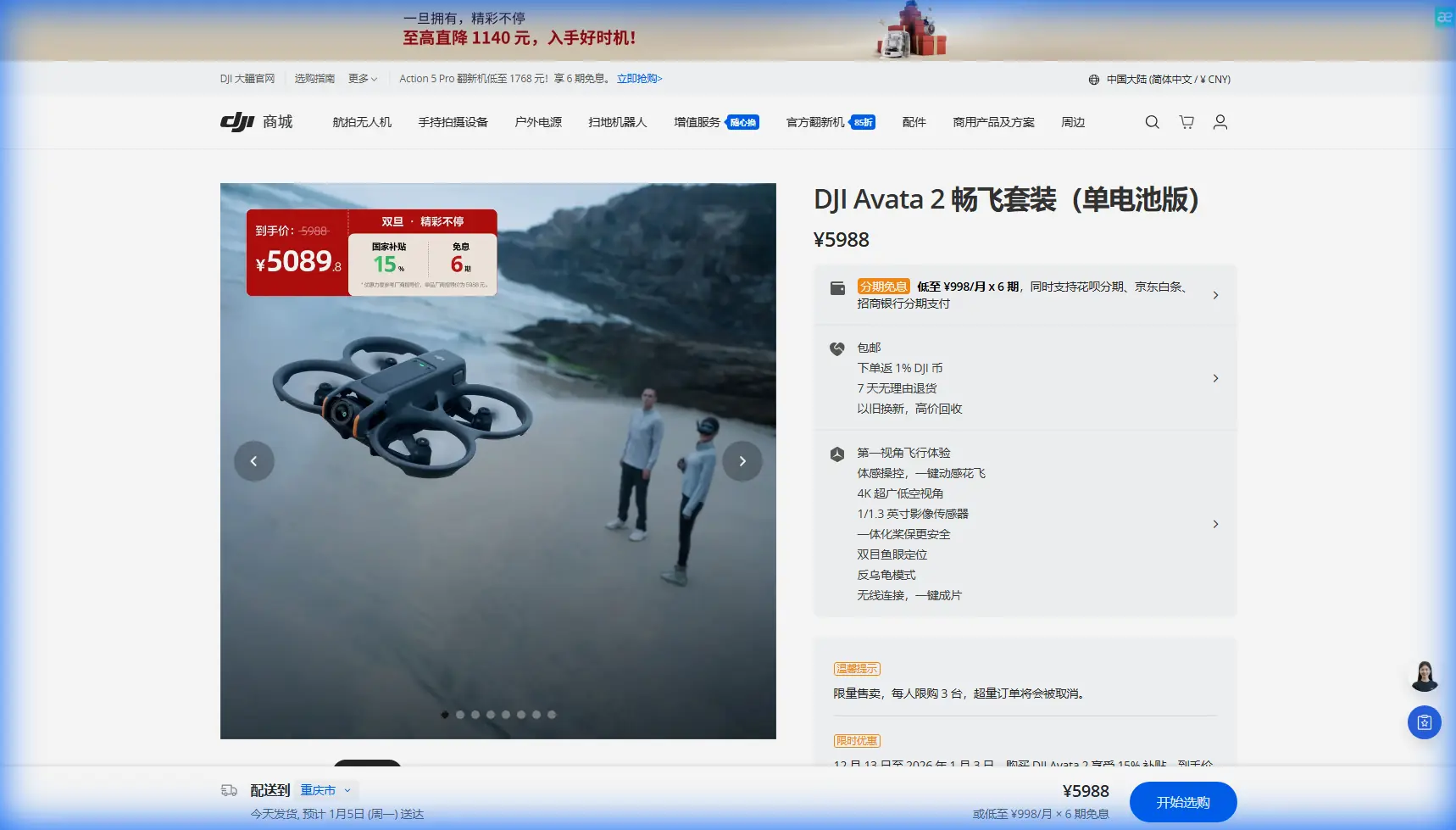
Avata 2 for Solar Farm Inspections in Extreme Temperatures: Practical Field Tips That Actually Matter
META: Learn how to use Avata 2 for solar farm inspection in extreme heat and cold, with practical tips on obstacle avoidance, D-Log workflow, pre-flight cleaning, and stable low-altitude flying around panel rows.
Solar farms are deceptively difficult places to fly.
From a distance, they look open and simple: long rows of panels, wide service roads, not much vertical clutter. But once you are actually on site, especially in punishing heat or winter cold, the job changes. Glare becomes a constant visual problem. Repeating panel geometry can confuse your depth perception. Dust coats everything. Hot air shimmers above dark surfaces. In colder regions, condensation and residue can quietly interfere with sensors before you even lift off.
That is where the Avata 2 becomes interesting.
Not because it is a generic “inspection drone” in the usual sense, but because its combination of compact size, protected propeller design, low-altitude confidence, and immersive manual-style flying creates a very specific advantage for close visual work around dense panel rows and narrow service corridors. For a solar farm operator, EPC team, or visual media specialist documenting asset condition, that matters more than spec-sheet theater.
I approach this as a photographer first and a field operator second. That perspective changes the workflow. You start paying attention to the details that keep footage usable and flights safe, especially when the environment is trying to work against you.
The real problem: extreme temperatures expose small weaknesses fast
Solar sites are not gentle on aircraft.
In high heat, the first issue is not always battery performance. Often it is contamination. Dust, fine grit, pollen, and airborne debris settle on the airframe while crews move around access roads and inverter stations. On a hot day, that residue can bake onto lenses and sensor windows. If you are relying on obstacle sensing for low, close passes near panel edges or support structures, a dirty sensor can quietly reduce the margin you thought you had.
Cold conditions create a different trap. Bringing the drone from a vehicle cabin into frigid air can fog optical surfaces. Then the site wind adds another layer of complexity, especially when you are flying low across long rows that channel airflow in odd ways.
This is why one of the most overlooked safety habits with the Avata 2 is a pre-flight cleaning step.
Not glamorous. Very necessary.
Before launch, inspect and gently clean the camera lens, the protective shell openings, and the obstacle sensing areas. On a solar inspection job, this should be standard procedure, not an afterthought. If the site is dusty, do it again between sorties. If the aircraft came from an air-conditioned truck into high ambient heat, pause long enough to confirm there is no fogging or smeared residue.
Operationally, that single step affects three things at once:
- Obstacle avoidance reliability during close passes along structures or near equipment.
- Image quality when glare and contrast are already difficult.
- Pilot confidence, because a clean optical system gives you a more truthful picture of what the aircraft is actually seeing.
For solar farms, confidence is not psychological fluff. It determines whether you can maintain a safe, repeatable low-level inspection line without overcorrecting every few seconds.
Why Avata 2 fits this environment better than many people expect
The Avata 2 is easy to misread if you only evaluate it as a consumer FPV product. In a solar field, its strengths show up in more practical ways.
Its compact build and guarded propellers make it more forgiving in tight lateral spacing than larger camera drones that need more air and more separation from structures. That matters when you are tracing long panel corridors, checking mounting consistency, documenting visible damage, or capturing low-angle footage for maintenance reporting.
The second advantage is flight perspective. Traditional overhead captures have value, but many solar issues become clearer from lower, oblique angles. You can reveal panel alignment inconsistencies, edge contamination, vegetation encroachment, pooled water near infrastructure, loose cable runs, and access limitations in a way that straight top-down views often flatten.
This is where the Avata 2’s style of flying becomes operationally useful rather than just visually dramatic. It lets you hold a line close to the subject and move through repetitive terrain with intent. In a solar farm, “staying close” is often the difference between footage that is merely pretty and footage that a site manager can actually use.
Heat, glare, and repetitive geometry: the visibility challenge
Solar panels create one of the harshest visual environments for pilots and cameras. The surfaces reflect sky and sun unpredictably. Midday heat can create shimmer. Every row starts to look like the last. If you are manually navigating a long corridor, visual fatigue sets in sooner than many operators expect.
That is why flight discipline matters more than speed.
With Avata 2, short, methodical runs usually outperform ambitious long passes. Break the farm into sections. Fly one row grouping at a time. Reset your position. Recheck surfaces. Confirm your intended path before moving again.
The drone’s obstacle avoidance can help, but it should not become an excuse to rush through reflective or visually repetitive terrain. On solar sites, passive assumptions fail quickly. Reflections can distort what looks open. Support frames, fencing, combiner boxes, and maintenance hardware appear where your eye did not initially register them.
A clean sensing system and a conservative route plan work together. One without the other is not enough.
A smarter way to use ActiveTrack and subject tracking on site
The obvious use for ActiveTrack and subject tracking is following moving people or vehicles. At a solar farm, though, the better use is usually more restrained.
If a technician is walking a designated inspection lane or a utility cart is moving slowly along an access route, tracking can help create progress documentation and site-context footage without forcing the pilot to split attention between framing and spatial awareness. That can be useful for training, maintenance records, or visual reporting to stakeholders.
But the operational significance is this: on a solar site, subject tracking should support structured movement in open lanes, not replace pilot judgment inside dense, close-clearance areas. The farm itself is the hazard. Rows, posts, cable hardware, and corner geometry do not care that the drone has tracking tools.
So yes, ActiveTrack can add efficiency. It can also reduce workload during repeatable, open-route documentation. But around infrastructure, disciplined manual oversight remains the safer choice.
Why D-Log matters more than people think in solar work
Many operators hear “D-Log” and think only about cinematic grading. That is too narrow.
Solar farms are contrast-heavy environments. You can have bright specular highlights bouncing off panels, dark gaps beneath structures, pale gravel roads, and a washed-out horizon all in one frame. Standard color profiles often force you into compromises, especially under harsh sun.
D-Log gives you more room to preserve highlight detail and manage contrast in post. For inspection-adjacent visual work, that flexibility is useful because it helps maintain separation between reflective surfaces and darker structural elements. You are not just chasing a prettier image. You are preserving information.
That distinction matters when footage needs to communicate site conditions clearly.
If your workflow includes client reporting, maintenance documentation, investor updates, or construction progress reels, D-Log can make the final output more legible and consistent across changing light conditions. The same site shot at 8 a.m. and 2 p.m. can look dramatically different. A flatter capture profile helps you normalize that variation later.
In practical terms, that means fewer clipped highlights on panel surfaces and a better chance of retaining detail in support structures and service paths.
QuickShots and Hyperlapse have a place here, but not the one most people imagine
On a working solar farm, QuickShots and Hyperlapse are not the main inspection tools. They are context tools.
QuickShots can help create standardized establishing visuals around substations, inverter blocks, or row clusters for presentations and project documentation. Hyperlapse can show construction progression, weather movement over the site, or the scale of cleaning and maintenance operations over time.
Used carefully, those automated or semi-automated modes help tell the broader operational story of the asset.
That is especially valuable for teams that need to communicate beyond the technical crew. Investors, landowners, project managers, and non-technical stakeholders often understand site status faster through visual context than through spreadsheets and static photos.
Still, these modes should be used in open, well-assessed areas. The inspection core remains deliberate, low-altitude, line-based flying.
Battery and sortie planning in extreme temperatures
Extreme temperatures punish sloppy planning.
In heat, crews get tempted to keep pushing because conditions “look stable.” In cold, they rush because they want to get the job done before their hands go numb. Both habits reduce safety margins.
With Avata 2, the better approach is to shorten sorties and define a purpose for each one. One pass for row-edge documentation. One for access-route review. One for infrastructure context. One for media capture if needed. That segmentation helps you avoid the common trap of trying to inspect, film, improvise, and explore in a single battery.
It also gives you natural pauses for the pre-flight cleaning cycle between flights. On dusty sites, this is not obsessive. It is basic fieldcraft.
If your operation runs in severe temperatures often, it is worth building a fixed checklist around environmental transitions:
- aircraft out of vehicle, acclimate briefly
- inspect lens and sensing surfaces
- verify no dust film or condensation
- confirm route section
- launch with a single task objective
That checklist is boring. Good. Boring checklists are usually the ones that prevent bad days.
A field workflow that works
For solar farm inspection with Avata 2, a practical sequence looks like this:
Start with a broad perimeter review from safe open space. Use that first flight to understand wind behavior, glare direction, crew movement, and any obvious obstacles such as fencing, parked vehicles, temporary equipment, or vegetation growth.
Then switch to lower, more focused runs. Fly parallel to panel rows rather than cutting diagonally unless there is a clear reason to do so. Parallel movement simplifies orientation and helps maintain predictable separation.
Before each close run, clean the relevant optical surfaces again if the site is dusty. This one habit directly supports obstacle avoidance performance and image reliability.
Capture your inspection-adjacent footage in D-Log if post-processing is part of the deliverable. Save QuickShots or Hyperlapse for open-space context shots after the essential documentation is complete, not before.
If you need to create training or stakeholder visuals, use subject tracking only where the path is open and highly readable. A technician walking an access lane is one thing. Tracking movement tightly between reflective structures is another.
And if your team wants a second opinion on configuring an Avata 2 workflow for solar sites, you can message our field team here.
The bigger takeaway
Avata 2 makes sense for solar farm work when the mission calls for close, controlled, visually rich flight in spaces where larger aircraft feel less comfortable or less revealing.
Its value is not that it replaces every other drone on site. It does not. Its value is that it gives you a more intimate inspection perspective while remaining compact and manageable in difficult conditions.
But that advantage only shows up when the operator respects the environment.
At solar farms in extreme temperatures, the small details decide the outcome: cleaning sensor surfaces before launch, flying shorter purposeful sorties, using obstacle avoidance as support rather than permission, choosing D-Log to preserve difficult highlights, and treating automated features like ActiveTrack, QuickShots, and Hyperlapse as tools with boundaries.
That is the difference between bringing back footage and bringing back something useful.
Ready for your own Avata 2? Contact our team for expert consultation.