
Avata 2 for Remote Venue Inspection: What Actually Gets
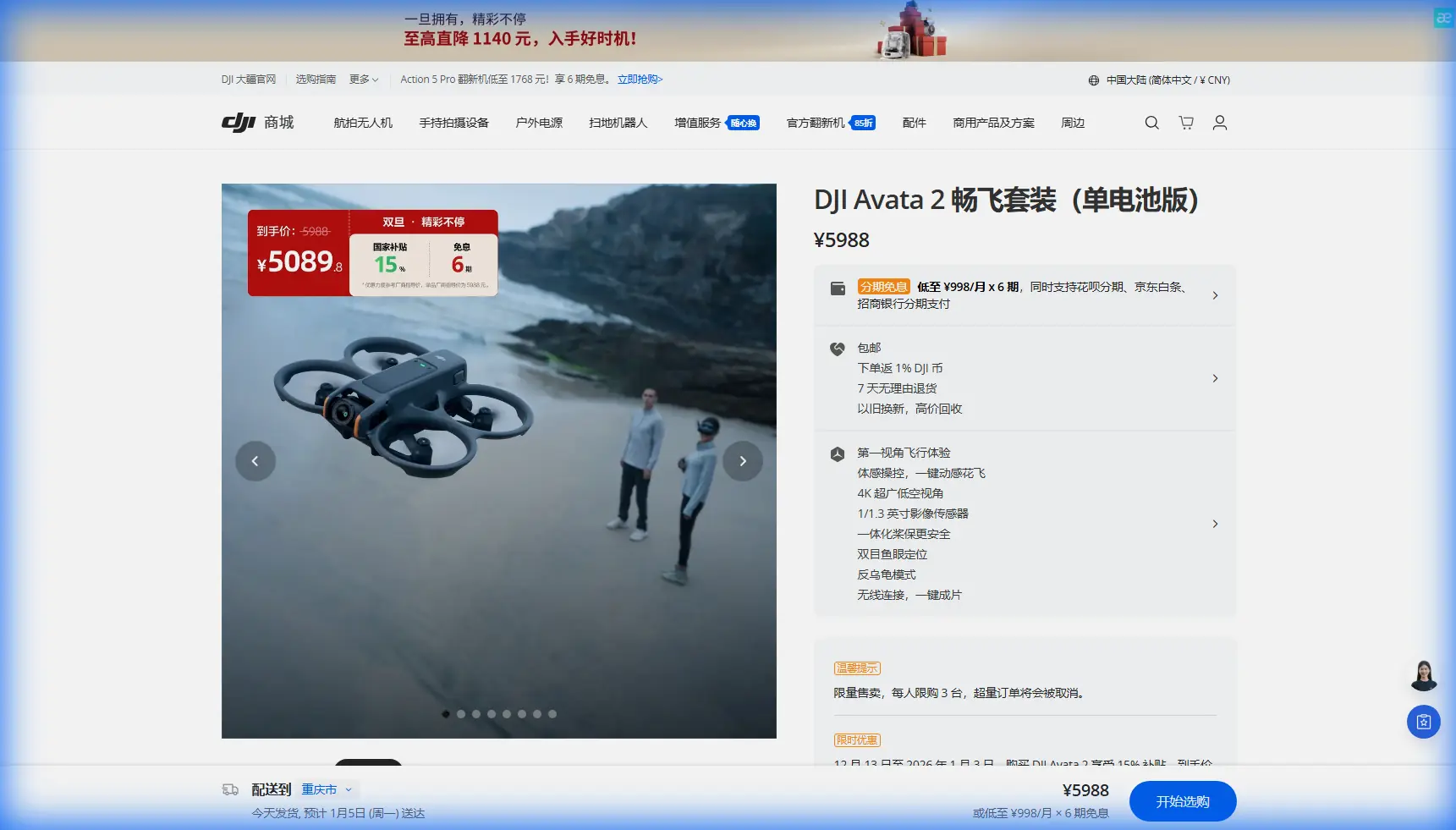
Avata 2 for Remote Venue Inspection: What Actually Gets Easier in the Field
META: A practical, expert look at how DJI Avata 2 helps with remote venue inspection, from obstacle avoidance and tight-space flying to D-Log capture, QuickShots, and safer low-altitude reconnaissance.
Remote venue inspection sounds simple until you are the one standing in wind, dust, uneven terrain, and fading light with a checklist that keeps growing.
I have had jobs where the hard part was not getting the shot. It was getting reliable visual information without walking a huge site twice, climbing where I did not want a crew member climbing, or guessing what sat behind a roofline, truss, tree belt, or service corridor. That is where a platform like the Avata 2 earns its place. Not because it promises magic, but because it reduces friction in very specific ways.
For anyone inspecting venues in remote areas, the Avata 2 sits in an interesting position. It is not just a camera drone and not just an FPV toy. Its value comes from how those two identities overlap. You get a compact aircraft built for immersive flying, but with enough stabilization, safety logic, and imaging control to make it genuinely useful when a venue is far from support infrastructure and every battery cycle needs to count.
The conversation around the Avata 2 often drifts toward cinematic flying. That misses a big part of the story. For inspection work, especially in isolated venues, the real benefit is confidence at low altitude and in confined pathways. You are not always mapping a clean open field. You are often moving through access roads, around seating structures, near utility lines, across stage builds, along perimeter fencing, or under partial canopy. A drone that feels predictable in those situations changes the pace of work.
The first operational difference is obstacle awareness. In remote venue work, “remote” rarely means empty. It often means visually messy. There may be temporary structures, cables, poles, generators, vehicles, uneven surfaces, and improvised layouts that never made it into the site plan. Obstacle avoidance matters here not as a luxury feature, but as a risk-control tool. It lowers the chance that a quick reconnaissance pass turns into a recovery exercise half a kilometer from your launch point.
That matters more than people think. On a remote inspection day, one small mishap has a domino effect. You lose time, concentration, and often the best light. If you are there to verify ingress routes, emergency access, spectator flow, rigging clearance, or maintenance conditions, you need repeatable movement through tight spaces. A drone that helps you stay off the wrong side of a beam or branch is not just protecting hardware. It is protecting the entire inspection window.
The Avata 2 also makes a practical case for close-in flying. Traditional inspection habits often push operators to stand off and zoom mentally, if not optically. With a compact FPV-oriented aircraft, you can safely work nearer to the subject and read the environment in a more intuitive way. That is a big advantage when inspecting venue edges, rooflines, catwalk access points, drainage channels, loading zones, or temporary event structures. You do not just see the object. You understand the path to it, the clearance around it, and the risks a crew would face when approaching it later on foot.
That immersive viewpoint is the part many spec sheets fail to capture. When I think back to older inspections, the frustrating moments were not usually about camera quality alone. They were about spatial ambiguity. A still image might show a gap, but not tell you whether a technician could realistically pass through it carrying gear. A high hover shot might show the venue footprint, but not reveal how tree cover or scaffold placement chokes a service route. FPV-style flight changes that. You read space like a moving human, only faster and with less exposure.
Subject tracking and ActiveTrack-style capabilities can also be more useful in inspection than they first appear. Most people associate tracking with action footage, not site work. But in remote venue assessment, there are cases where keeping a moving subject framed saves time: following a utility vehicle through an access loop, documenting how staff move between service points, or recording a technician walking a boundary line to expose obstacles, mud zones, bottlenecks, or blind spots. The point is not aesthetics. The point is workflow. If the aircraft can hold visual attention on the moving element while you focus on route and spacing, you gather cleaner evidence in less time.
The same goes for QuickShots and Hyperlapse. On paper, those sound like creative tools. In practice, they can serve a documentation role when used intelligently. A pre-programmed orbit around a small remote amphitheater, communications mast, or central structure can create a consistent visual reference that is easy to compare with previous visits. A Hyperlapse sequence can show environmental context that a still frame misses, such as shifting shadows across seating banks, traffic patterns near service roads, or how weather moves across a ridge-backed site. Used this way, automation is not fluff. It is shorthand for repeatability.
Imaging format matters too. D-Log is not a feature reserved for colorists chasing dramatic sunsets. In inspection scenarios, especially in remote locations, lighting is rarely cooperative. You may be dealing with harsh midday sun, deep shade under overhangs, reflective roofing, or dark surfaces against bright sky. Shooting in D-Log gives you more flexibility when pulling back highlights or lifting detail in the shadows during review. That can be the difference between merely pretty footage and usable evidence.
Operationally, this is significant. Let’s say you are checking the underside of a canopy adjacent to a bright open field. In a standard baked-in profile, you may lose texture where fittings, cables, or water damage actually matter. A flatter profile gives your team more room to recover those details later. That is not an academic benefit. It directly affects whether the footage can support maintenance decisions, client briefings, or a return-visit plan.
Another underappreciated advantage of the Avata 2 for remote venue work is the way it lowers the threshold for short, purposeful flights. On difficult jobs, operators sometimes over-plan because each launch feels expensive in time and attention. A more approachable aircraft encourages targeted reconnaissance. You can launch to answer one question, land, assess, then launch again with a better plan. That cadence is valuable. It keeps inspections adaptive instead of forcing everything into one long, mentally overloaded sortie.
I remember one venue assessment that still bothers me because of how inefficient it was. We were evaluating a semi-rural event location with mixed terrain, scattered trees, temporary fencing, and a loading area that looked straightforward on paper. From the ground, the route for support vehicles appeared wide enough. From our first aerial look with older gear, it still looked acceptable. But we lacked a clean low-level pass through the actual approach line, and that meant uncertainty. When crew arrived later, the turn-in geometry near a service gate was far tighter than expected, with overhead branches narrowing the usable space. We solved it, but not elegantly.
A drone with the Avata 2’s style of close-quarters confidence would have shortened that whole decision chain. One low, stable run through the corridor would have told the real story: not just width, but usable width, branch height, surface condition, and driver visibility. That is the difference between aerial content and aerial inspection. Good inspection flying answers logistical questions before those questions become field problems.
For remote readers specifically, battery discipline and information density should shape how you use the aircraft. The goal is not to fly everywhere. It is to return with the fewest clips that answer the most important operational questions. I usually think in layers: first a broad perimeter read, then route verification, then structure-specific checks, then a final context pass for reporting. The Avata 2’s mix of agility and automated capture modes supports that structure well. You can build a visual narrative of the site that starts wide and ends in practical detail.
There is also a human factor here. Venue stakeholders who are not drone specialists still need to understand what you found. FPV-style footage is often easier for non-pilots to interpret because it reads like movement through real space rather than abstract top-down imagery. If you are explaining why a service lane is compromised, why a tent line crowds an emergency path, or why a stage support area needs clearing, immersive footage often communicates faster than a bundle of stills.
That makes reporting cleaner. It also improves collaboration. A site manager, production lead, or maintenance supervisor can watch one short sequence and immediately grasp a constraint that would take several annotated photos to explain. If you need a second opinion during a field day, I have found it useful to share a clip and message the operations desk directly rather than trying to describe a three-dimensional problem over a call.
Of course, the Avata 2 is not a replacement for every other platform. If your assignment demands broad-area mapping, specialized sensors, or long endurance over large infrastructure, you will reach for something else. But that is not a weakness. It is a reminder to match the aircraft to the mission. For remote venue inspection, many of the hardest questions are not huge-area questions. They are access, clearance, visibility, obstacles, routing, and condition questions. Those are exactly the places where a nimble aircraft with obstacle avoidance, stable close flight, and flexible imaging can outperform heavier assumptions.
The strongest case for the Avata 2 is that it helps inspectors gather better answers at the moment those answers are needed. You can slip through a route instead of approximating it. You can document a structure from the perspective that maintenance crews will actually experience. You can capture in D-Log when lighting is ugly, use tracking when movement matters, and deploy QuickShots or Hyperlapse as repeatable documentation tools rather than decorative extras.
That combination is what makes the aircraft relevant to remote venue work. Not hype. Not novelty. Just fewer blind spots and better field decisions.
If you are evaluating the Avata 2 through the lens of inspection rather than content creation, that is the frame worth keeping. Ask whether it helps you verify access, read obstacles sooner, preserve detail in bad light, and communicate findings clearly to people who were not on site. In my experience, those are the questions that separate useful drone deployments from wasted flights.
And when a remote venue is hours away, “useful” is the metric that matters.
Ready for your own Avata 2? Contact our team for expert consultation.