
Avata 2 for Urban Coastline Mapping: What Changed in My
Avata 2 for Urban Coastline Mapping: What Changed in My Workflow
META: A field-tested look at how the DJI Avata 2 fits urban coastline mapping, with practical insight on obstacle avoidance, D-Log, Hyperlapse, and safer low-altitude flight near complex waterfront structures.
Urban coastline mapping sounds tidy on paper. In practice, it is a balancing act between wind, reflective surfaces, tight access corridors, pedestrians, seawalls, piers, railings, light poles, and the constant pressure to capture usable data before conditions shift. That is the context where the Avata 2 becomes interesting.
I come at this as a photographer first, not as someone chasing spec-sheet trophies. My interest in the Avata 2 is simple: can it help produce cleaner, more repeatable visual passes along dense waterfronts where conventional camera drones often force you to back off, climb higher, or abandon a route entirely?
For urban coastal work, that question matters. A drone that looks impressive in an open field can become awkward the moment you put it beside a marina, beneath promenade lighting, or near concrete flood defenses where GPS confidence, wind behavior, and line choice all get messy. The Avata 2 is built for a different style of flying, and that difference has real operational value when the job is documenting edges, structures, and shoreline change in built-up environments.
The problem with mapping coastlines in cities
A few years ago, I was asked to document a waterfront redevelopment corridor with a focus on erosion control, pedestrian access points, and the condition of retaining walls. The client wanted imagery that showed not just the shoreline line itself, but how the coast interacted with human infrastructure. That meant flying low enough to reveal cracks, drainage outlets, stair access, mooring hardware, and transitions between natural and engineered surfaces.
That kind of work exposed a recurring problem. Traditional aerial passes from higher altitude were fine for broad context, but they flattened the story. The subtle failures were harder to read. Spray zones disappeared. Surface texture became abstract. The relationship between seawall geometry and public pathways was visible, but not legible.
Lower flights helped, but they introduced another layer of risk. Waterfronts in urban areas are cluttered. Signage, ropes, handrails, cranes, boat masts, trees, utility lines, and overhanging architectural features can all intrude into the path. Add gusting air bouncing off buildings and hard surfaces, and precision stops being a luxury. It becomes survival.
This is where the Avata 2’s design logic starts to matter.
Why the Avata 2 fits this specific job
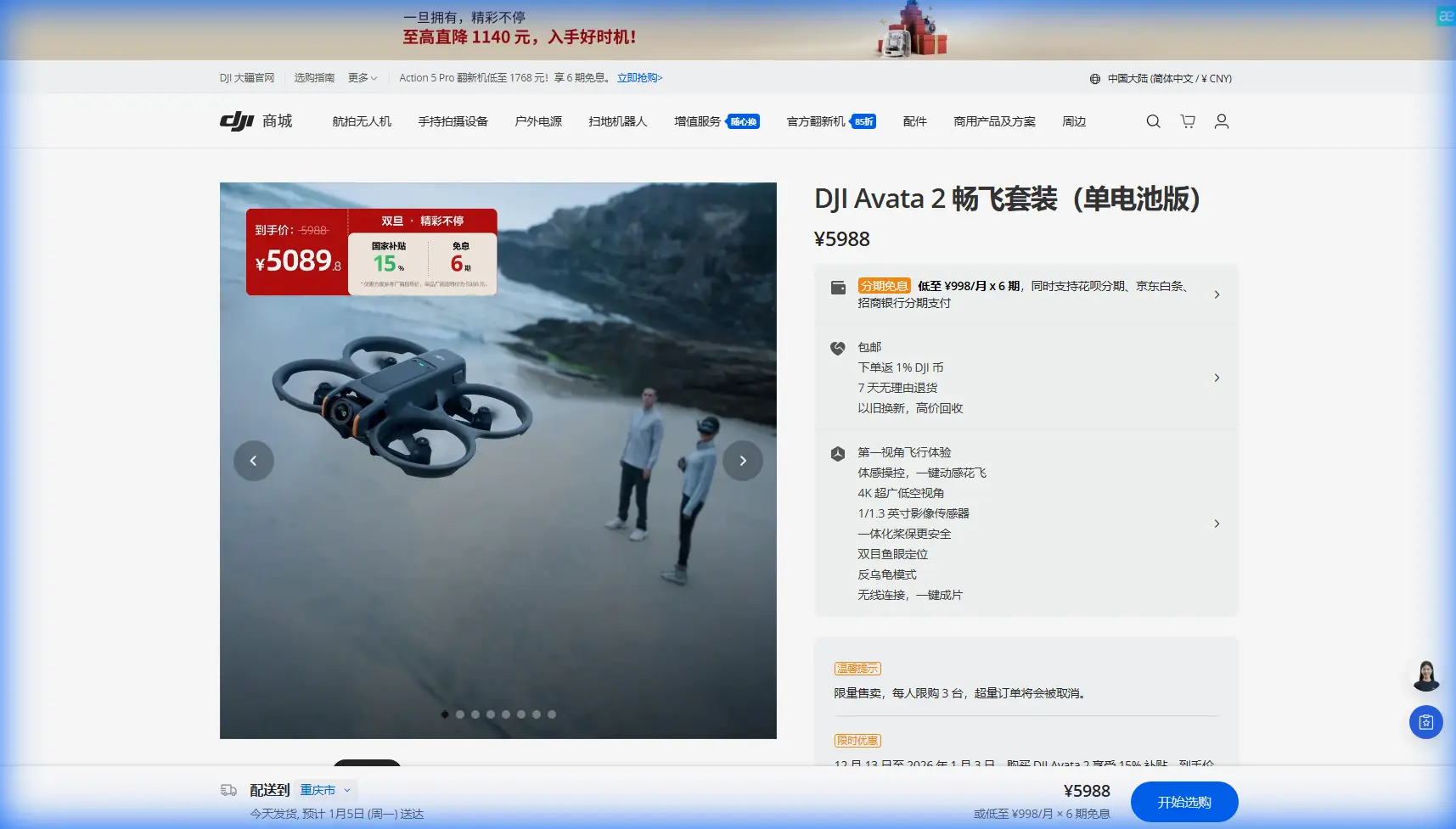
The Avata 2 is not simply a smaller camera platform. It is a ducted FPV-style aircraft built to stay composed in tighter spaces and to tolerate environments that would make many pilots hesitate. For urban coastline mapping, that changes route planning.
The most useful shift is psychological as much as technical: you can design flight paths closer to the built environment without treating every near-structure pass like a final exam. Its guarded propeller layout makes low-altitude corridor work more practical around boardwalk edges, under overhanging features, and near rigid infrastructure where a tiny misjudgment would otherwise end the flight.
Obstacle avoidance is one of those phrases that gets overused, but in this setting it has operational significance. Around waterfront architecture, your challenge is rarely one dramatic obstacle. It is layered clutter. Railings in the foreground, lamp posts offset to one side, moving pedestrians below, and vertical facades that alter your visual depth cues. Systems that help the aircraft interpret and react to that complexity reduce workload, especially when the pilot is focused on maintaining a smooth visual line for documentation. That does not replace skill, but it buys margin.
The second detail that matters is image flexibility. D-Log gives the Avata 2 more room in post when you are shooting scenes with brutal contrast. Urban shorelines often force that issue: bright water reflections, pale concrete, dark understructures, and shadowed recesses beneath piers can all exist in the same frame. A flatter color profile is not about stylistic editing. It is about preserving enough tonal information to pull out surface detail from retaining walls and structural joints without blowing out reflective water. For mapping-adjacent visual work, that can be the difference between “cinematic” footage and actually useful footage.
A better answer to the old access problem
On a dense coastline, access is never evenly distributed. One section may be fully open, while the next is boxed in by fencing, moored vessels, public foot traffic, or maintenance equipment. The Avata 2 helps because it allows you to think in segments rather than broad sweeps.
Instead of forcing a single high-altitude path that clears everything, you can break the shoreline into smaller, lower, more descriptive runs. One pass follows the seawall. Another tracks drainage outlets. Another moves laterally past stair landings and public access nodes. Another reveals how wave action is interacting with a corner section where hard infrastructure meets softer shoreline material.
That is where the drone’s handling style earns its keep. It is capable of controlled, immersive movement that feels more like threading a route than surveying from above. For readers focused on urban mapping, that matters because usable documentation often comes from angle discipline rather than height.
In other words, the Avata 2 makes it easier to capture the coastal edge as a system. Not just a line on a map, but a living boundary where public space, engineering, and environmental stress meet.
The overlooked advantage: repeatable visual storytelling
There is a temptation to discuss the Avata 2 only through action-oriented features, but one of its quieter strengths for this kind of work is repeatability. Coastline monitoring is not always about one perfect shoot. It is often about returning after storms, during seasonal shifts, or after construction phases to compare the same locations.
When a drone lets you confidently run similar low-altitude paths across multiple visits, your documentation gets stronger. You are no longer relying on a single broad overhead record. You are building a visual sequence that can reveal progression: staining on a wall face, sand displacement near steps, movement around culvert outfalls, wear along timber edges, or pooling near promenade drains.
Hyperlapse is surprisingly useful here when applied with restraint. Not as a gimmick, but as a way to show change across a longer waterfront corridor in a format that clients and planners can understand quickly. A carefully designed Hyperlapse sequence can communicate continuity, access constraints, and shoreline condition transitions more effectively than a stack of disconnected clips.
QuickShots also have a place, though not in the way hobby pilots often use them. In a professional urban-coast setting, they are better treated as fast, structured capture patterns for context shots rather than creative shortcuts. If the assignment includes both analytical footage and presentation-ready visuals for stakeholders, these automated moves can help gather supplementary material efficiently without consuming the main flight window.
What subject tracking means near the water
Subject tracking and ActiveTrack are usually discussed in sports scenarios, but there is a serious use case near the coast. Not for chasing people, but for maintaining stable framing on a moving reference such as a patrol craft, inspection boat, or shoreline vehicle during support operations.
That said, the bigger value is indirect. Systems built for tracking and scene awareness tend to reduce the friction of keeping composition disciplined while external conditions are changing. Along an urban shoreline, the scene rarely stands still. Water texture shifts, boats move, pedestrians enter and leave, and the light can swing fast off reflective surfaces. Tools that help the pilot maintain framing free up attention for spacing, safety, and route continuity.
The caveat is obvious: no automated function should be treated as permission to switch off judgment near complex structures or busy public areas. But when used carefully, these features can make the footage more consistent and the flight less mentally saturated.
Where the Avata 2 genuinely saves time
The biggest time savings are not in headline speed. They come from fewer aborted runs.
Anyone who has flown near a city waterfront knows the pattern. You line up a pass, notice a cable or mast late, climb out, reset, and try again. Then a gust catches the aircraft near a corner. Then a pedestrian movement changes your safe line. Then glare makes depth harder to read than expected. These interruptions eat battery, concentration, and daylight.
The Avata 2 reduces that churn because it is comfortable operating in the kind of close, layered space where these jobs actually happen. Obstacle-aware flying, a more protected airframe, and stronger confidence in low-level routing mean more successful first attempts. Over a full site day, that efficiency compounds.
For teams trying to build a repeatable coastal documentation workflow, that matters more than flashy top-end capability. The winning drone is often the one that gets the needed route cleanly on the second battery instead of the fifth.
My field rule for using it well
The Avata 2 is most effective in urban coastline work when you stop treating it like a substitute for a larger general-purpose drone and start using it as a precision edge-documentation tool.
I would not make it the only aircraft for a full mapping program. Broad orthomosaic-style outputs and high-altitude contextual coverage still belong to other platforms. But when the mission includes seawall inspection visuals, infrastructure adjacency documentation, public-realm shoreline storytelling, or close-in condition capture, the Avata 2 fills a gap that many teams have been improvising around for years.
My preferred workflow is straightforward:
- use a conventional platform for wide context;
- deploy the Avata 2 for the coastline edge, transition zones, and constrained corridors;
- shoot in D-Log where contrast is punishing;
- reserve QuickShots and Hyperlapse for stakeholder communication layers;
- keep ActiveTrack and tracking tools as support features, not decision-makers.
That combination produces a more complete record of the waterfront.
The human side of the upgrade
The first time I realized a drone had genuinely improved my waterfront workflow was not during some dramatic reveal shot. It was during a simple pass beside a concrete seawall with staggered stair access, metal railings, and uneven gusts coming off adjacent buildings. Normally, that setup would have demanded a cautious, compromised route from farther out over the water.
With the Avata 2, the route stayed tighter, cleaner, and more descriptive. The resulting footage made the site readable. You could see how access points met the wall face. You could judge wear patterns. You could understand where maintenance issues were emerging. That is the kind of improvement that changes a tool from “fun to fly” into “worth deploying.”
If you are trying to think through whether this platform fits your shoreline work, the better question is not whether it can fly near the coast. Plenty of drones can. Ask whether it helps you document the narrow, messy, infrastructure-heavy edge conditions that urban coastlines are made of.
That is where the Avata 2 earns attention.
If you are planning a workflow for waterfront documentation and want to compare route ideas, safety margins, or camera settings, this direct project chat link is a practical place to start the conversation.
The Avata 2 does not simplify coastal mapping by turning it into a push-button task. It helps by making the hard parts more manageable: close access, obstacle-rich routes, difficult contrast, and repeatable low-altitude passes in spaces where precision matters. For urban shoreline work, that is not a minor convenience. It is the whole job.
Ready for your own Avata 2? Contact our team for expert consultation.