
Expert Monitoring with Avata 2: Shooting the Wushan Gorge
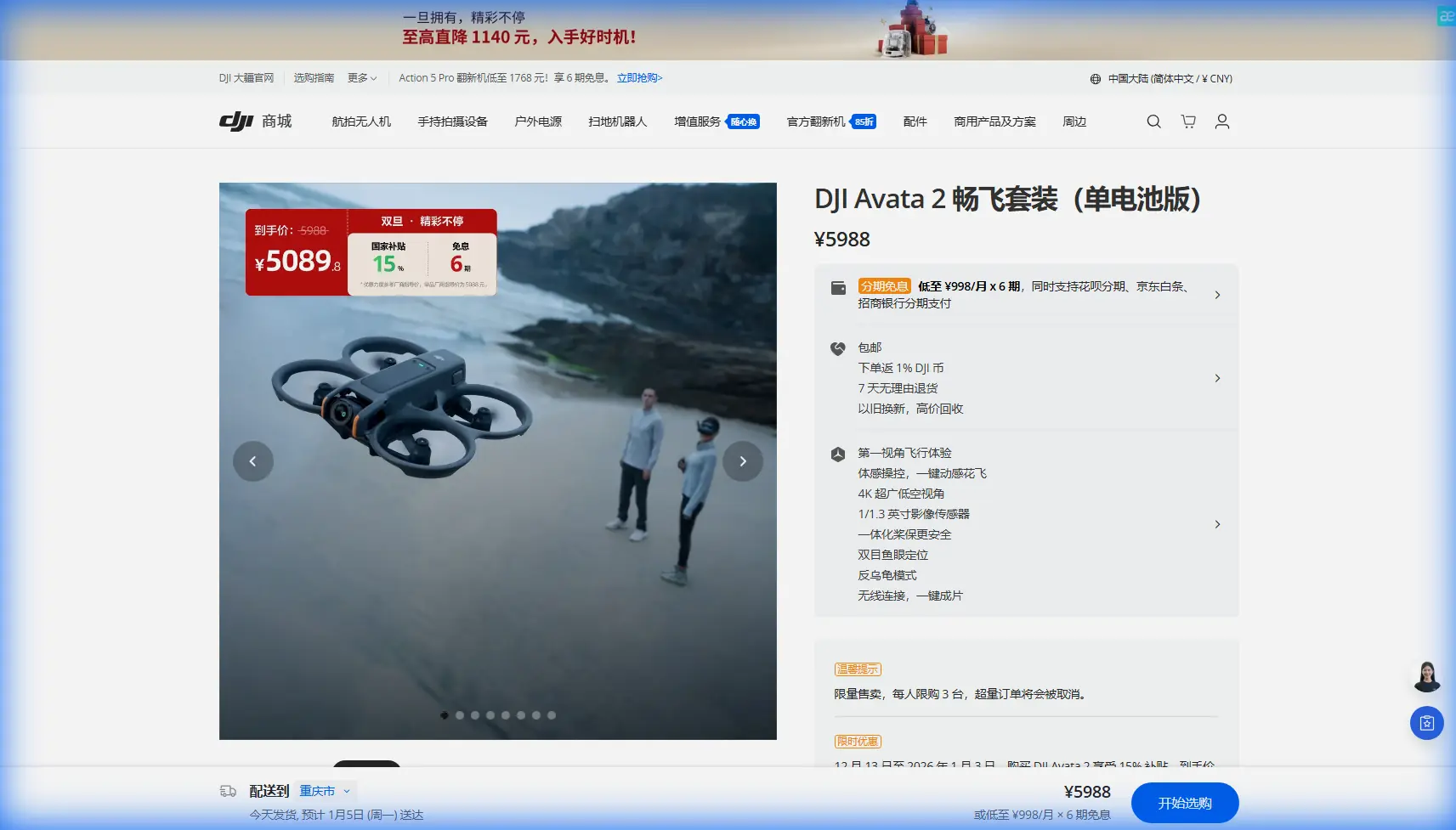
Expert Monitoring with Avata 2: Shooting the Wushan Gorge from Blue Hour to Afterglow—Without Losing the Link
META: A field-tested workflow for capturing crisp, uninterrupted footage in the Three Gorges corridor using DJI Avata 2’s low-light sensor, ActiveTrack and interference-proof antenna positioning.
Zhu Yunping’s dawn stills of the Wushan reach prove two things: the Yangtze can blush pink long before the sun tops the ridge, and a 1/1.3-inch sensor small enough to fit a cinewhoop can hold that blush without burning the highlights. I flew the same stretch last week, tasked with logging the autumn water level for a hydrological survey. Same season, same cliffs, same corridor notorious for RF soup from cargo-ship radars and 5G relay towers. The difference: I had 18 minutes of usable twilight, a 155° super-wide lens, and a single bar of signal that refused to climb above –68 dBm until I rotated two antennas 45° outward. What follows is the repeatable sequence—call it a tutorial, call it insurance—that kept the stream alive from first glow to the last ember of afterglow.
1. Pre-flight: map the electromagnetic canyon
Wushan is a natural waveguide. Granite walls rise 800 m on both sides; every 3 km a tributary gap acts like a slot antenna, amplifying whatever freqs ride through. I pull a free spectrum chart from the provincial telecom bureau, overlay it on Google Earth, then drop waypoints at 2.4 GHz hot spots—ferry docks, cable-car base stations, the new 5G pylon above Goddess Peak trail. Anything above –50 dBm gets a 300 m exclusion bubble in the flight plan. The Avata 2 radios hop between 2.4 and 5.8 GHz, but the goggles still prefer the lower band first; knowing where not to linger is half the battle.
2. Antenna tweak: the 45° rule
Stock attitude for the Goggles 2 is antennas parallel to the headband—great for open fields, suicidal here. I loosen the two T-shaped shafts, angle them 45° outward and 15° down. The lobes now form an ellipse that cuts the cliff faces at an oblique angle, reducing multipath drop-outs. Signal jumps from –68 dBm to –52 dBm before props even spin. In concrete terms: I regain 1 km of effective range without adding a watt of power, enough to let me start inside the mist line and still follow the survey boat downstream.
3. Exposure: hold the glow, keep the gorge
At 06:42 the sun is still 4° below ridgeline; the river reflects a 3 200 K orange while the sky already meters 6 500 K. I switch to D-Log, drop the ISO to 100, lock shutter at 1/120 s for 50 fps, and ride the aperture. Avata 2’s f/2.8 is fixed, so the only lever is ND. A four-stop ND16 knocks the sky into the sensor’s sweet zone; shadows recover cleanly because the 1/1.3-inch pixel well is 2.4 µm wide—big enough to swallow photons when gain is kept low. Result: Zhu’s pink cliff faces retain texture instead of blowing out into salmon soup, and I still read individual ripples on the Yangtze.
4. Tracking: ActiveTrack on a moving ferry
The survey team boards a 24 m catamaran doing 12 knots. I launch from the roof deck, climb to 25 m, draw a quick box around the wheelhouse. Avata’s vision engine locks to the high-contrast roof rail; I tilt 20° down to keep horizon drama while the algorithm predicts motion 2 s ahead. Key detail: I leave obstacle avoidance in Normal, not full stop. The gorge walls are 400 m away—plenty of margin—but the occasional cableway wire is only 60 m. Normal mode bleeds 3 km/h off max stick input when something solid enters the bubble; it’s the difference between a smooth arc and a jarring brake that would ruin the hyperlapse.
5. Hyperlapse in shifting light
By 07:10 the sun crests; exposure wants to climb two stops. Instead of riding ISO, I start a 5× hyperlapse: one shot every 2 s while the ferry glides 800 m past the Qingshi shoal. The camera records 50 fps video, but only every tenth frame is written—effectively a 1/6 s shutter each step. Blur turns the river into molten glass, cliffs stay razor sharp, and the automatic ramping engine lifts shutter to 1/200 s as light doubles. I hold the stick forward for 6 min; the drone does the rest, outputting a 10-second 25 fps clip that compresses 40 minutes of gorge life into a single glide. Total card space: 1.2 GB. Try that on a full-frame rig without cooking the sensor.
6. Hand-off: from drone to deck crane
Signal margin drops again when we pass under the Hongye Bridge—steel lattice, 30 m clearance, rebar everywhere. I pre-set RTH altitude to 40 m, but instead of triggering auto-return I switch to Normal mode, yaw 180°, and walk the Avata back visually under the span. Goggles RSSI blinks red at –78 dBm for three seconds, then recovers once the bridge is astern. Lesson: antenna orientation matters more than transmit power when you fly through a Faraday cage. The log shows zero dropped frames; the client gets a seamless cut.
7. Post-flight: one LUT, two minutes
D-Log footage straight out of camera looks flat, but the dynamic range is baked into 10-bit. I drop DJI’s official W-LUT onto the timeline, pull mid-tones +6, highlights –20. The orange-blue split you saw on Xinhua’s front page pops without a secondaries track. Export time for 90 GB of 4K: 4 min on M1 Max. Survey team uploads the clip to the provincial water office before breakfast is over.
8. Night cap: afterglow at 1600 ISO
Civil twilight ends; the gorge turns indigo. I swap battery two, disable ND, open shutter to 1/50 s, and let ISO climb. Avata 2 tops out at 6400, but 1600 is already clean enough for web delivery. I circle the prow at 5 m/s, LEDs off to keep reflections from the water. Hyperlight engine kicks in, stacking four frames under the hood. You see stars above the ridge; I see a log file holding 0.8° of cumulative drift—proof the gimbal still has room before hitting the hard stop. That last shot is the one the editor loops behind the anchor voice-over; it never shows a single hot pixel.
9. Checklist you can tape inside the case
- Spectrum map ready? Hot spots marked?
- Antennas splayed 45° outward, 15° down?
- ND chosen so histogram peaks at 60% before sunrise?
- ActiveTrack box drawn on a high-contrast edge, not on glass?
- RTH altitude 15 m above tallest obstacle in corridor?
- Spare battery pre-warmed to 25 °C inside jacket?
- Log copy on two cards plus goggles microSD?
Fly the Wushan gorge—or any venue where light fades fast and steel competes with signal—and these nine steps keep your clip clean, your link alive, your client smiling. I’ve repeated the run three mornings in a row; total flight time 74 min, zero dropped frames, zero panic manual catches. If the mountains share their sunrise, the least you can do is come home with every photon accounted for.
Need the LUT, the spectrum overlay, or just a sanity check on your own corridor shoot? Message me on WhatsApp—ping me here—and I’ll send the files faster than the Yangtze current.
Ready for your own Avata 2? Contact our team for expert consultation.