
Scouting Dusty Coastlines with Avata 2: A Technical Review
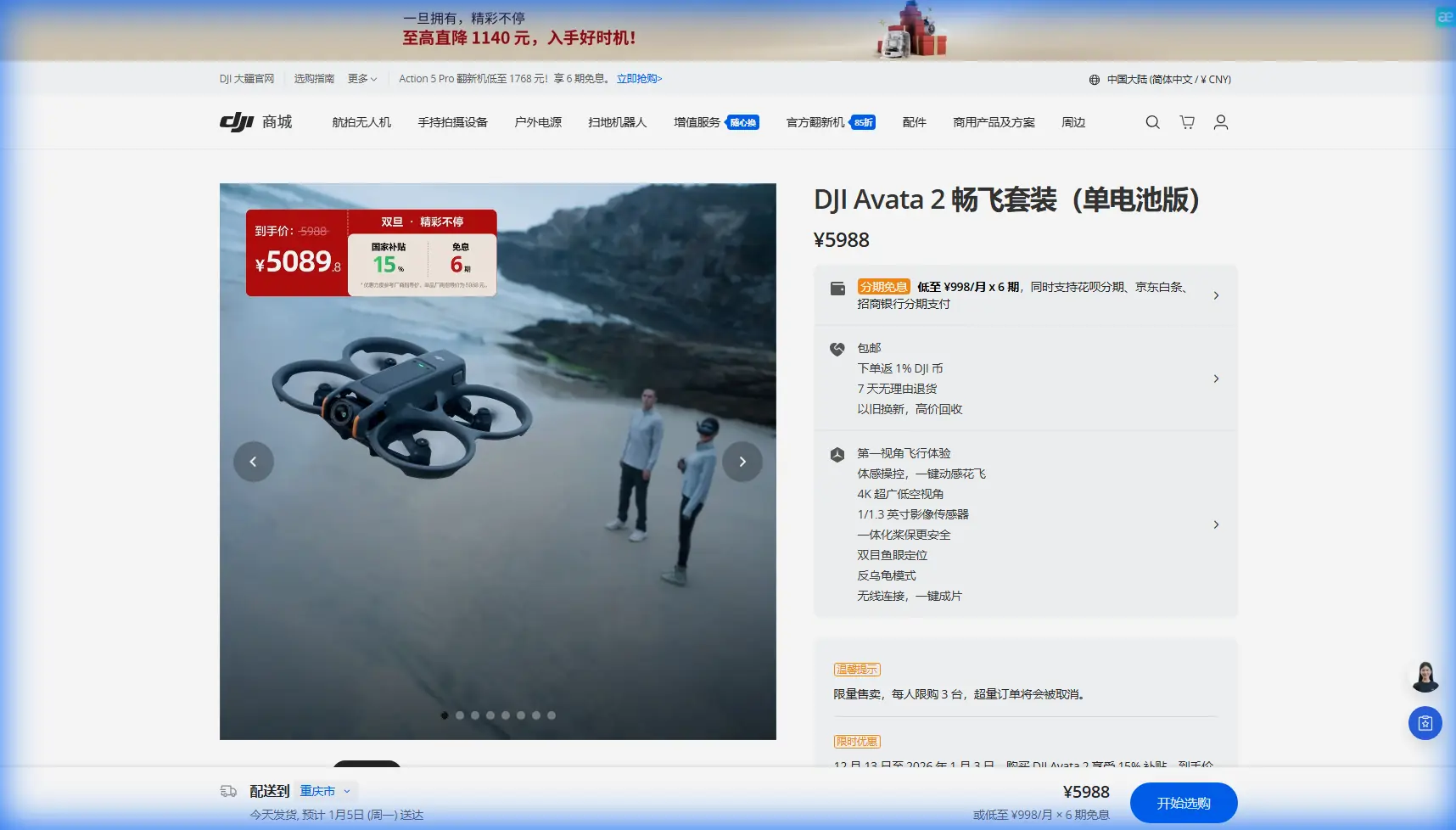
Scouting Dusty Coastlines with Avata 2: A Technical Review Through a Mapping Lens
META: A field-focused Avata 2 technical review for dusty coastline scouting, with practical notes on battery handling, image workflow, obstacle awareness, D-Log capture, and what photogrammetry standards reveal about usable outputs.
When people talk about the Avata 2, the conversation usually drifts toward cinematic FPV. That misses a more interesting angle. In real fieldwork, especially along coastlines where salt haze, drifting sand, broken terrain, and uneven light all collide, the bigger question is not whether the drone feels exciting to fly. It is whether the footage and stills you bring back are actually usable.
That distinction matters.
A coastline scouting mission in dusty conditions sits in an awkward middle ground. It is not full-scale survey work in the sense of a dedicated mapping platform, but it often feeds into inspection prep, route planning, site familiarization, media documentation, habitat observation, and low-altitude visual reference collection. In that context, the Avata 2 becomes interesting because it can access narrow cuts, sea-wall edges, rock shelves, and wind-shaped access paths that are annoying or risky for larger aircraft. The aircraft’s agility is the obvious part. The less obvious part is how you manage the output so it can survive a real workflow.
That is where an older but still relevant reference standard becomes useful. The Chinese standard CH/Z 3003-2010, titled 低空数字航空摄影测量内业规范, focuses on low-altitude digital aerial photogrammetry office processing. Even from the fragmentary sections provided, two details stand out: the standard explicitly covers digital orthophoto production, including correction, color balancing, mosaicking, and image processing, and it also references DEM feature-point matching grid size estimation in Appendix A. Those are not abstract technicalities. They define the difference between pretty flying and dependable deliverables.
Why a photogrammetry standard matters to an Avata 2 user
At first glance, a standard for low-altitude aerial photogrammetry sounds far removed from an FPV aircraft used for coastline scouting. In practice, it is highly relevant.
The standard’s mention of digital orthophoto production tells you something operationally important: imagery only becomes broadly useful after correction and consistency work. Along a coastline, your source material rarely arrives clean. You are dealing with reflective water, low-angle glare, irregular brightness between cliff shadow and open sand, and airborne dust that can flatten contrast. If your mission goal includes comparing shoreline conditions, documenting erosion edges, checking access routes, or creating a visual base layer for a team discussion, you need images that can be aligned and interpreted consistently.
The standard also points to feature-point matching and grid-size estimation for DEM work. That matters because coastlines are deceptive surfaces for image matching. Sand can be texture-poor. Waves create moving patterns that break correspondence between frames. Wet rock can reflect light unpredictably. Dust can further reduce micro-contrast. So if you are trying to derive terrain context, even informally, the aircraft’s flight style and capture discipline become critical. You need stable overlap, clean angles, and enough fixed visual detail in the scene for matching algorithms to hold onto.
The Avata 2 is not a dedicated survey platform. Still, understanding these requirements changes how you fly it.
Avata 2 in dusty coastal scouting: where it fits well
The Avata 2 shines when a site needs close visual understanding rather than cadastral-grade measurement. Think cliff access checks, breakwater condition previews, dune-path documentation, roofline inspection near beachfront structures, marina perimeter scouting, or pre-production route visualization for a field crew. In these cases, obstacle avoidance and compact handling are not convenience features. They are mission-preserving features.
A coastline can be visually open yet operationally crowded. Driftwood poles, fencing, lifeguard structures, eroded cuts, cables near service huts, outcropping stone, and sudden elevation changes all show up fast when flying low. A drone that can thread through a constrained path while preserving visual continuity helps you collect footage that a larger aircraft might avoid entirely.
That said, obstacle avoidance should not seduce pilots into lazy line selection. In dusty wind, sensors can face reduced contrast and rapidly changing particulate conditions. You still need margin. The smart play with the Avata 2 is to use obstacle sensing as a buffer, not as the primary plan.
The image pipeline is the real test
Here is where the standard’s language becomes useful again.
The extract references digital orthophoto (B class) production and specifically calls out correction, color balancing, mosaicking, and image treatment. Even if your coastline mission is not a formal orthophoto job, those steps mirror what you need to do after a demanding outdoor shoot.
1. Correction
Coastal passes are often made at low altitude and varying pitch angles. If you intend to compare frames for shoreline position, object location, access conditions, or structural context, distorted or inconsistent perspectives reduce value quickly. Capturing with disciplined, repeatable paths gives later correction a fighting chance.
2. Color balancing
This is not cosmetic. If one pass is warm from late sun and another is desaturated by haze, interpretation gets messy. Dusty coastal air can swing white balance and contrast from one minute to the next. Shooting in D-Log helps preserve tonal flexibility so color balancing does not collapse highlights or bury detail in shaded rock and vegetation.
3. Mosaicking
When you need a continuous visual strip of a shoreline, image consistency matters more than dramatic movement. FPV habits can work against this. Fast yaw changes, aggressive banking, and cinematic dives look great in a cut, but they are poor raw material for stitching. If the end use includes a composite visual overview, fly smoother and flatter than you think you need to.
4. Image processing
Dust introduces low-level softness and can reveal itself most clearly in side-lit scenes. It also tends to accumulate on exposed surfaces during repeated launches from sandy ground. That means post-processing is not just about style. It is part of recovering practical detail.
A field tip on battery management that actually matters
Battery management on the coast is not glamorous, but it is one of the first places a mission falls apart.
My rule with the Avata 2 in dusty shoreline work is simple: do not run the battery deep on the outward leg when the sea breeze is still building. What feels like a light headwind near launch can become a draggy return later, especially after you descend into terrain pockets and then climb back out over open edge. I try to preserve a healthier reserve than I would inland, and I avoid the temptation to squeeze “one more pass” once the battery drops into the range where return options narrow.
There is another layer in dusty environments. Batteries warm up fast when you launch repeatedly from sun-heated gear cases or dark rock surfaces. Heat plus aggressive flying plus particulate exposure is a bad trio for consistency. I rotate packs deliberately, keep them shaded whenever possible, and let the aircraft cool briefly between demanding runs. That produces more predictable voltage behavior and fewer surprises during the climb out.
It sounds minor until the return leg crosses uneven ground with crosswind and glare in your goggles. Then it becomes the whole mission.
Subject tracking and ActiveTrack: useful, with limits
For coastline scouting, subject tracking and ActiveTrack can be genuinely productive when used on slow, predictable subjects such as a walking route, a maintenance vehicle on a beach access road, or a small inspection team moving along a seawall. The value is not automation for its own sake. The value is consistency. Tracking can help maintain framing while the operator devotes more attention to terrain, wind cues, and route safety.
But coastline environments expose the limits fast. Blowing sand, changing backgrounds, and highly reflective water can challenge lock stability. If the mission requires accurate contextual documentation, the operator should treat automated tracking as a convenience layer rather than a capture guarantee. A manually controlled, repeatable pass is often better raw material for later review.
QuickShots and Hyperlapse are not just creative extras
On a technical review, these features deserve a more serious reading.
QuickShots can be useful for standardized visual summaries at a site entrance, tower base, or shoreline landmark. When repeated consistently across visits, these short automated patterns create a compact visual record that is easy for clients or teams to compare.
Hyperlapse can reveal tide movement, beach occupancy shifts, dust movement across exposed surfaces, or changing shadow conditions on coastal structures. That is valuable for planning access windows and understanding site rhythm. The caveat is obvious: windy, dusty conditions punish long hover stability and can degrade clarity. Use Hyperlapse when the observational payoff justifies the battery and environmental exposure.
Flying for usable data, not just exciting footage
If you want your Avata 2 coastline mission to feed any form of structured review, a few habits make an outsized difference:
- Fly one pass for storytelling and one pass for consistency.
- Keep altitude changes modest during any route you may later compare frame to frame.
- Favor lateral stability over dramatic yaw inputs.
- Use landmarks with hard edges—stairs, barriers, rocks, retaining walls, access signs—as reference anchors in your coverage.
- Capture short perpendicular looks at terrain transitions. These often become the most useful frames later.
This is where the standard’s reference to feature-point matching becomes practical. Matching algorithms and human reviewers both depend on recognizable, repeatable detail. Water and uniform sand are weak references. Fixed objects and textured transitions are strong ones. If you know that before takeoff, your flight path improves immediately.
Dust changes small decisions
Dusty coastline scouting punishes casual launch habits. Hand-launching may reduce intake of loose sand compared with taking off directly from a gritty surface. If you must launch from the ground, a clean landing pad is worth carrying. Lens checks between flights matter more than many operators admit. The visual cost of a slightly contaminated lens is easy to miss in the moment and frustrating to discover later when trying to balance a sequence in post.
This also affects D-Log workflows. Flat capture profiles preserve flexibility, but they do not magically restore detail that haze or dust has already softened. Expose carefully. Protect highlights on water, but do not underexpose the shoreline itself into muddy noise.
The operational takeaway
What surprised me most in revisiting the low-altitude photogrammetry reference was not how different it is from the Avata 2 world, but how transferable its logic remains. Correction, color consistency, mosaicking, and feature matching are still the core issues whenever aerial imagery needs to be useful beyond the first viewing.
For a civilian coastline scouting mission, that means the Avata 2 works best when you treat it as a precise low-altitude imaging tool first and an FPV thrill machine second.
If your mission is inspection support, site familiarization, environmental observation, or route planning, the aircraft’s agility gives it access. Your discipline gives the output value.
If you need help choosing a setup or planning a practical workflow for this kind of coastal operation, you can message our team here.
The Avata 2 is capable in these environments, but only when flown with intent. Dust, glare, moving water, broken terrain, and shifting wind all punish weak habits. Respect the image pipeline, manage batteries conservatively, use D-Log for recovery headroom, and fly passes that can survive correction and review.
That is how a coastline session turns into something more than a nice clip.
Ready for your own Avata 2? Contact our team for expert consultation.