
Avata 2 for Construction Sites in Extreme Temperatures
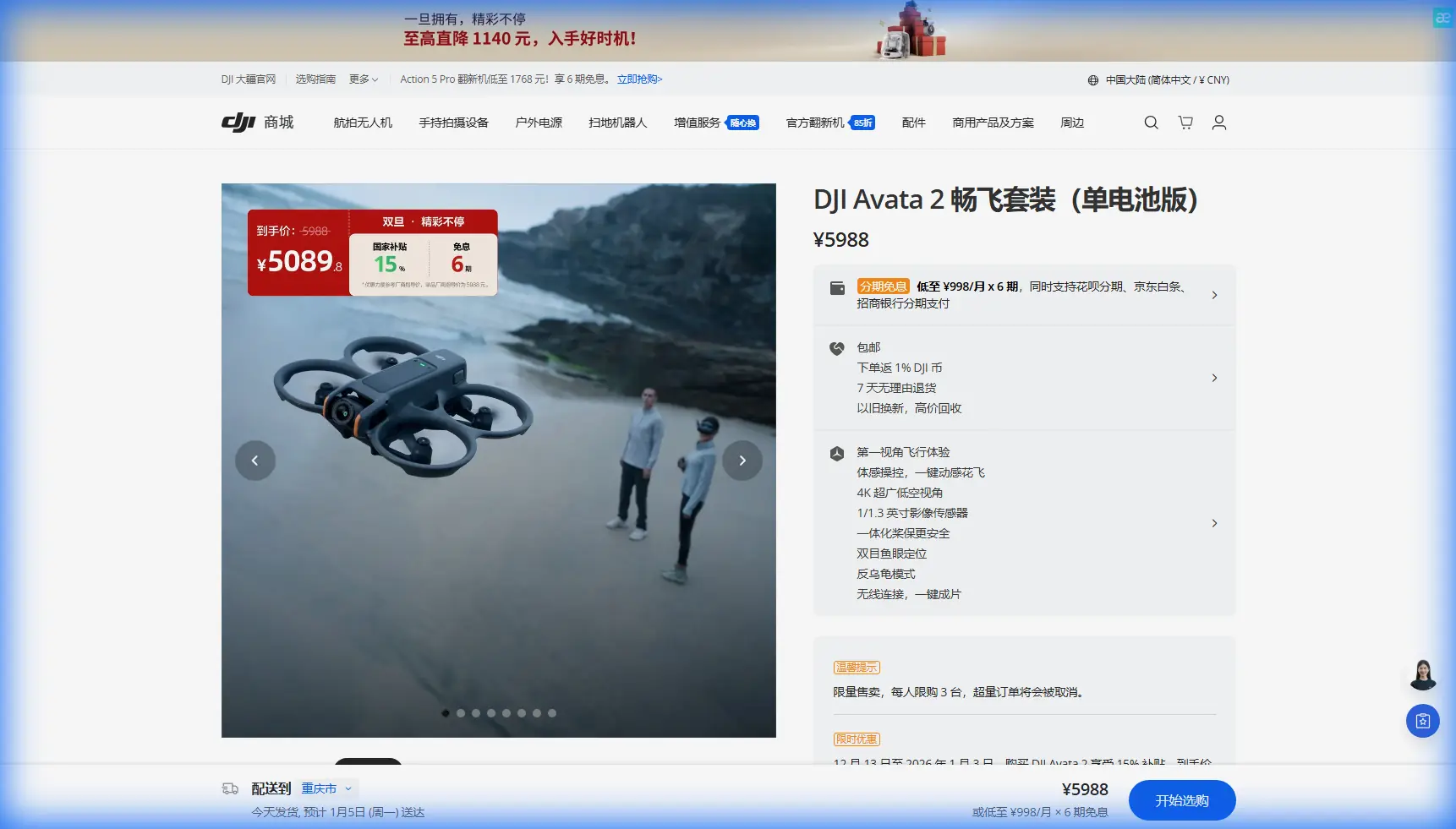
Avata 2 for Construction Sites in Extreme Temperatures: A Technical Review
META: Expert review of DJI Avata 2 for construction site scouting in extreme heat and cold, covering obstacle avoidance, D-Log, tracking limits, EMI handling, and practical flight workflow.
Construction crews do not need another broad drone overview. They need to know whether a compact FPV platform can survive a real site visit at dawn in winter, at midday in summer, and around steel, concrete, temporary power, rebar mats, and signal noise. That is the right lens for evaluating the Avata 2.
I have been looking at the Avata 2 less as a cinematic toy and more as a field instrument for short, high-information inspections. In that role, it becomes interesting. Not perfect, and not universal, but surprisingly capable when the mission is to move through partially built structures, capture tight visual references, and come back with footage that project managers can actually use.
The key is understanding what the aircraft does well, where its automation helps, and where construction conditions push it toward the edge.
Why the Avata 2 fits a construction scouting brief
The Avata 2 sits in a niche most site teams overlook. Traditional camera drones are efficient for broad top-down progress mapping, roof scans, and perimeter checks. FPV-style platforms, by contrast, are better at navigating through spatially complicated environments: between framing, under overhangs, through steel skeletons, and alongside facades where conventional flight paths feel clumsy.
That matters on active builds. A superintendent often wants answers that are close to human eye level but safer and faster than sending someone up ladders, onto unfinished decks, or near unstable access points. The Avata 2 can fill that gap when the goal is visual verification rather than survey-grade measurement.
Its appeal on site comes from a few operational traits:
- compact size for tighter approach angles
- built-in protection suited to confined flights
- immersive control that makes spatial awareness stronger in complex environments
- stabilized output that remains usable for stakeholders who are not FPV enthusiasts
Those points sound abstract until weather and site clutter enter the picture.
Extreme temperatures change the mission before takeoff
Construction does not wait for ideal weather. If you are scouting in extreme heat or cold, battery behavior, sensor confidence, and pilot decision-making all change.
In cold conditions, the first issue is not image quality. It is power delivery. Batteries sag faster, and that affects punch-out power, flight time, and your confidence margin when you are threading through structures. On the Avata 2, this means the smart move is short sorties with very specific objectives: one façade, one mechanical chase, one atrium pass. Treat each battery as a task battery, not a wandering exploration battery.
In heat, the pressure shifts. You are dealing with thermal stress on the aircraft, on the battery, and on the pilot’s planning window. A compact drone flying aggressively around reflective surfaces, asphalt, HVAC exhaust, and sun-baked concrete is operating in an environment that punishes hesitation. You want clean route design, minimal hovering in hot dead air, and quick recovery after each capture run.
This is where the Avata 2’s style of flight becomes an advantage. It is built for decisive movement. That makes it suitable for short, structured inspection passes in bad temperature conditions, provided the pilot resists the urge to fly it like a demo reel machine.
Obstacle avoidance helps, but construction sites remain hostile
One of the strongest reasons to consider the Avata 2 for site scouting is obstacle awareness. On paper, that sounds like reassurance. In practice, it should be treated as a backup layer, not a permission slip.
Construction sites are messy in ways consumer safety systems do not fully understand. Netting, cables, protruding rebar, reflective cladding, temporary barriers, and narrow gaps can all create visual ambiguity. Obstacle avoidance can reduce the chance of a preventable mistake in a straightforward pass, especially when moving around columns, wall edges, or incomplete interior geometry. Operationally, that buys confidence during reconnaissance runs and slow reveal shots for stakeholder review.
But there is a real distinction between “the drone can detect obstacles” and “the drone can interpret a construction site.” Those are not the same thing. The Avata 2’s avoidance capability is useful when you are entering a partially enclosed area or backing away from a facade while maintaining visual composition. It is less reliable as a substitute for route discipline in cluttered, evolving spaces.
For site work, the best method is to use obstacle avoidance as one layer in a stack:
- pre-visualize the route
- fly the path once conservatively
- mark interference zones mentally
- then repeat only if the first pass proves clean
That approach keeps the technology in its proper role.
ActiveTrack and subject tracking are not the headline feature here
A lot of marketing attention around drones goes to subject tracking, and the Avata 2’s ecosystem naturally raises questions about ActiveTrack-style workflows. For construction scouting, though, tracking is not the reason to deploy this aircraft.
Following a moving excavator, loader, or vehicle convoy sounds attractive until you factor in dust, abrupt motion, occlusions, and the density of obstacles around a live site. Tracking can be useful in open areas to illustrate logistics flow, haul routes, or material staging movement. It can create a fast briefing asset for managers trying to understand how traffic or machinery circulates through a constrained layout.
Still, the operational significance is narrower than many teams expect. In a construction environment, subject tracking is best treated as a situational tool for clean exterior zones, not as the backbone of your inspection workflow.
What matters more is controlled manual positioning with strong stabilization. The Avata 2 lets you build intentional movement around structures, which is often more valuable than automated pursuit. If your audience is a site owner, insurer, or project executive, they usually need clarity over spectacle.
QuickShots and Hyperlapse can support reporting if used carefully
QuickShots and Hyperlapse are easy to dismiss as creative extras, but on a jobsite they can serve a reporting function when used with restraint.
A QuickShot can help produce a repeatable establishing view of a tower section, laydown yard, or access road. If the same flight is repeated at intervals, teams can compare changes visually without manually recreating complex camera motion every time. That consistency matters for stakeholder updates.
Hyperlapse has a narrower but still practical role. On a large site, compressing movement of equipment, worker flow, or shadow progression can reveal bottlenecks and activity patterns that are less obvious in real time. It is not a substitute for proper documentation, but it can expose workflow friction in a way static stills cannot.
The trap is obvious: overusing cinematic modes can turn an inspection flight into a marketing montage. For technical review, these features only earn their keep when they clarify site conditions, sequencing, or access constraints.
D-Log is one of the most valuable features for real site deliverables
For serious users, D-Log is where the Avata 2 becomes more than an FPV novelty.
Construction sites are full of harsh contrast. White membrane roofing, deep interior shadow, reflective glass, sky spill through unfinished openings, and dark steel all end up in the same frame. Standard color profiles can clip highlights or bury shadow detail exactly where decision-makers need to inspect conditions.
D-Log gives you more flexibility to preserve tonal information in these high-contrast scenes. Operationally, that means two things.
First, you have a better chance of showing texture in both bright and dark areas of the build envelope during the same pass. That can matter when reviewing envelope installation, façade transitions, roof penetrations, or moisture-prone zones.
Second, D-Log produces footage that cuts more cleanly into a larger reporting workflow. If your media team is assembling updates from multiple cameras, a flatter profile gives them room to normalize the site’s color and exposure shifts across different weather windows.
That does not mean every site operator should shoot flat all the time. It does mean that for critical captures, especially around noon sun or mixed indoor-outdoor transitions, D-Log is one of the Avata 2’s most professionally relevant tools.
Handling electromagnetic interference on site
This is where the Avata 2 conversation gets real.
Construction sites can be ugly RF environments. Temporary power systems, large steel assemblies, cranes, dense concrete, active equipment, and nearby communications infrastructure can all contribute to signal inconsistency or directional weakness. Add enclosed spaces or partially shielded structural zones, and your clean control link assumptions disappear fast.
One practical habit matters more than people admit: antenna adjustment.
If you start to see link quality degrade or image transmission feel unstable near structural steel or energized zones, do not just push through and hope the aircraft sorts it out. Pause. Reassess your body position relative to the drone, the structure, and the likely interference source. Then adjust antenna orientation deliberately rather than randomly.
The operational significance is straightforward. Antenna alignment affects how well your control and video link propagates through a compromised environment. On a site with steel framing or reinforced concrete, a small change in pilot position or antenna angle can materially improve link stability. Sometimes stepping laterally out from behind a column line or turning your stance to maintain cleaner geometry with the aircraft is enough to recover confidence.
With the Avata 2, I would treat EMI management as part of flight planning, not troubleshooting. Before entering a cluttered zone:
- identify likely shielding structures
- maintain a route that preserves cleaner line-of-sight where possible
- avoid deep penetration behind multiple layers of steel or concrete on a single battery
- be ready to break off early if transmission quality starts to deteriorate
If your team wants a second opinion on setting up safer site-specific flight procedures, this is the kind of scenario where a quick field workflow review helps: message us here.
How the Avata 2 behaves in confined inspection work
The strongest case for the Avata 2 on construction sites is confined visual work. Think parking structure entries, breezeways, partially enclosed plant rooms, atrium edges, façade setbacks, and circulation paths under active construction.
Its protected design and FPV control style make it comfortable in spaces where larger drones feel like they are carrying too much inertia. That translates into better confidence around close-proximity visual inspection, especially when you need to snake through geometry and maintain a coherent shot.
The caveat is that confidence can become overconfidence. Confined site work should be flown with conservative speed and clear exit paths. The Avata 2 may be physically suited to narrow routes, but the environment can change daily. A gap that was clean yesterday may now contain hanging cable, duct material, or temporary edge protection.
For repeat site missions, route discipline matters more than bravado. Build a library of dependable passes and update them as conditions evolve.
Where the Avata 2 is the wrong tool
A technical review is only useful if it states the limits plainly.
The Avata 2 is not the best first choice when you need:
- broad-area orthomosaic mapping
- survey-grade positional accuracy
- long loiter inspections over large open tracts
- heavy wind authority at altitude compared with larger enterprise platforms
- deeply automated industrial inspection routines
If your main task is volumetrics, topographic capture, or highly repeatable geospatial work, a different platform makes more sense. The Avata 2 wins when the mission is about spatial storytelling with operational purpose: showing conditions inside complex structures, documenting hard-to-reach pathways, and creating usable visual records from difficult angles.
Recommended field workflow for extreme-temp site scouting
For crews using the Avata 2 on demanding construction visits, I recommend a disciplined workflow:
Start with one question per flight. Do not launch with a vague aim to “look around.” Decide whether the sortie is checking façade progress, MEP access, roof edge conditions, circulation routes, or equipment placement.
Use short flights. In extreme temperatures, battery confidence is part of the safety margin. Keep reserves healthy and bring the aircraft back early.
Fly a reconnaissance pass before a keeper pass. This is especially important when obstacle avoidance may be dealing with irregular site geometry.
Use D-Log for difficult lighting and stakeholder-grade review footage. Keep exposure decisions conservative so highlight detail survives.
Treat tracking features as optional. Manual control is usually the better choice in dense site conditions.
Monitor signal behavior near steel and reinforced structures. If interference appears, adjust antenna orientation and your own position first, then reassess the route.
Capture one repeatable establishing shot every visit. That gives project teams a stable visual reference over time, even if the rest of the flight plan changes.
Final assessment
The Avata 2 is not a universal construction drone. It is a specialized aircraft that becomes highly valuable when the mission involves tight spaces, complex approach angles, and fast visual intelligence under difficult environmental conditions.
Its obstacle avoidance offers a meaningful safety layer. D-Log gives it professional credibility in harsh lighting. QuickShots and Hyperlapse can support visual reporting when used with discipline. Subject tracking and ActiveTrack-style thinking are secondary on active sites, where controlled manual flight usually produces better results. And if you are operating around electromagnetic interference, antenna adjustment is not a footnote. It is a core field skill.
For construction teams scouting in extreme temperatures, that is the real verdict: the Avata 2 works best when flown like a technical instrument, not a novelty. Respect the battery. Respect the site. Respect RF conditions. Do that, and this small FPV platform can deliver some of the most useful close-range visual documentation available in its class.
Ready for your own Avata 2? Contact our team for expert consultation.