
Scouting Urban Construction Sites With DJI Avata 2
Scouting Urban Construction Sites With DJI Avata 2: A Practical Case Study for Tighter, Safer Recon
META: A field-tested look at using DJI Avata 2 for urban construction site scouting, with practical insight on obstacle avoidance, D-Log, ActiveTrack, QuickShots, and what it does better than larger rivals.
I’ve spent enough time around active builds to know that “site visibility” usually means two very different things. One is the polished progress shot for stakeholders. The other is the messy, high-value reality: checking access routes between scaffolding, looking at roofline transitions, inspecting material laydown zones, and understanding how a crane path interacts with everything below it.
That second job is where the DJI Avata 2 becomes genuinely interesting.
Not because it replaces a conventional camera drone in every construction workflow. It doesn’t. If the brief is broad-area mapping or long, static overwatch, there are better tools. But if the assignment is scouting a dense urban jobsite where structures, temporary barriers, steel, fencing, and narrow corridors create a cluttered airspace, Avata 2 solves a different problem. It gets you into the site visually, not just above it.
I approached this from the perspective of a photographer working around real-world constraints: limited launch space, changing light, unpredictable movement on the ground, and the need to capture footage that is both useful for decision-making and clean enough to share internally. In that context, Avata 2 stands out less as a flashy FPV machine and more as a highly specialized reconnaissance platform.
Why Avata 2 fits urban construction scouting
Urban construction sites punish bulky aircraft. The usual obstacles are obvious—rebar cages, concrete cores, temporary walkways—but the real issue is how quickly the environment changes. A path that was clear at 8 a.m. can be partially obstructed by delivered materials at 10. Wind also behaves differently between towers, around parapets, and beside unfinished facades.
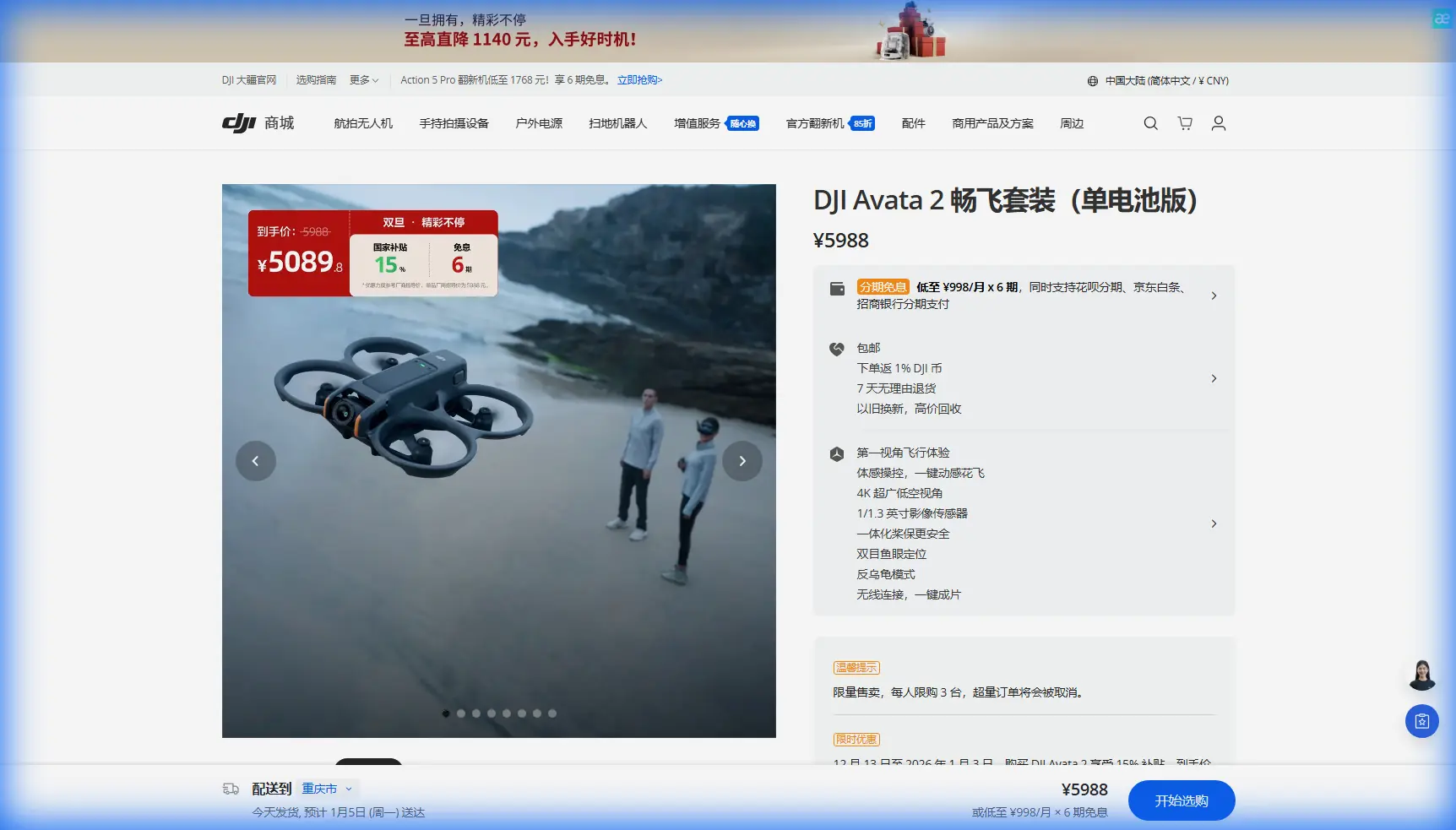
Avata 2’s compact, ducted design matters here. The propeller guards are not just a safety talking point. On a crowded site, they change how confidently you can work around tight edges, unfinished openings, and confined staging areas. That has operational significance. A pilot who is comfortable flying closer to the structure can collect more relevant footage in less time, especially when the task is to understand spatial relationships instead of capturing a wide cinematic reveal.
Compared with larger camera drones, Avata 2 excels when the route itself is the story. Think of a pre-installation walkthrough from street access to upper-deck material staging. Or a visual run that starts outside a facade opening, moves through a partially enclosed floor, then exits to show line-of-sight to adjacent buildings. A conventional drone can document the perimeter. Avata 2 can show how the site actually feels and functions.
That distinction matters to project managers, safety teams, and contractors because movement through a space often reveals more than a top-down still ever will.
The obstacle question: what actually matters on site
Obstacle avoidance gets oversimplified in marketing. On a construction site, the value is not that the drone magically prevents every bad decision. The value is that it gives the pilot another layer of awareness in a place where visual clutter is constant.
For Avata 2, that matters most during low-altitude passes near edges, under temporary overhead structures, or around corners where your perspective compresses distance. Even when a pilot is experienced, urban sites create false visual cues. Similar-colored surfaces, mesh barriers, and repeating steel patterns can distort depth perception. Better obstacle sensing reduces the chance of a small misread becoming an incident.
That is one of the reasons I’d choose Avata 2 over a more traditional prosumer drone for close-in site scouting. Many competing models are excellent when they have room to breathe. Avata 2 feels more composed when the mission profile is intimate and technical.
It also changes how safely you can gather repeatable footage. If you need to run the same route every week to compare staging changes, facade progress, or access conditions, consistency matters more than spectacle. A platform that stays predictable around obstacles is easier to standardize into a recurring documentation workflow.
ActiveTrack and subject tracking in a worksite environment
Construction professionals often ask whether subject tracking is even useful on a site where people and equipment move unpredictably. Used carelessly, not really. Used selectively, yes.
ActiveTrack and subject tracking are most useful when the “subject” is not a person weaving through hazards, but a defined motion pattern: a vehicle entering a controlled access lane, a lift moving through a staging area, or a supervisor walking a planned route for progress review. The operational advantage is that the pilot can concentrate more on airspace and clearance while the drone helps maintain framing.
That is especially useful in urban settings where background clutter can ruin the clarity of a shot. If the point is to document how a truck navigates a constrained delivery zone or how crews transition materials from one side of the site to another, stable tracking footage becomes more than a visual extra. It becomes evidence of how the site is functioning.
I still wouldn’t treat tracking as an autopilot substitute in dense environments. It works best as a controlled tool, not a default mode. But on Avata 2, having that option expands what kind of site stories you can capture during a single visit.
Why D-Log matters more than people think
Most site scouting happens under ugly lighting. Harsh midday sun. Deep shadows beside concrete cores. Reflective glazing next to unfinished raw materials. Bright sky framed through narrow structural openings.
That is exactly why D-Log is one of the most practical features on Avata 2.
If you’re documenting site conditions for decision-makers, you need footage that holds detail in both bright and dark regions. D-Log gives you more flexibility in post when the exposure balance is difficult, which is often the case on urban jobsites. You can retain detail in shaded steelwork without blowing out the skyline, or preserve facade texture while keeping visible information in lower interior sections.
Operationally, this reduces the chance that a scouting flight produces footage that looks dramatic but hides the very details people need to evaluate. That is a major difference between content made for social clips and content made to inform site decisions.
As a photographer, I also appreciate how D-Log helps unify mixed sequences. One pass might be an exterior approach; the next might push into a darker area under temporary cover. Matching those clips later is easier when the source footage gives you room to work.
QuickShots and Hyperlapse are not just creative extras
On paper, QuickShots and Hyperlapse sound like features built for casual flying. On a construction site, they can be surprisingly useful if you understand the job.
QuickShots are valuable when you need a repeatable, polished overview at the start or end of a site visit. Stakeholders often want a fast visual summary before they dig into detailed observations. A controlled automated move can produce that efficiently, particularly when launch conditions are tight and you want to conserve battery for close-range scouting.
Hyperlapse has a different role. It helps communicate change over time in a way ordinary clips often fail to do. On urban projects, activity patterns matter: crane swings, traffic rhythm around access points, shadow movement across active work zones, or how pedestrian interfaces behave near the perimeter. A short Hyperlapse segment can reveal congestion, timing conflicts, or operational bottlenecks far more clearly than a few isolated still frames.
That makes these modes more than aesthetic tools. They support context. And context is usually what a site team lacks when reviewing static progress media.
Where Avata 2 beats some competitors
This is where the comparison becomes practical instead of abstract.
Several competing drones deliver stronger endurance, larger sensors, or more mapping-oriented workflows. If your mission is orthomosaic production, corridor mapping, or long-duration hover observation, those aircraft may be the better choice.
But Avata 2 excels in one area where many competitors feel compromised: immersive, close-proximity visual scouting in confined urban spaces.
Its advantage is not just speed or maneuverability. It is the combination of protected propellers, confidence near structures, and the ability to produce footage that lets a viewer understand the site from a human-near perspective. That perspective is extremely hard to replicate with larger drones that are optimized for stand-off capture.
In other words, competitors may show you the site. Avata 2 is better at showing you how the site works.
That difference becomes obvious on jobs with partial enclosures, narrow setbacks, bridging structures, rooftop equipment zones, and complex facade access. These are not edge cases in urban construction. They are normal conditions. And they are exactly where Avata 2’s flight character becomes an operational asset rather than a novelty.
A realistic case study workflow
If I were scouting an urban construction site with Avata 2, my workflow would be structured around information density.
First, I’d capture a short establishing pass to show the site’s relationship to surrounding streets, neighboring buildings, and access constraints. This is where a controlled QuickShot or a smooth manual perimeter move earns its keep.
Next comes the close-range recon phase. I’d fly low, slow, and deliberately through the areas that usually create site coordination issues: loading zones, facade interfaces, rooftop transitions, and any route that crews or materials must use repeatedly. This is where obstacle awareness and Avata 2’s smaller footprint matter most.
Then I’d run one or two repeatable paths specifically for weekly comparison. Same start point, same altitude, same route logic. Over time, this creates a visual record that is much more useful than random “progress footage.”
After that, if there is a process worth illustrating—vehicle entry timing, hoist interaction, or controlled crew movement—I’d use subject tracking carefully to create a readable sequence for internal review.
Finally, I’d shoot selected clips in D-Log so the most important sequences can be graded for maximum clarity later. Construction scouting is often reviewed on laptops, phones, and conference room screens with inconsistent display quality. Footage that can be tuned cleanly in post is easier to interpret across all of them.
If you’re trying to build that kind of repeatable site capture workflow and want a second opinion on route planning or settings, you can reach me directly through this Avata 2 field chat.
What to watch out for
Avata 2 is excellent within its lane, but the lane matters.
It is not the aircraft I’d pick if the site needs highly formal survey-grade outputs. It is also not a substitute for disciplined flight planning in active urban environments. Tight spaces do not forgive casual piloting, and construction sites add enough unpredictability that every flight should be treated as a serious operational task.
The best results come when Avata 2 is used with a clear objective: reveal spatial constraints, document movement, inspect access logic, and create a visual record that helps teams make better decisions. If that is the brief, it performs exceptionally well.
The mistake is treating it like a toy for dramatic fly-throughs. The real value is that it turns difficult, cluttered environments into understandable visual information.
Final take
For urban construction scouting, DJI Avata 2 fills a niche that many drones only partially address. It is not trying to be the universal answer. That is exactly why it works.
Obstacle avoidance improves confidence where site geometry gets messy. ActiveTrack and subject tracking help document movement when used with discipline. D-Log preserves details in punishing mixed light. QuickShots and Hyperlapse provide context that busy teams can absorb quickly. And the ducted, close-proximity design gives it an edge over larger competitors when the mission calls for precise visual access rather than distant observation.
If your job is to understand what is happening on a dense construction site—not just admire it from above—Avata 2 is one of the most capable tools available for that specific role.
Ready for your own Avata 2? Contact our team for expert consultation.