
Avata 2 Field Report: Scouting Complex Terrain With More
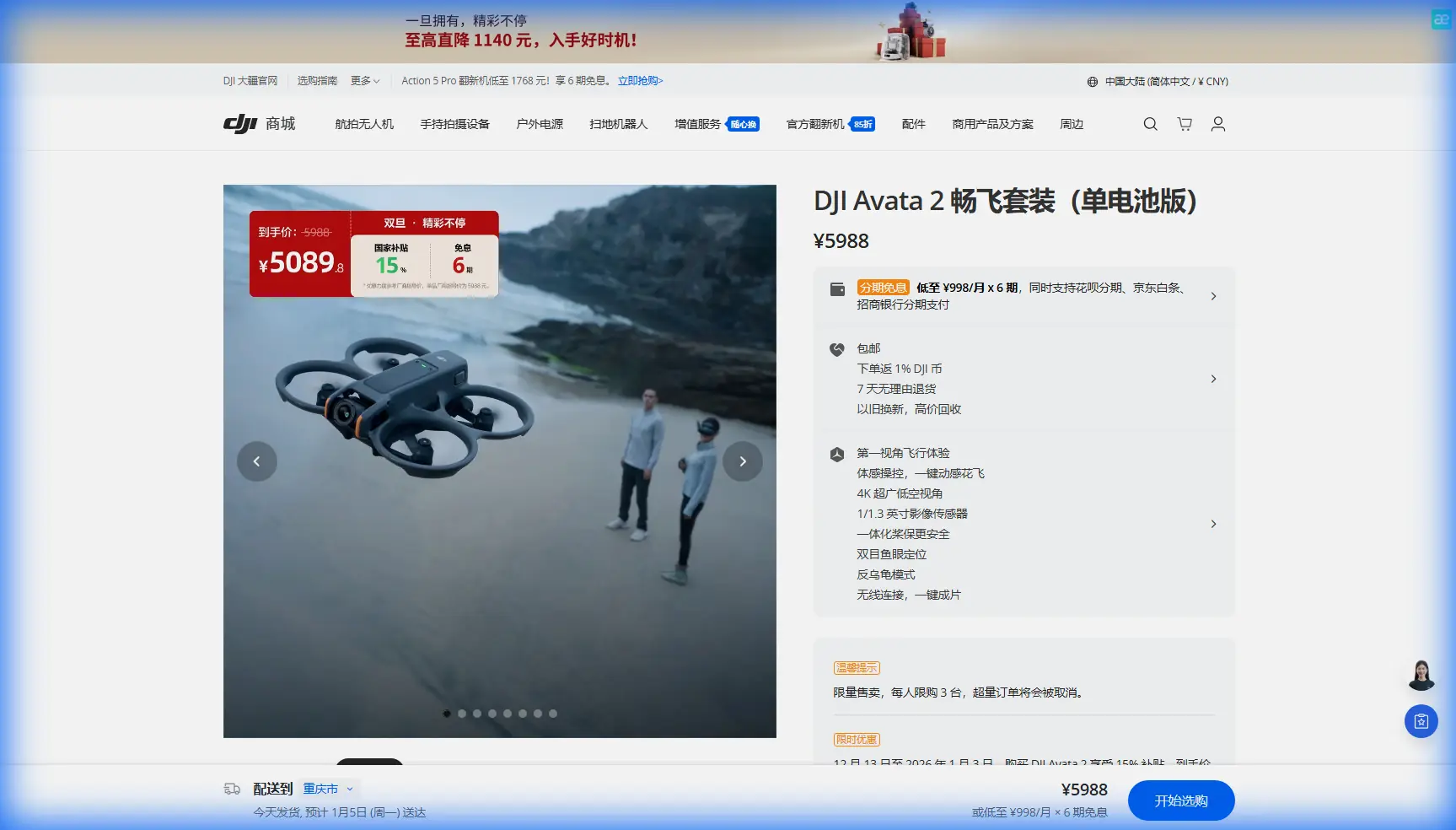
Avata 2 Field Report: Scouting Complex Terrain With More Precision and Less Guesswork
META: Practical field report on using DJI Avata 2 for scouting in complex terrain, including flight altitude strategy, obstacle avoidance limits, D-Log workflow, and where QuickShots and tracking help most.
Complex terrain exposes every weakness in a scouting workflow. Ridgelines interrupt signal paths. Tree canopies hide access routes. Drainage cuts and rock shelves flatten out on standard map views, then suddenly become mission-critical once you are on site. That is where the Avata 2 earns attention—not as a general-purpose camera drone, but as a close-in situational tool for seeing the parts of a field that broad overhead passes often miss.
For pilots scouting land, hunting entry points, checking slopes, or reading vegetation changes across uneven ground, the most useful question is not whether the Avata 2 can fly a field. It can. The real question is how to use its particular strengths without forcing it into jobs better handled by a larger platform. That distinction matters, especially in broken terrain where a bad altitude choice or overconfidence in automation can waste a flight window fast.
I have been looking at the Avata 2 through that lens: not as a spec-sheet object, but as a field machine for difficult topography. In this setting, a few capabilities stand out immediately. Its obstacle sensing helps when threading through partial cover or moving along irregular edges. Its compact FPV-style flight profile lets you inspect terrain features from angles that are awkward with more conventional aircraft. And its support for D-Log M gives you more flexibility when the light across a valley floor and an exposed ridge refuses to match.
That combination changes how scouting can be done. It does not simplify the terrain. It gives you a better way to read it.
Why the Avata 2 fits complex-field scouting
The Avata 2 is at its best when a pilot needs proximity, not just altitude. That sounds obvious, but many scouting mistakes begin with staying too high for too long. A clean top-down view may show boundary shape, major tree lines, and broad elevation logic. What it often misses are the features that decide whether a route is usable: the washout hidden beneath grass cover, the gap in a hedgerow, the shelf that could serve as a staging point, or the way a drainage ditch pinches a crossing into one narrow section.
An FPV-oriented drone like the Avata 2 is valuable because it encourages terrain-following observation. You are not simply collecting broad coverage. You are reading the land in motion.
This is also where obstacle avoidance has practical significance. In a scouting environment with uneven vegetation, isolated trunks, fence remnants, and contour-driven blind spots, forward confidence matters. No obstacle sensing system should be treated as permission to fly carelessly, but it does reduce the workload when you are skimming along field edges or peeking into transitions between open ground and cover. For field scouting, that means more attention can be directed toward interpreting the site rather than constantly second-guessing every small correction.
Still, pilots should be honest about what obstacle avoidance can and cannot do. Branch tips, wires, and terrain contrast issues remain real hazards. Complex terrain multiplies those risks because the background changes constantly. A drone that looks confident at one angle can suddenly lose the visual clarity it needs as sun, slope, and vegetation density shift. On the Avata 2, obstacle sensing is best treated as a buffer, not a shield.
The altitude insight that actually matters
For this scenario, the sweet spot is usually lower than many pilots expect. If your goal is to scout fields in complex terrain, an initial working band around 20 to 40 meters above ground level often gives the best balance of terrain readability, reaction time, and route interpretation.
Below that range, the view can become too fragmented unless you are inspecting a very specific feature such as a wash crossing, a stand gap, or a narrow access line between trees. Above that range, the land starts to simplify in unhelpful ways. Micro-contours disappear. Vegetation height differences blend together. Erosion channels that matter on foot can flatten visually. In other words, you gain overview but lose operational meaning.
That 20 to 40 meter zone works because it preserves context. You can still read the relationship between slope, cover, and access. You can observe how a field edge bends around a rise. You can judge whether a line of scrub is sparse enough to move through or dense enough to block movement. And if you need to descend for a closer look, you are not starting from an altitude that disconnects you from the feature.
The right altitude also changes with the section of terrain you are evaluating:
- On open but rolling ground, hold closer to 30 to 40 meters to understand contour flow and identify probable drainage paths.
- Near tree lines, cutovers, or broken edges, dropping toward 20 to 25 meters often reveals passage options and hidden obstructions.
- In narrow gullies or along sharply defined ridges, lower still only when the inspection target is specific and you have already established a safe exit line.
That last part is critical. In complex terrain, altitude is not just about the shot. It is about escape geometry. If wind curls off a ridge or signal quality drops behind a rise, you need enough room to recover without climbing blindly into branches or terrain.
ActiveTrack, subject tracking, and what they are actually good for here
Many readers see terms like ActiveTrack or subject tracking and immediately think action footage. For field scouting, their value is narrower but still real.
If you are following a moving vehicle, a walking survey team, or even a repeated route across uneven ground, tracking can help document how terrain affects movement. That is operationally useful. Watching a route from above while the aircraft maintains visual engagement with the subject can expose where pace slows, where a vehicle has to adjust line, or where vegetation density changes enough to force a detour.
But this only works if the pilot uses tracking as a documentation aid, not as a substitute for judgment. Complex terrain introduces occlusions constantly. A stand of brush, a sudden dip, or crossing branches can interrupt a track quickly. In those moments, the pilot needs to be ahead of the aircraft, not surprised by it.
Used correctly, tracking helps answer practical questions:
- Which path through the field is most efficient?
- Where does line-of-travel break down?
- Which obstacles consistently force route changes?
- How much separation is there between the visible route and the truly usable one?
That is more than cinematic convenience. It becomes evidence.
QuickShots and Hyperlapse are not just creative extras
There is a tendency to dismiss QuickShots and Hyperlapse as features for social edits. That misses their value in the scouting context.
QuickShots can provide repeatable, structured movement around a feature. If you are evaluating a knoll, isolated stand of trees, or a possible access opening, a controlled automated orbit-style move can reveal spatial relationships that are easy to miss during manual flight. The key benefit is consistency. Instead of improvising a pass, you create a stable visual reference that can be reviewed later.
Hyperlapse serves a different purpose. In field work, it can be useful for showing environmental progression over time—shifting fog on a low section, changing shadows on slope faces, or visible movement patterns in vegetation that hint at wind behavior. Those details matter when a field looks straightforward on static inspection but behaves differently over the course of an hour.
Neither feature should dominate the mission. But both can turn scattered impressions into something more legible.
D-Log M is quietly one of the most useful tools on this aircraft
When scouting complex terrain, dynamic range becomes an operational issue, not merely a post-production luxury. A shaded gully and a sunlit ridge can exist in the same frame. If you expose for one, the other can collapse. That weakens interpretation.
D-Log M matters because it preserves more flexibility when those contrast-heavy scenes need to be reviewed carefully later. You can recover detail in areas that might otherwise look too dark or too harsh. For field users, that means better reading of surface texture, vegetation density changes, and terrain breaks after the flight.
This is one of those details that sounds minor until you compare footage. Standard color can look punchy and immediate, which is fine for quick review. But if your scouting decision depends on whether a shaded cut is navigable, or whether a low section holds standing moisture, having more grading latitude can make the footage meaningfully more informative.
My advice is simple: if the field has mixed light, shoot your key reconnaissance passes in D-Log M, then reserve standard-looking clips for rapid sharing if needed. That gives you both speed and depth.
If you need a second opinion on flight planning for rough sites, I’d use this direct field-contact link before trying to improvise around unknown terrain.
Flight style matters more than raw capability
The pilots who get the most from the Avata 2 in field scouting are usually the ones who resist the urge to “fly everything” in one pass. Complex terrain rewards segmentation.
Break the site into layers:
- First pass: medium-altitude orientation
- Second pass: edge analysis
- Third pass: low inspection of critical features
- Final pass: route validation or tracking
That sequence aligns well with what the Avata 2 does best. Start broad enough to understand the landform. Then narrow your attention. By the time you are flying lower, you should already know where the hazards and escape routes are likely to be.
This also reduces a common FPV-style mistake: getting seduced by proximity before understanding the map. The Avata 2 makes close flight tempting because it is agile and immersive. But in scouting work, immersion is only useful if it serves decision-making.
Where the Avata 2 has limits
This aircraft is not the answer to every field mission. If the objective is large-acreage mapping, highly repeatable survey-grade data, or prolonged stand-off observation in open country, there are better tools. The Avata 2 is strongest where closeness, agility, and terrain interpretation matter more than broad-area efficiency.
That distinction is especially relevant in complex landscapes because pilots can overvalue maneuverability. Just because a drone can squeeze through a feature-rich area does not mean that is the best way to document it. Sometimes a higher, calmer pass tells the story more clearly.
Battery discipline is also more important than many realize. Terrain scouting often generates “just one more pass” thinking, especially when every ridge or tree break reveals another question. The Avata 2 should be flown with a conservative margin in these settings. Terrain can interfere with clean return paths, and the route back is rarely as simple as retracing the route in.
The practical takeaway
If I were using the Avata 2 to scout fields in complex terrain tomorrow, I would build the mission around three principles.
First, keep your primary reconnaissance altitude around 20 to 40 meters above ground level unless the terrain forces a different logic. That is usually where the land is most readable without becoming claustrophobic.
Second, use obstacle avoidance and tracking features as workload reducers, not decision-makers. Their significance is real, especially near irregular edges and moving route assessments, but they do not remove the need for disciplined manual oversight.
Third, record the decisive passes in D-Log M when the light is difficult. It is one of the most practical ways to preserve useful information from a scene that would otherwise force compromise.
The Avata 2 stands out here because it is not trying to be a survey aircraft in disguise. It gives you a more intimate view of terrain, and when used with restraint, that intimacy becomes actionable. You stop seeing the field as a flat parcel and start seeing it as movement, friction, access, and risk.
That is the difference between flying over land and actually scouting it.
Ready for your own Avata 2? Contact our team for expert consultation.