
Expert Scouting with Avata 2: What Flight
Expert Scouting with Avata 2: What Flight-Control Research Tells Us About Highway Work in Dusty Conditions
META: A technical review of Avata 2 for dusty highway scouting, with practical altitude advice, control-system context, obstacle avoidance insights, and workflow guidance for stable, useful footage.
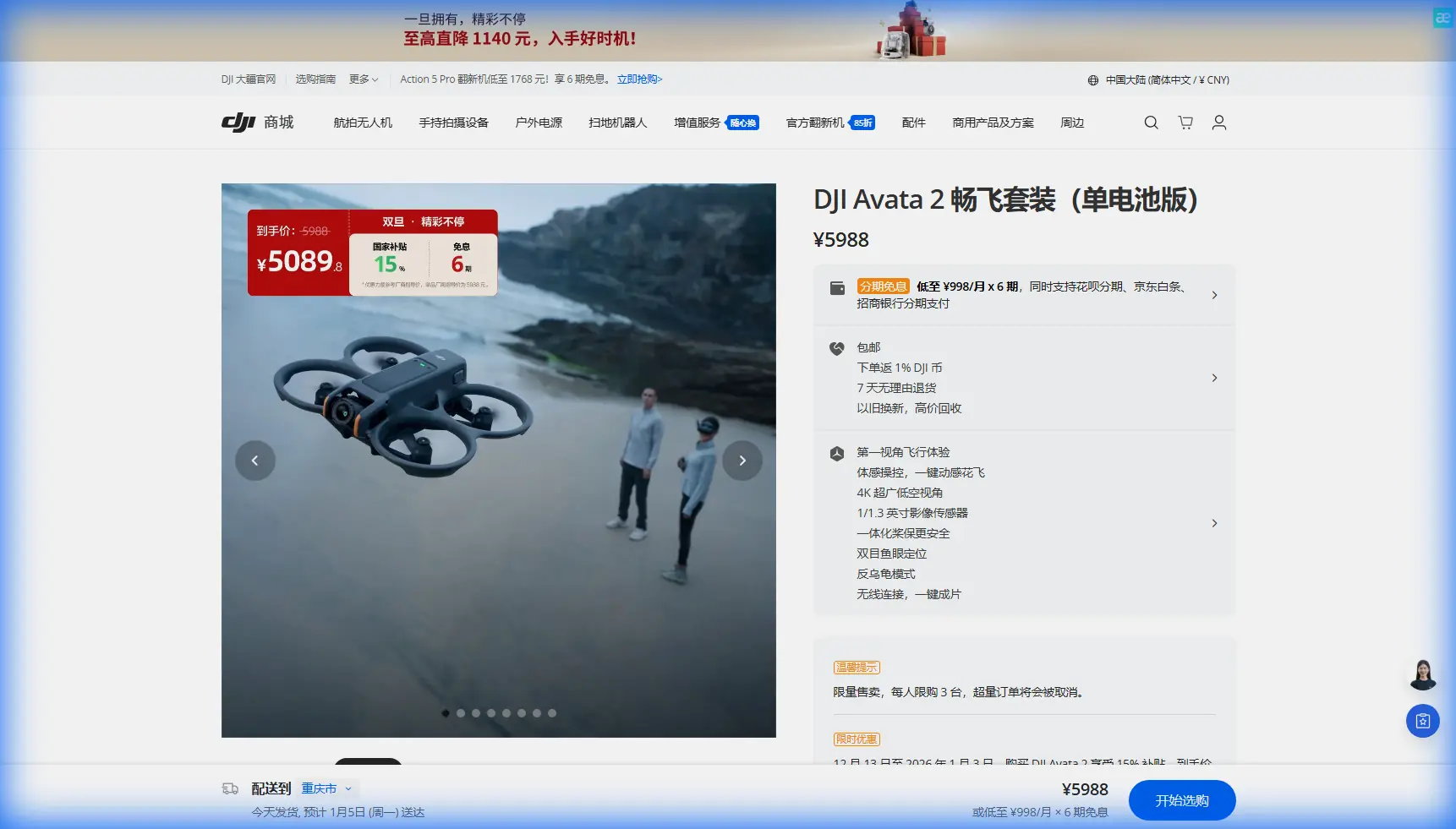
Highway scouting sounds simple until the environment starts fighting back. Dust lifts off shoulders and median strips. Heat shimmer distorts the scene ahead. Long corridors create a false sense of safety, yet poles, cables, signs, overpasses, and moving vehicles stack risk into every pass. In that setting, the appeal of Avata 2 is obvious: compact FPV handling, immersive situational awareness, strong stabilization, and an imaging pipeline that can deliver footage useful for review rather than just excitement.
But to judge whether Avata 2 is genuinely suitable for this kind of work, it helps to look past the product page and think like an aircraft designer. The reference material behind this piece is not a marketing brochure. It points back to a control-theory lineage: research comparing PID and LQ control techniques for indoor micro quadrotors at IROS 2004, work on backstepping and sliding-mode control presented at ICRA 2005, and studies on visual-feedback control from ICRA 2002. There is also a thread on real-time inertia tensor parameter identification using adaptive control, plus later work on flight-control parameter optimization through advanced estimation methods.
That matters more for Avata 2 highway scouting than most operators realize.
Why old control research still matters to a modern FPV drone
A drone in dusty roadside air is constantly being pushed out of trim. Small gusts roll the aircraft. Turbulence coming off trucks changes yaw behavior. Fine particulate can reduce visual clarity, making precise manual correction harder for the pilot. In that environment, stability is not a luxury feature. It is the reason a scouting run remains readable and repeatable.
The older quadrotor papers referenced in the source material dealt with a foundational problem: how do you keep a small rotorcraft controllable when the system is highly coupled, light, and easily disturbed? Comparing PID with LQ control was never just an academic exercise. It was an early effort to understand how different control philosophies behave when an aircraft needs to recover quickly and smoothly from disturbances. For a platform like Avata 2, the operational takeaway is straightforward: a drone that feels “locked in” during line inspection or roadside scanning is the product of control tuning that prioritizes fast correction without turning the aircraft twitchy or exhausting the pilot.
The same goes for the backstepping and sliding-mode work cited from 2005. Those methods are associated with handling nonlinear dynamics and maintaining robustness when conditions are messy. Dusty highway corridors are messy. You do not need to know the equations to feel the result. If Avata 2 can absorb little jolts from crosswind and still let you frame lane edges, barriers, drainage channels, and sign structures in one flowing pass, that is control theory doing real work.
Avata 2’s best role in highway scouting
Avata 2 is not the aircraft I would choose for every infrastructure mission. If the job is broad-area corridor mapping over many kilometers, a larger platform built for endurance and survey repeatability may be the better match. If the assignment is close-range visual scouting in constrained spaces, though, Avata 2 starts making a lot of sense.
Its strongest fit is fast, low-to-moderate altitude reconnaissance where the client needs to quickly identify:
- shoulder erosion
- barrier damage
- blocked drainage
- vegetation encroachment
- debris zones
- access-road conditions
- worksite staging conflicts
- signage visibility issues under real traffic conditions
This is especially true when the site has overpasses, embankments, cut slopes, or service roads that make ground inspection slow and fragmented. Avata 2 gives the operator a more intuitive sense of forward space than many conventional camera drones, which can be valuable when tracing a road segment and checking how one feature leads into the next.
The altitude insight that actually works in dusty highway conditions
For this scenario, the most useful starting altitude is usually 8 to 15 meters above the roadway edge or shoulder reference, not directly over active traffic lanes unless the operation plan specifically allows it and local rules are satisfied.
Why that band?
Too low—say around 3 to 5 meters—and the aircraft spends more time inside the worst dust plume layer kicked up by passing vehicles, especially near unpaved pull-offs, maintenance cuts, and dry shoulders. At that height, visibility and lens cleanliness degrade quickly. The pilot also has less time to react to signposts, guardrail transitions, and unexpected updrafts from vehicle wake.
Too high—say 20 meters and above for detailed scouting—and the mission starts losing the very thing Avata 2 does best: immersive, close-perspective detail. Fine surface clues become less legible. Small shoulder failures can flatten into the background. You also reduce the value of obstacle sensing in a task where spatial awareness around fixed structures matters.
The 8 to 15 meter range tends to balance three competing needs:
- Cleaner air than the lowest dust zone
- Enough detail density to spot practical maintenance issues
- Reasonable reaction margin around signs, barriers, poles, and overpass edges
When dust is severe, I would push toward the upper side of that band and offset laterally from the dirtiest shoulder line. If the goal is drainage or crack-edge observation rather than corridor context, dip lower for short segments, then climb back out before the plume builds on the lens.
This is where the visual-feedback ideas from the reference material become relevant. The cited 2002 work on visual feedback control reflects a long-standing truth in small UAVs: the quality of what the aircraft “sees,” and how that visual information supports control, can define practical mission performance. In highway dust, visibility is not just a camera issue. It affects confidence, tracking, obstacle perception, and pilot decision-making.
Obstacle avoidance is useful here, but don’t treat it as a dust shield
Avata 2’s obstacle avoidance capability is helpful in roadside work, especially when moving through areas with sign gantries, utility runs, retaining structures, and irregular terrain transitions. Still, dusty highway scouting exposes a limit that experienced operators already know: obstacle systems are excellent assistants, not substitutes for route discipline.
Dust can soften contrast and reduce the crisp visual cues that any perception system likes. Add changing sunlight, shadows under overpasses, and fast background motion from traffic, and the safest approach is to build the flight around predictable geometry. Fly a consistent offset from the roadway. Keep your lane of travel clean. Use altitude changes deliberately rather than continuously surfing the terrain at low level.
That operational style aligns with the control-research thread in the source data. One of the cited areas is real-time parameter identification of the inertia tensor using adaptive control. In plain terms, adaptive thinking in flight control is about compensating when the aircraft’s effective behavior is not perfectly known or is being disturbed. Dust, small turbulence bursts, and constant pilot corrections all add uncertainty. A drone that remains composed helps, but the mission is still won by reducing unnecessary variables.
ActiveTrack, subject tracking, and why they are secondary on highways
The context hints mention Subject tracking and ActiveTrack, and they do have a place. For example, if a maintenance convoy or survey vehicle needs to be documented moving through a work zone, tracking can provide useful continuity. But on a dusty highway, I would treat tracking features as secondary to manual route control.
There are two reasons.
First, the subject itself may generate the dust that degrades visual consistency. Second, a highway environment contains many competing moving objects. A road is not a clean trail in a forest or an isolated open field. It is a layered motion scene with vehicles, shadows, reflective surfaces, and intermittent obstructions.
A better use of Avata 2 in this setting is often to fly planned observation lines and use tracking only for short, low-complexity segments where the background is controlled. That gives you footage with stronger review value later. If the task is engineering-oriented, consistency beats flashy automation.
QuickShots and Hyperlapse: useful, but only if the client needs context
Many operators ignore the fact that highway clients can have two very different needs. One is defect spotting. The other is communication. A maintenance contractor, civil consultant, or project stakeholder may need a concise visual explanation of site conditions, access limitations, or sequencing challenges.
That is where QuickShots and Hyperlapse can be practical tools rather than recreational extras.
A Hyperlapse from a safe elevated offset can reveal traffic flow interaction with a shoulder closure or show how dust accumulates in a recurring trouble zone during peak vehicle movement. QuickShots can establish spatial context around an interchange, culvert entry, retaining wall, or embankment toe before the detailed scouting pass begins.
The trick is not to let those modes dominate the mission. Avata 2 earns its place in highway scouting by making the technical pass efficient. Context shots are supporting material.
D-Log is worth using if the footage will be reviewed seriously
The context also points to D-Log, and this is one of the smarter choices for dusty daytime work. Dusty scenes often create a tonal problem: bright sky, reflective surfaces, pale soil, and shadow under structures all live in the same frame. Standard profiles can make the image feel crisp at first glance but clip useful information or harden contrast where you later need to inspect detail.
If the footage is headed into a reporting workflow, D-Log gives more flexibility to recover balance between bright and dark regions and preserve the subtle texture that shows sediment build-up, edge fraying, or grading inconsistency. For teams that compare multiple site visits over time, a disciplined color workflow is not vanity. It improves interpretability.
What Avata 2 does especially well in this mission profile
Avata 2 stands out when the assignment calls for human-readable reconnaissance rather than pure survey data. That distinction matters. A lot of highway scouting decisions are made from visual patterns: where runoff starts to undermine the shoulder, how sight lines are blocked by temporary materials, whether a guardrail transition looks compromised, how a service road meets the main corridor, where dust itself is being generated.
The aircraft’s FPV character helps the operator understand these patterns as a connected space rather than isolated stills. That can shorten the path from “we have footage” to “we know what needs checking on the ground.”
Its limitations are just as real. Heavy dust is still a contamination risk. Shorter-duration close reconnaissance is usually a better fit than extended corridor coverage. And because road environments are dynamic, pilot discipline matters more than mode selection.
A practical flight template for dusty highway scouting
If I were setting up Avata 2 for this kind of work, I would build the mission in three layers:
1. Establishing pass
Fly at roughly 12 to 15 meters on a lateral offset from the shoulder. Capture broad context, identify obstacles, watch dust behavior, and mark areas needing closer review.
2. Detail pass
Drop to about 8 to 10 meters where specific features need inspection: drainage inlets, barrier lines, shoulder breaks, cut-slope edges, or access points. Keep segments short to reduce lens fouling and maintain safety margin.
3. Communication pass
If needed, capture one context move using Hyperlapse or a restrained automated shot to help non-technical stakeholders understand the site geometry and operational constraints.
If your team is refining this workflow or comparing setups for corridor inspection, I’d suggest messaging our UAV specialists here to discuss the mission profile in practical terms.
The real verdict
Avata 2 is not just interesting because it is agile. It is interesting because agile flight becomes useful when backed by mature control thinking. The reference material behind this discussion points to the core ingredients that still define competent small-UAV behavior today: stable control under disturbance, visual-feedback awareness, adaptive handling, and parameter optimization. Those are not abstract research themes when you are flying along a dusty highway shoulder trying to produce footage people can act on.
For this job, Avata 2 works best as a close reconnaissance platform flown with intent. Keep the altitude mostly in the 8 to 15 meter range, favor clean offsets over dramatic proximity, use obstacle avoidance as support rather than a crutch, and record in D-Log when the output needs serious review.
That is where the aircraft stops being a fun FPV tool and starts becoming a credible scouting instrument.
Ready for your own Avata 2? Contact our team for expert consultation.