
Avata 2 for Coastal Power Line Scouting: What Actually
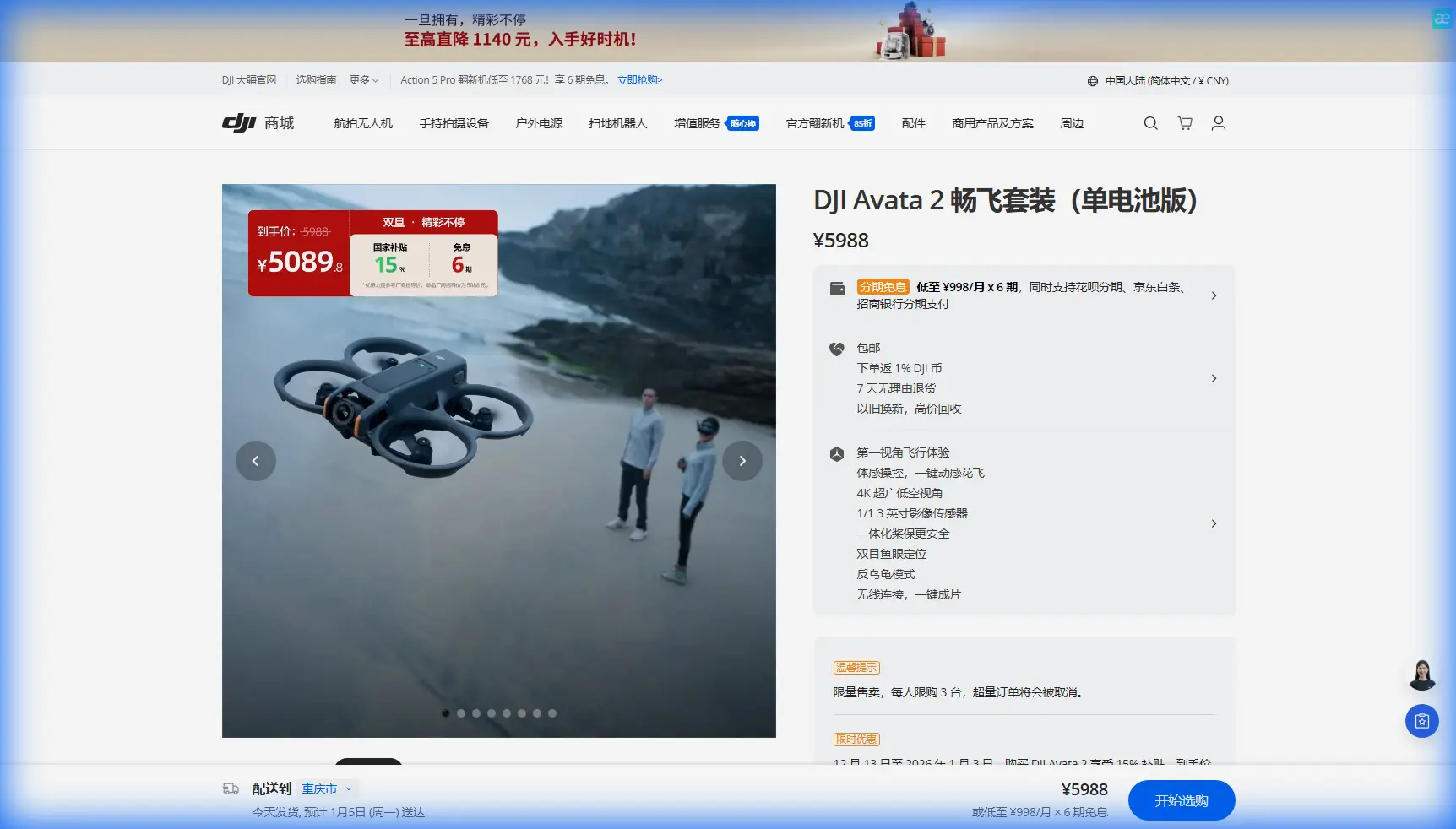
Avata 2 for Coastal Power Line Scouting: What Actually Matters in the Field
META: A practical look at using DJI Avata 2 for coastal power line scouting, with emphasis on obstacle avoidance, low-altitude situational awareness, D-Log footage, and workflow decisions that matter in salt-air environments.
Coastal power line scouting is awkward work for most drones.
The route is rarely clean. You’re dealing with shifting wind coming off the water, reflective surfaces, gullies, poles, guy wires, scrub, access roads, and the constant visual clutter that makes line-following harder than it looks on a spec sheet. Add salt air, changing light, and wildlife moving through the corridor, and the gap between “can fly” and “can inspect usefully” gets wide very quickly.
That’s the context where the Avata 2 becomes interesting.
Not because it replaces a dedicated enterprise inspection platform across every mission. It doesn’t. The real value is more specific: it gives field teams a compact FPV aircraft that can scout complex coastal corridors, slip into visually tight approaches, and produce footage that is actually useful for pre-inspection planning, training, and route familiarization. When used well, it helps crews understand the terrain and line environment before they commit heavier equipment or people to the site.
I’ve seen this become especially relevant on coastal power assets where the first challenge is not thermal analysis or close-detail component diagnosis. It’s simply understanding access, exposure, vegetation pressure, pole spacing, and the visual rhythm of the line through uneven terrain. In those situations, the Avata 2 can do something many conventional camera drones struggle to do elegantly: move with intent through the corridor while keeping the operator immersed in the route.
The real problem with coastal scouting
On paper, power line scouting sounds straightforward. You launch, follow the route, record footage, identify concerns, and hand that information to the asset team.
In practice, coastal routes punish lazy assumptions.
Wind is never just “wind.” It curls around dunes, cuts across clearings, accelerates between embankments, and changes character near cliff edges or marsh openings. Light is also unstable. Morning haze can flatten detail, while midday glare off water or wet ground can hide the depth cues pilots rely on. Then there’s the vegetation. Coastal growth often creates irregular, narrow visual channels around poles and lower conductors. That means route scouting is not only about seeing the line. It’s about understanding the line inside its environment.
This is where an FPV-style aircraft earns its keep.
The Avata 2’s core advantage in this scenario is not raw sensor size or broad-area mapping efficiency. It’s controllable proximity and situational awareness. For scouting teams, that changes the type of information you can collect. Instead of broad, detached overhead passes, you can build an eye-level understanding of how a line corridor behaves from one span to the next.
That matters operationally. A maintenance planner doesn’t just need images of infrastructure. They often need to know whether a vehicle can approach safely, whether vegetation is encroaching on a work zone, whether a pole line enters a gust-prone gap, or whether an upcoming section will force a different aircraft or crew setup.
Why obstacle handling matters more here than in open terrain
A lot of drone discussions treat obstacle avoidance as a convenience feature. Along coastal utility corridors, it’s a workload feature.
The Avata 2 is widely recognized for helping pilots manage movement in tighter, more dynamic spaces, and that matters when the job is route intelligence rather than cinematic freedom. Around power corridors near the coast, the aircraft may be passing beside brush lines, terrain contours, service tracks, fencing, and occasional structures that create conflicting visual references. Any system that reduces collision risk and stabilizes pilot decision-making has immediate operational value.
There’s another layer to this. Coastal scouting is often not a one-pass mission. Teams revisit routes after storms, tidal changes, vegetation growth, or maintenance cycles. Consistent, cautious flight behavior becomes more useful than aggressive flying. Obstacle-aware operation supports repeatable corridor reviews, which is exactly what asset managers need when comparing conditions over time.
And yes, wildlife changes the equation too.
On one coastal line scout, a pair of white-bellied sea eagles lifted from a stand of trees near the corridor edge just as the aircraft rounded a scrub-covered bend. That kind of encounter can go bad fast if the pilot is overloaded or flying a platform poorly suited to controlled low-level maneuvering. The value of the Avata 2 in that moment wasn’t some flashy automated trick. It was that the aircraft’s controlled, close-in handling and environmental awareness allowed a clean retreat path without turning the encounter into a chaotic overcorrection. In wildlife-sensitive areas, that kind of margin is not a luxury. It’s part of responsible flight planning.
The FPV view is not just about excitement
There’s a tendency to treat FPV aircraft as cinematic toys or training machines. That misses the point for industrial scouting.
For coastal power line work, immersion helps the operator read the route as a continuous spatial problem. You’re not looking at disconnected stills. You’re interpreting line geometry, surrounding vegetation, lateral clearances, terrain approach, and access constraints in motion. That makes the Avata 2 particularly useful for first-look scouting before a fuller inspection package is deployed.
Think about a line segment running parallel to the shoreline before cutting inland through low trees. A standard hover-and-pan approach may show the structures, but it often fails to communicate the corridor’s practical feel. The Avata 2 can reveal how the route narrows, where crosswinds bite, how access roads break away, and where crews may lose visual simplicity. Those are planning insights, not just pretty visuals.
This is also where subject tracking ideas such as ActiveTrack-adjacent workflow thinking can be misunderstood. In utility scouting, the goal is not to “follow” infrastructure the way a consumer pilot tracks a cyclist. The useful takeaway is different: intelligent motion tools and stabilized route-following behavior can reduce pilot strain during repetitive corridor observation. Even when teams are not relying on automated tracking as a primary method, the broader philosophy of assisted flight helps maintain consistency and frees attention for route interpretation.
D-Log is more useful than many scouting teams realize
A common mistake in drone scouting is treating image quality as secondary because “it’s just a recce flight.” That mindset usually creates problems later.
The Avata 2’s D-Log recording capability matters because coastal environments are contrast-heavy. You can have bright water, pale sky, dark vegetation, weathered timber, and shadowed hardware all in the same scene. If your footage clips highlights or crushes detail, your planning material becomes less reliable. D-Log gives teams more room in post to recover a balanced view of the corridor.
That’s not only an editor’s concern. It has operational significance.
When reviewing footage for maintenance planning, route risk assessment, or internal reporting, it helps if the video preserves enough tonal information to show vegetation density, ground texture, access washouts, and the silhouette of line hardware against a bright background. Better grading latitude can make the difference between “we think this area is manageable” and “we can clearly see the approach hazard.”
For creators working inside utility-adjacent documentation, D-Log also improves continuity across changing light. Coastal sorties often start under one sky condition and end under another. Having flexible footage means the final review package is easier to normalize, annotate, and compare.
QuickShots and Hyperlapse are not just creative extras
On a pure inspection brief, QuickShots and Hyperlapse may sound irrelevant. They aren’t always.
Used selectively, they can support communication with stakeholders who are not drone specialists. A short, controlled establishing sequence can show how a problematic span sits relative to shoreline erosion, access roads, or adjacent vegetation. A Hyperlapse sequence can summarize weather movement, traffic near access areas, or changing site visibility across a scouting window. Those outputs are not replacements for disciplined manual flight. They are communication tools.
The point is to make technical conditions legible to non-pilots.
Utility managers, environmental consultants, and contractors often need a quick visual summary before committing time and resources. When a short automated sequence helps explain why a section needs special attention, it has done a legitimate job. The key is restraint. Use these tools to clarify context, not to dress up routine footage.
Where the Avata 2 fits in a sensible workflow
The best use of the Avata 2 in coastal power line operations is as an early-stage scout and route interpreter.
A practical workflow often looks like this:
First, use the aircraft to assess corridor character: access paths, vegetation pressure, terrain constrictions, visible obstructions, and environmental sensitivity. Second, capture route footage that can be reviewed by planners and pilots before a larger inspection mission. Third, document any sections where conditions suggest a different aircraft, different launch point, or additional ground support.
That sequence keeps the platform in a role it performs well.
It is especially strong when teams need to understand spaces that are visually tight, awkward to access, or too dynamic for a broad, detached overview to tell the whole story. Along the coast, that can include line segments near dunes, bluffs, salt marsh edges, drainage crossings, and irregular service tracks.
If a team needs a second opinion on how to set up that kind of operation, a direct field conversation often saves more time than endless gear comparisons. In that spirit, you can message the operations desk here and talk through the route profile before you send a crew.
Limitations are part of the value discussion
A serious article should say this plainly: the Avata 2 is not the answer to every power line task.
If the mission requires specialized close-detail asset diagnosis, highly formalized inspection data collection, or sensor payloads beyond visual scouting, other platforms are better suited. Coastal utility work can also involve conditions that make any small aircraft less effective, especially when wind and salt exposure intensify.
But that does not reduce the Avata 2’s value. It defines it.
Its strength is in the gap between a simple site visit and a full inspection deployment. It helps teams see the route in a usable way. It improves training for pilots learning corridor behavior. It creates reviewable footage that can support planning and communication. And because the aircraft is compact and agile, it can often make sense on jobs where carrying a larger system into the field would be inefficient.
For training teams, this matters even more. Newer pilots can use Avata 2 scouting flights to understand corridor spacing, obstacle reading, and visual discipline without assuming that every utility mission begins as a close-proximity technical inspection. That distinction produces better habits. The pilot learns to observe first, diagnose second.
What I would pay attention to before deploying one on a coastal line scout
Not the marketing checklist. The actual field questions.
How exposed is the route to lateral gusts? Where are the likely bird activity zones? Are there reflective water sections that may distort depth perception at certain sun angles? Which spans matter most to planners, and what exact decision should the footage support? Are you scouting access, vegetation, structure context, or all three? Is your output intended for technical review, pilot briefing, stakeholder communication, or training?
The Avata 2 performs best when those answers are defined in advance.
If your goal is simply “get some footage of the line,” you’ll probably return with something visually impressive and operationally thin. If your goal is “document corridor behavior from launch point A to pole group D, identify access barriers, highlight vegetation encroachment, and produce gradeable footage for a planning review,” the aircraft starts to show real professional value.
That is the difference between flying a drone and using one properly.
Along coastal power routes, the Avata 2 stands out not because it turns scouting into a spectacle, but because it lets teams move through a difficult environment with control, awareness, and enough image quality to make the flight count after landing.
Ready for your own Avata 2? Contact our team for expert consultation.