
Avata 2 Field Report: What Happened When Mountain Weather
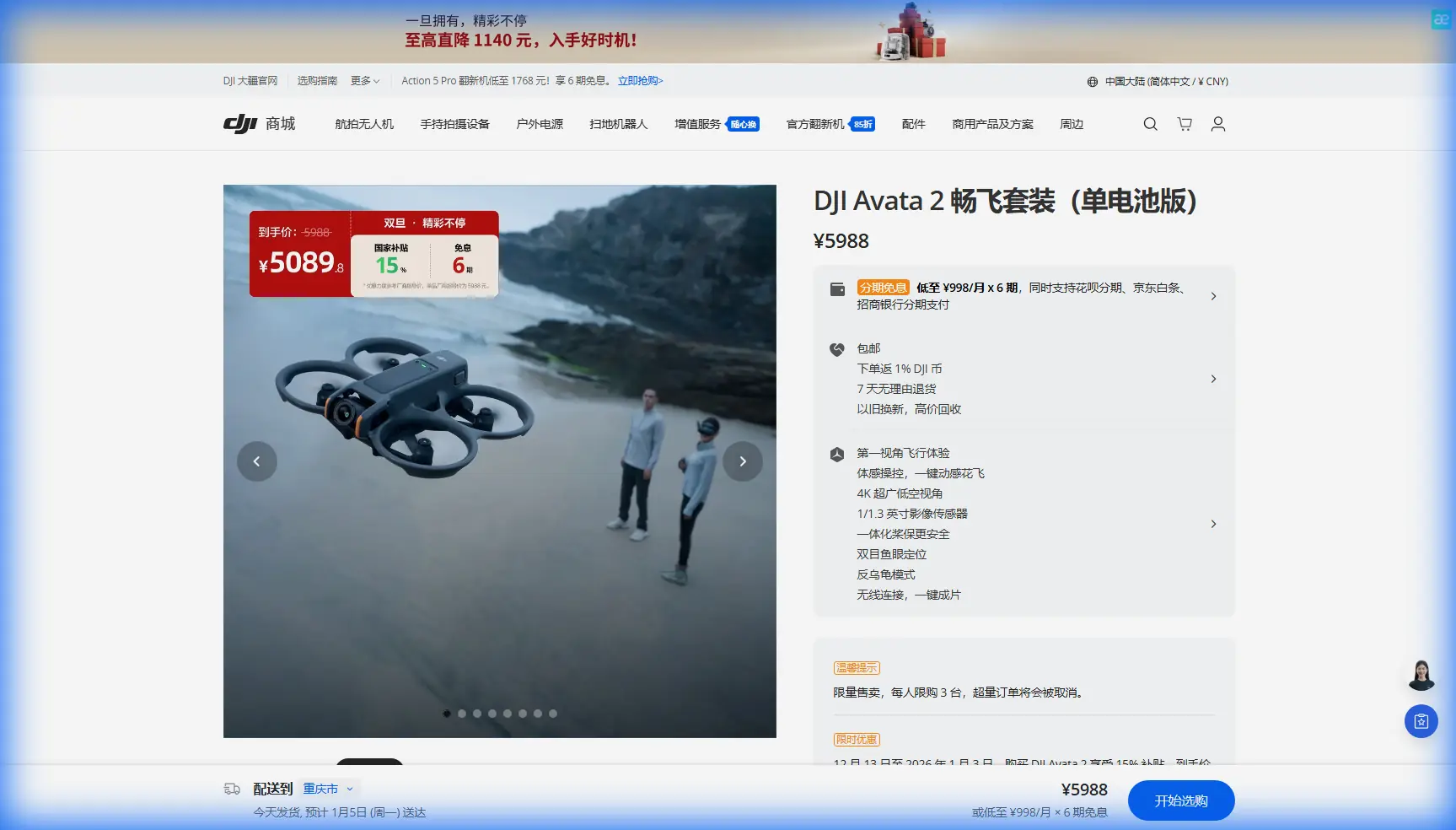
Avata 2 Field Report: What Happened When Mountain Weather Shifted Over a High-Altitude Farm
META: A field-style expert report on using DJI Avata 2 around high-altitude farmland, with practical notes on wind, obstacle avoidance, D-Log capture, ActiveTrack limits, and changing weather.
I took the Avata 2 into a high-altitude agricultural setting with one question in mind: not whether it could spray fields—it cannot and should not be treated as an agricultural spraying platform—but whether it could play a useful support role around spraying operations when the terrain is steep, the air is thinner, and the weather refuses to stay put.
That distinction matters.
A lot of people arrive at the Avata 2 because they want a small, agile aircraft for difficult environments. Then they look at hillside farms, orchard edges, terraced plots, or mountain-access fields and start asking if this compact FPV drone can help. The answer is yes, but not in the way a dedicated ag drone helps. The Avata 2 is better understood as a fast visual tool for route preview, edge inspection, terrain awareness, and communication footage around the operation. In high-altitude field work, those jobs can be more valuable than they sound on paper.
This report is based on that exact kind of day.
The setup: farmland, elevation, and a tight weather window
The location was a highland farm area where the fields sat unevenly across sloped ground with scattered trees, utility lines, irrigation hardware, and a few narrow access paths cut into the terrain. Conditions in these places rarely stay static. The air can be calm at one end of a field and unsettled at the other. Even when the sky looks open, the ridgeline tends to manufacture its own surprises.
That is where the Avata 2 immediately makes sense. Its ducted design and compact footprint are not just aesthetic differences from a conventional camera drone. They change how close you can work to obstacles and how confidently you can explore awkward field margins, especially where branches, posts, sheds, retaining walls, and wire fencing create a cluttered environment.
For agricultural teams working at altitude, this kind of aircraft is not replacing a heavy-lift sprayer. It is giving the crew a quick way to read the field before committing larger equipment, and a safer way to document access lanes, wind exposure points, runoff channels, and crop-edge risks.
Why Avata 2 fits support work better than people expect
The Avata 2 has a very different personality from survey-first platforms. It is nimble, immersive, and built around controlled movement through space rather than static top-down measurement. That may sound like a limitation for farm work, but in mountain terrain it becomes an advantage.
You are not always trying to create a perfect orthomosaic. Sometimes you need to fly the contour of a terraced edge, slip along a tree line, examine whether a sprayer approach path is partially blocked, or verify whether workers can safely reach a corner plot without crossing a muddy drainage cut. That is where obstacle awareness and controlled proximity are operationally significant.
Obstacle avoidance is often discussed as a convenience feature. In this environment, it is closer to a workflow feature. Around high-altitude fields, where visual clutter piles up quickly, the system gives the pilot more margin when moving through irregular spaces. It does not remove the need for judgment, and it should never be treated as permission to fly carelessly near wires or foliage. But it does reduce the mental load in complex spaces, which helps when weather starts changing and your attention needs to widen.
The same goes for return planning. In thin air and variable wind, every support drone flight should be treated as a short mission with a clean exit. The Avata 2 is most useful when flown with that mindset.
Mid-flight, the weather turned
The day’s most useful lesson came about halfway through a low pass along the upper edge of the fields.
The first minutes were stable. The aircraft tracked cleanly along the slope, and the live view made it easy to identify standing water in one section where a spraying vehicle would likely lose efficiency. Then the wind shifted. Not dramatically at first—just enough to show up as a different feel in the aircraft’s hold and heading corrections. A minute later, the light flattened, cloud cover rolled in from the ridge, and the field changed character.
That is the reality of high-altitude work. The weather rarely “arrives” all at once. It builds in layers.
This is where the Avata 2 handled itself better than many new pilots expect, provided the operator stayed disciplined. The compact frame and FPV format can tempt people into flying aggressively to beat the weather. That is exactly the wrong response over farmland with obstacles. The better approach was to widen the line, keep the drone out of turbulence generated by trees and structures, and stop trying to squeeze cinematic proximity out of a working flight.
The aircraft remained usable because the pilot shifted the mission goal. Instead of pushing deeper into the field edge, I turned the remainder of the flight into a weather-read pass: watching crop movement, checking dust drift near the access lane, and verifying whether the lower plot was seeing the same wind behavior as the exposed upper terraces.
That gave the crew something practical. It confirmed that conditions were diverging by elevation inside the same farm area. If you are planning any aerial agricultural task at altitude, that is a real operational point, not a cinematic footnote.
What ActiveTrack and subject tracking can—and cannot—do here
People often ask whether ActiveTrack or subject tracking can simplify farm support flights. Sometimes, yes. But this is where context matters.
If you are following a ground vehicle along an open farm road, tracking tools can help generate visual oversight and training footage with less manual camera management. They are also useful when documenting how a team moves through a complicated site, especially if the goal is later review, safety debriefing, or showing a client how access routes affect timing.
But in high-altitude agricultural terrain, autonomous tracking has limits. Terraces, poles, netting, uneven canopy height, and sudden contrast changes from cloud cover can all complicate the scene. Tracking should be treated as an assistive option, not as a substitute for active piloting. The Avata 2’s value is not that it lets you stop thinking. Its value is that it gives you a more intimate view of dynamic spaces while preserving enough stability and intelligence to make that view usable.
That distinction is especially important when weather changes mid-flight. Subject tracking can become less reliable when visibility, background separation, or movement patterns shift. A human pilot who recognizes those changes early is still the decisive factor.
D-Log, field footage, and why image flexibility matters on working farms
One of the more overlooked strengths of using an Avata 2 in a farm support role is how useful D-Log can be when conditions go sideways.
When sunlight disappears behind passing cloud on a mountainside, the contrast profile of the scene changes fast. Bright reflective surfaces such as wet leaves, irrigation pipe, standing water, and light soil can break apart visually if your footage has no room for grading. D-Log gives more flexibility in those mixed conditions. That is not just a benefit for filmmakers. It matters when footage is being used to review site conditions, explain operational delays, or compare one section of a field against another after the flight.
The point is not to create “pretty” footage. The point is to preserve usable information.
On this flight, once the cloud thickened, the flatter image profile helped maintain detail in the darker vegetation zones while holding the brighter portions of the field. For anyone documenting crop edge condition, access hazards, runoff, or wind effects, that extra post-production control can make the difference between a clip that merely looks dramatic and one that actually supports a decision.
QuickShots and Hyperlapse are not just creative extras
QuickShots and Hyperlapse tend to get dismissed in working environments as consumer-facing tools. That is too simplistic.
Used carefully, they can support communication. A short automated establishing sequence can show the layout of a farm section before a manual low-altitude pass begins. A Hyperlapse sequence can compress weather movement over a ridge or show how fog, cloud, or shadow advances across a work area. On a high-altitude farm, that is not trivial information. It can help explain why one block was suitable for treatment earlier in the day and another was not.
The caveat is obvious: do not prioritize automation over situational awareness. Around agricultural structures and uneven terrain, the mission always comes first. But if you already have a safe window and a clear area, these modes can create reference material that is genuinely useful for planning and reporting.
The practical role of Avata 2 around spraying operations
To be clear, the Avata 2 is not a crop sprayer. It is not designed to carry liquid payloads or execute pesticide application. Anyone searching for “spraying fields with Av2” needs to separate support operations from application operations.
Where it helps is before, during, and after those tasks:
- Pre-flight inspection of terrain and access
- Checking for new obstacles near field edges
- Reviewing drift exposure zones on ridgelines
- Documenting worker routes and vehicle approach paths
- Capturing visual records of weather and field condition changes
- Producing training footage for teams operating in difficult topography
In mountain agriculture, support information has high value because errors are expensive in time, labor, and safety margin. A five-minute recon flight that reveals stronger-than-expected wind on an upper terrace can save a lot more than battery time.
What stood out most from the day
The strongest takeaway was not speed, image quality, or even agility. It was adaptability.
The Avata 2 worked because the pilot changed objectives as the environment changed. That is the real skill in high-altitude farm flying. The drone’s obstacle handling, compact design, and intelligent features gave options, but they did not replace decision-making. When the weather shifted mid-flight, the aircraft remained useful because it was being used as a field-reading instrument, not as a rigid mission machine.
That mindset also keeps expectations realistic. If your operation requires payload, precision application, or large-area treatment, you need a proper agricultural aircraft. If your need is fast visual understanding in complicated terrain, the Avata 2 becomes surprisingly relevant.
Tips I would give any operator taking Avata 2 to a high-altitude farm
Start with the weather, not the shot list. Ridge wind and cloud movement should decide your route.
Fly support missions short. In mountain environments, the best reserve is the one you never needed.
Do the exposed sections first. Lower sheltered areas can usually wait; upper edges may change first.
Treat obstacle avoidance as a safety layer, not a guarantee. Branches, wires, and irregular farm infrastructure still demand conservative flying.
Use D-Log if the light looks unstable. Mountain weather can turn contrast ugly in minutes.
Be careful with ActiveTrack around cluttered farm geometry. If the scene gets messy, take back full manual responsibility.
Capture one wide context pass before diving low. It helps later when reviewing where wind, moisture, or access issues were actually located.
If you want to compare notes with operators who use compact FPV drones in tough field environments, I’d suggest messaging here for a direct discussion.
Final assessment
The Avata 2 earns its place around high-altitude agricultural work not by pretending to be a sprayer, but by doing something many larger systems do poorly: giving the operator a fast, close, highly readable view of terrain under changing conditions.
On the day I flew it, the weather did exactly what mountain weather likes to do. It changed the assignment while the aircraft was already in the air. The Avata 2 handled that moment well because it stayed controlled, readable, and useful when the mission shifted from inspection to interpretation.
That is the real advantage. Not spectacle. Not gimmicks. A small FPV platform that can help a field team see more clearly when the environment starts rewriting the plan.
Ready for your own Avata 2? Contact our team for expert consultation.