
Surveying Mountain Power Lines With DJI Avata 2
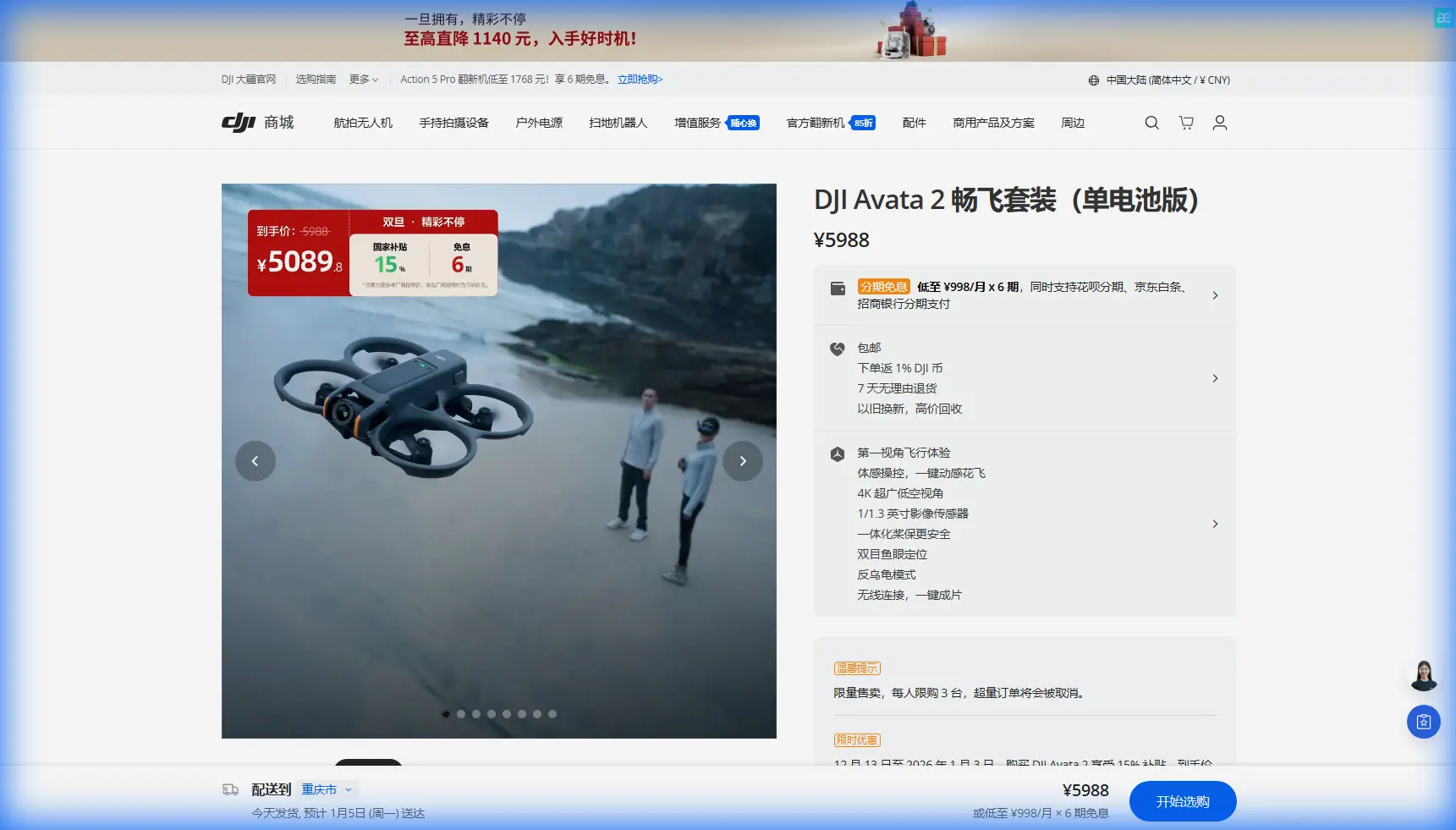
Surveying Mountain Power Lines With DJI Avata 2: A Technical Review for Real-World Inspection Work
META: A practical technical review of DJI Avata 2 for mountain power line surveys, covering obstacle avoidance, image workflow, flight handling, D-Log M, tracking limits, and where it outperforms larger inspection drones.
Mountain power line inspection is one of those jobs that looks straightforward on paper and becomes complicated the moment you reach the slope. Wind tunnels form around ridgelines. Tree cover blocks your line of sight. Terrain changes fast enough that altitude management stops being a background task and becomes the task.
That is exactly where the DJI Avata 2 becomes interesting.
Not because it replaces a dedicated utility inspection platform in every scenario. It does not. If your mission requires long-range corridor mapping, interchangeable zoom optics, or high-end thermal payloads, you are looking at a different class of aircraft. But if the job is to move through broken terrain, get close visual context around poles, insulators, and conductor clearances, and do it with a smaller FPV platform that can thread through tight geography, the Avata 2 deserves a serious look.
This article focuses on a specific use case: surveying power lines in mountain environments. That means less lifestyle talk, less generic drone hype, and more about how the aircraft behaves when terrain and infrastructure force you to fly precisely.
Why Avata 2 makes sense in the mountains
The first thing that separates Avata 2 from many conventional camera drones is its flight character. It is built around immersive, close-range flight rather than high-hover photography. For power infrastructure in steep terrain, that changes how you inspect.
A traditional foldable camera drone often excels when you can stop, hold, zoom, and capture from a safe standoff distance. In mountain corridors, you do not always get that luxury. Trees may block your approach. Conductors may run alongside rock faces. Utility structures can sit in awkward pockets where the safest path is not a direct one but a curved, terrain-following route. Avata 2’s compact FPV-style platform is well suited to this kind of pathing.
That matters operationally because inspections are not just about image quality. They are about access. A drone that can safely work through narrow approach lines can reveal angles a larger aircraft may avoid, especially near vegetation, terrain breaks, and lower-level infrastructure elements.
The integrated propeller guards are part of that equation. For mountain utility work, they are not a cosmetic feature. They increase confidence when flying near branches, rocky outcrops, and crossarms, where a minor brush would be mission-ending for many unprotected aircraft. No responsible pilot should plan to hit anything, but field reality is messy. Extra physical resilience has practical value.
Obstacle sensing is useful, but not a substitute for inspection discipline
One of the most relevant features for this use case is obstacle awareness. In mountain environments, situational complexity comes from several directions at once: trunks and branches on one side, slope rise on the other, and utility hardware ahead. Avata 2’s obstacle sensing and positioning aids help smooth low-altitude navigation and reduce the workload during careful approach segments.
The operational significance is simple. When you are inspecting power lines along uneven terrain, pilot attention is divided between aircraft attitude, lateral spacing from the line, terrain closure, and image composition. Any system that lowers basic collision risk helps preserve attention for the inspection task itself.
That said, utility infrastructure is a poor place for overconfidence. Thin wires are historically difficult for many drones’ sensing systems to interpret consistently. Mountain sun angles, shadow bands, and high-contrast backgrounds only make this harder. So while obstacle avoidance is an advantage, the best workflow is still conservative: inspect from offset angles, maintain generous standoff, and treat sensing as a backup rather than your primary protection layer.
This is one area where Avata 2 compares well against simpler FPV aircraft. Many FPV platforms are agile but ask the pilot to manage almost everything manually. Avata 2 gives you much of that agile access while adding safety logic that is genuinely useful for slower, deliberate commercial flying. For infrastructure teams moving into FPV-assisted inspection, that is a meaningful edge.
Why the image pipeline matters more than people expect
Power line surveys in mountains are often judged by whether the footage can support later decision-making, not just whether the pilot completed the route. That is where Avata 2’s recording options matter.
D-Log M is especially relevant here. Mountain inspections routinely involve extreme contrast: bright sky, reflective conductors, dark tree cover, and shaded hardware under crossarms. A flatter profile gives you more flexibility to recover highlights and lift shadows in post without immediately breaking the image. If you are documenting component condition or corridor encroachment for engineering review, preserving tonal detail is not just a creative benefit. It can make footage more useful for actual assessment.
This is one of the most practical distinctions between recreational capture and inspection capture. A standard profile may look punchier straight out of the aircraft, but a log workflow often holds up better when you need to study details under inconsistent lighting. On steep slopes, where one second of footage is sunlit and the next drops into dense shadow, that extra grading latitude becomes noticeable.
You also have the benefit of high-frame-rate capture options on the platform, which can help when reviewing fast pass-bys around hardware. Slowing footage down slightly can make it easier to evaluate spacing, vegetation proximity, and visible wear around fittings after the flight.
ActiveTrack and subject tracking: useful idea, limited utility around lines
The product conversation around Avata 2 often includes subject tracking, ActiveTrack-style functions, QuickShots, and Hyperlapse. Those features have value, but for mountain power line survey work, their usefulness is uneven.
Tracking tools are strongest when the subject is predictable and safely separated from hazards. Utility corridors are the opposite. You are usually dealing with static assets in cluttered environments, where your real challenge is route precision and perspective control. For that reason, ActiveTrack is not the headline feature for this job.
The operational takeaway is that manual flight skill still matters more than automation during line inspection. If you are following a service road beneath a corridor to establish context footage, assisted tracking may be convenient. Once you move near poles, conductor offsets, or vegetation choke points, manual control becomes the safer and more reliable option.
QuickShots and Hyperlapse fall into a similar category. They are not central to defect inspection, but they can still serve a purpose in reporting and stakeholder communication. A well-planned Hyperlapse of a corridor segment can help explain terrain exposure, access difficulty, or vegetation pressure around infrastructure. QuickShots, used carefully and away from hazards, can create orientation footage for project briefings. The mistake would be treating these creative modes as inspection tools. They are support tools.
Compared with larger inspection drones, where Avata 2 actually excels
A lot of buyers ask the wrong question: “Can Avata 2 replace a larger enterprise drone?” The better question is: “Which part of the mountain inspection workflow does it improve?”
Here is the answer. It excels in near-structure visual access, terrain-hugging route work, and contextual footage from awkward angles.
Larger multirotors often win on endurance, zoom reach, and payload specialization. They are excellent for broad corridor review and higher-level documentation. Avata 2 becomes compelling when the environment itself is the bottleneck. In steep mountain sections, access geometry often matters more than sensor prestige. A nimble aircraft that can move low, bank through narrow openings, and maintain stable video while navigating difficult terrain can deliver footage that a larger platform would either avoid or capture less efficiently.
This is where Avata 2 stands out against competitors in the small FPV-style category too. Some alternatives are agile but feel like enthusiast tools adapted to work. Avata 2 feels closer to a commercial bridge product: immersive enough to access complex spaces, structured enough to support repeatable mission work, and forgiving enough for trained crews who are not pure manual-FPV specialists.
That combination is rare.
The mountain workflow I would actually use
If I were deploying Avata 2 on a civilian power line survey in mountainous terrain, I would not use it as the only aircraft on every job. I would use it as the close-access platform within a layered inspection workflow.
Start with a conventional overview pass if available. Identify terrain choke points, tree encroachment, pole locations, and any sections where line geometry becomes hard to assess from above. Then send the Avata 2 into the segments where spatial complexity is highest.
The key is to divide the mission into three types of passes:
1. Corridor context pass
Fly offset from the line to establish terrain relationship, vegetation pressure, and access routes. This is where stabilized cinematic footage and even a cautious Hyperlapse can support project documentation.
2. Pole and hardware approach
Use slow, controlled arcs around poles and crossarm assemblies while maintaining safe separation. Let obstacle sensing help with terrain awareness, but do not trust it to “see” every conductor.
3. Clearance and encroachment review
Focus on vegetation, rock faces, and line proximity relative to the surrounding environment. This is where Avata 2’s small footprint gives it an advantage. You can often hold useful visual angles without needing as much open airspace as a larger drone.
In post, grade D-Log M footage for consistency across mixed light. Build clips into short inspection segments by structure number or terrain section. That makes the footage more usable for engineering or maintenance teams than a single long highlight reel.
Limitations you should respect
Avata 2 is capable, but it is not magic.
Battery planning matters more in mountain work because climbing, wind correction, and detours around terrain can consume margin faster than expected. Radio environment and line-of-sight management also become more complicated around ridges. FPV immersion is helpful for precision, but crews still need disciplined visual observation and route planning, especially where terrain folds can interfere with signal quality.
Wind is another factor. Mountain ridgelines can create unstable air that feels manageable one second and chaotic the next. The Avata 2 can handle demanding conditions better than many people expect, but utility work is not the place to discover your personal wind limit. Build conservative weather thresholds and stick to them.
And while the aircraft can produce highly informative close-range footage, it does not replace specialized inspection data sets. If the mission requires thermal diagnostics, high-magnification stand-off imagery, or survey-grade geospatial outputs, you will need other tools in the stack.
Who should seriously consider it
Avata 2 makes the most sense for three groups.
First, utility service providers who need visual documentation in hard terrain and want a more maneuverable aircraft for close-context inspection.
Second, training teams developing safer route-planning habits for infrastructure crews. Because the platform sits between consumer ease and FPV agility, it is a useful teaching tool for terrain-aware flying.
Third, engineering and operations teams that already use larger drones but keep running into access limitations in steep, tree-heavy environments.
If your work regularly involves mountain corridors, the Avata 2 is not just an interesting side platform. It can become the aircraft that solves the shots your main platform misses.
If you need help matching the aircraft to a real inspection workflow, this is a good point to message our UAV team on WhatsApp and discuss the terrain, corridor type, and reporting requirements before building your kit around assumptions.
Final assessment
As a technical tool for surveying power lines in mountain environments, the DJI Avata 2 is strongest when the mission demands controlled movement through constrained space. Its obstacle awareness, protected design, and D-Log M workflow are not isolated spec-sheet items; they directly affect how safely and usefully the aircraft can document infrastructure in difficult terrain.
Obstacle sensing reduces workload during careful approach segments. D-Log M helps preserve image detail across harsh mountain contrast. The compact FPV-style design opens flight lines that bulkier aircraft may handle less elegantly. Those are not minor advantages. They are operational advantages.
The Avata 2 will not replace every inspection drone. It does not need to. What it does offer is a very effective answer to a specific problem: how to capture high-value visual data around power infrastructure when terrain, vegetation, and access geometry work against you.
For mountain utility surveys, that specificity is exactly why it deserves attention.
Ready for your own Avata 2? Contact our team for expert consultation.