
Avata 2 for High-Altitude Wildlife Surveys
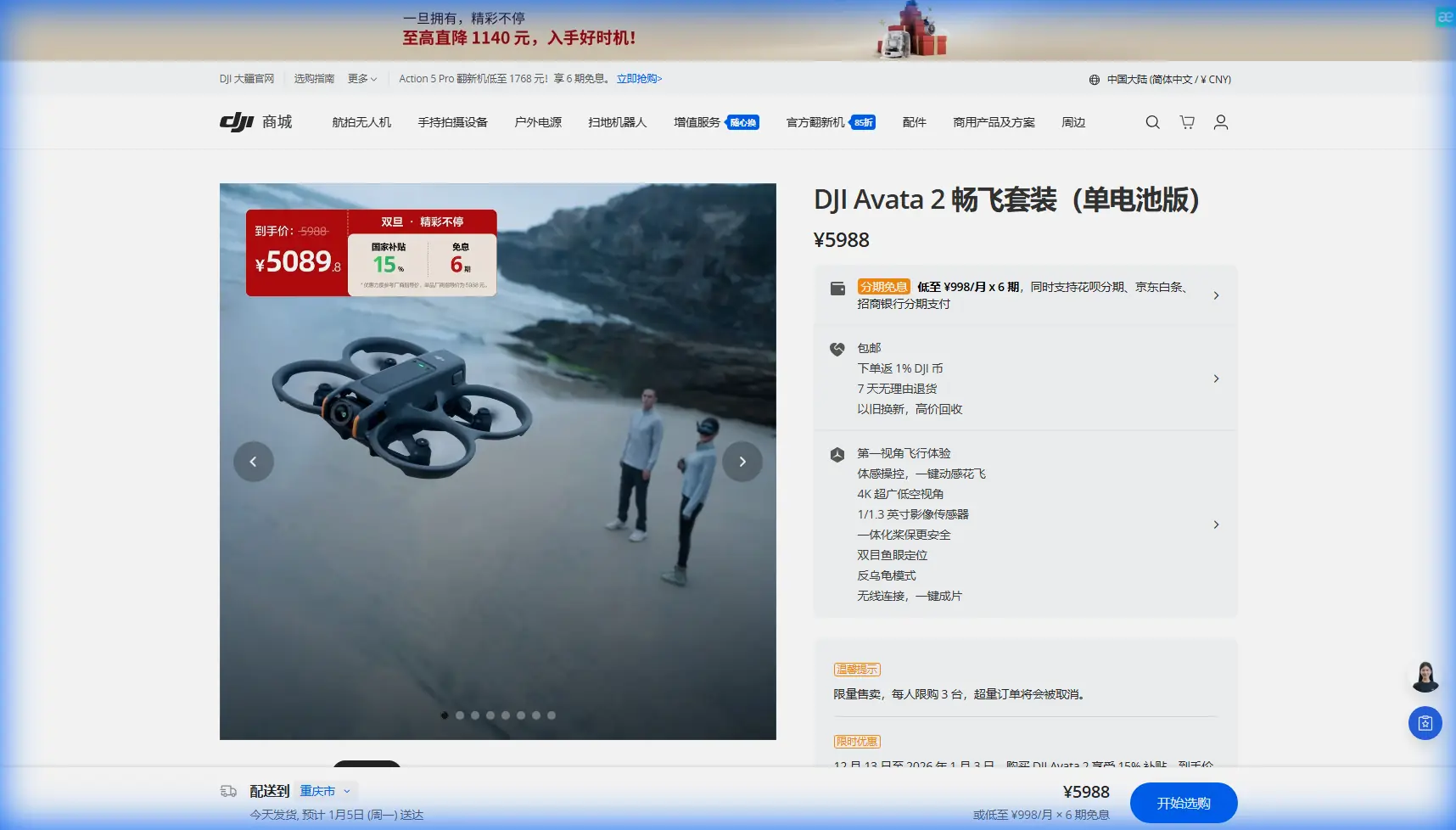
Avata 2 for High-Altitude Wildlife Surveys: A Field Review from a Photographer’s Perspective
META: A technical review of the DJI Avata 2 for high-altitude wildlife work, covering obstacle avoidance, D-Log M, ActiveTrack, battery implications, and where it outperforms rival FPV platforms.
The tricky part about wildlife work at altitude is not getting a drone into the air. It’s bringing back footage and observations that are actually usable when the air is thin, the terrain is unforgiving, and the subject rarely gives you a second chance.
That is where the Avata 2 becomes interesting.
Most people still look at it through the wrong lens. They see “FPV drone” and assume speed, acrobatics, and social clips. In practice, the Avata 2 deserves a more serious reading. For wildlife survey teams, mountain researchers, and photographers working in exposed alpine terrain, it occupies a narrow but valuable space: a compact aircraft with unusually controlled low-level maneuverability, strong image tools, and a safety envelope that is more forgiving than traditional FPV rigs.
I have spent enough time around camera drones to know that spec sheets rarely tell the real story. What matters in the field is whether the aircraft helps you hold a line above uneven ground, preserve detail in high-contrast snow and rock, and avoid turning every close pass into a recovery exercise. For that kind of work, the Avata 2 is better than many of its competitors precisely because it is not trying to be everything.
Why the Avata 2 makes sense in alpine wildlife work
High-altitude wildlife surveying places contradictory demands on an aircraft. You need enough speed to cover ridgelines and valleys efficiently, but not so much that you overshoot a herd or flush birds from a nesting zone. You need immersion and spatial awareness, yet also restraint. You need stabilization and image latitude, but in a platform small enough to move through broken terrain and launch from awkward positions.
The Avata 2’s ducted design is one of the first details that matters operationally. On paper, it may look like a style choice inherited from cinewhoops. In the field, those guards change how confidently you can work near rock faces, sparse tree lines, scrub, or talus slopes where a light touch can mean the difference between a safe correction and a damaged prop. Wildlife survey flights are often flown low and deliberately, not high and cinematic. A platform that tolerates proximity is not a luxury there; it is risk control.
That advantage becomes more obvious when compared with conventional open-prop FPV drones. Many of those aircraft are fast and highly capable in expert hands, but they demand constant precision and offer less margin when the pilot is maneuvering in gusts near terrain. The Avata 2 does not replace that class of aircraft for aggressive freestyle or custom payload work. It does something else. It lowers the workload enough that the operator can think more about the animal, the habitat, and the shot sequence than about merely surviving the flight.
For wildlife users, that trade is often the right one.
Obstacle avoidance is not a buzzword here
The term “obstacle avoidance” gets used too loosely in drone marketing, so it is worth being specific. In mountain environments, terrain does not present itself as a tidy wall in front of the aircraft. It arrives as changing relief: protruding ledges, outcrops, dead branches, uneven slopes, and sudden elevation shifts as you contour a hillside.
This is where the Avata 2’s sensor-backed safety features have practical value. They are not a license to fly carelessly, especially in technical terrain, but they do widen the operating window. If you are tracking movement along a ridge or skimming over tundra broken by boulders, the drone is less punishing than fully manual FPV competitors that rely almost entirely on pilot reflex.
That matters because wildlife survey work is cognitively dense. You may be watching for signs of motion, herd spacing, nesting behavior, or escape paths while also managing wind, battery, and line of sight. Every bit of protective automation that reduces the chance of a minor error becoming a crash preserves mission continuity.
I would still never recommend trusting automated protections blindly in high alpine conditions. Thin branches, visual clutter, and shifting light can confuse any system. But the Avata 2 gives you a more realistic margin for close-quarters terrain work than many drones in its FPV-adjacent class.
The camera is more useful than its category suggests
If your only reference point is older FPV drones, the Avata 2’s imaging package is a significant step up in practical value. For wildlife documentation, the headline is not just resolution. It is tonal control.
D-Log M is the feature that deserves more attention than it usually gets. In high-altitude environments, contrast can be severe. Snowfields, pale rock, dark fur, shadowed ravines, and reflective water all compete inside the same frame. Standard color profiles often force hard compromises, clipping highlights or crushing shadow detail that may matter later when you are trying to identify species, count individuals, or assess behavior.
D-Log M gives you more room to recover that scene in post. For a photographer, that extra grading latitude is not a cosmetic benefit. It can be the difference between a visually dramatic shot and a usable observational record. If a herd of mountain ungulates moves from sunlit scree into shadow, or if a raptor passes against a bright sky and dark ridge, you want a file that bends without falling apart.
That puts the Avata 2 ahead of many small FPV-style alternatives that still feel optimized for immediacy rather than image resilience. Some competing platforms can be fast and fun, but they often ask you to accept thinner dynamic range or less refined color handling. The Avata 2, by contrast, behaves more like a serious camera tool wrapped in an FPV form factor.
ActiveTrack and subject tracking: helpful, but with real limits
The inclusion of subject tracking tools such as ActiveTrack changes how some users will approach wildlife coverage, but this is the feature that requires the most discipline.
Let’s be clear: autonomous tracking is not a substitute for ethical fieldcraft. You should not use a drone to pressure animals, alter movement, or chase them through difficult habitat simply because the aircraft can maintain lock. Wildlife work is about observation with minimal disturbance. That principle comes first.
Used correctly, though, tracking can reduce pilot input during carefully managed passes. If you are documenting lateral movement across open terrain, the ability to maintain framing on a moving subject can help produce cleaner footage and more consistent visual records. It also frees a bit of mental bandwidth for situational awareness, which is valuable when wind begins to shift or topography tightens.
Operationally, I would trust subject tracking most in relatively open areas where terrain and vegetation are not constantly interrupting the line between aircraft and target. In cluttered mountain environments, manual control still wins. Animals do not move like cyclists on a paved path, and the drone should never be allowed to dictate the encounter.
So yes, ActiveTrack is useful, but only when the operator understands that “useful” and “appropriate” are not the same thing.
QuickShots and Hyperlapse are not just for showreels
It is easy to dismiss QuickShots and Hyperlapse as social-media extras. That would be a mistake.
For survey teams, communication matters almost as much as data collection. Researchers often need to brief land managers, conservation partners, local authorities, or sponsors who may not think in raw telemetry or field notes. A well-constructed Hyperlapse can show weather movement over habitat, changing light across a survey area, or the spatial relationship between cliffs, grazing ground, and water access in a way that static maps cannot.
QuickShots, used sparingly, can also help create contextual sequences that establish terrain before cutting to more detailed observations. That matters when you are building a visual narrative for a field report or presentation. The point is not spectacle. The point is clarity.
The Avata 2 handles these modes within an aircraft that can also drop back into close, deliberate manual work. That flexibility is part of its appeal. Some competitors give you either a straightforward camera drone experience or a fully manual FPV experience. The Avata 2 sits between those poles in a genuinely useful way.
If you are planning a field workflow around that balance and want to talk through flight setup or accessory choices, you can message the survey support desk and compare notes before heading into the mountains.
Control confidence is the real differentiator
Here is where the Avata 2 quietly separates itself.
In wildlife operations, the best drone is often the one that keeps your inputs calm. Not the one with the biggest numbers attached to it, and not the one that invites heroics. Calm inputs mean smoother arcs around terrain, steadier altitude adjustments, and less abrupt noise or motion near animals.
The Avata 2’s control philosophy supports that. It offers immersive flying without requiring the operator to accept the full burden of a stripped-down manual FPV platform. That middle ground is why it can outperform nominal rivals in wildlife-specific scenarios.
A traditional camera drone may offer more hover stability and longer-lens options, but it usually cannot move through tighter spaces or trace uneven ground with the same intimate feel. A pure FPV competitor may offer greater speed and customization, but it tends to demand more pilot effort and carries more consequence when the environment turns technical. The Avata 2 is compelling because it narrows that gap.
For high-altitude wildlife work, that translates into more repeatable flights. Repeatability matters. If you need to document the same slope, colony, or migration corridor across multiple days, you want an aircraft that lets you reproduce lines and camera movement with minimal drama.
What to watch for at altitude
None of this means the Avata 2 is immune to mountain realities.
Battery management becomes more serious when temperatures drop and climbs become sustained. Wind shear can appear abruptly along ridgelines. Sound matters too. Even a compact drone can disturb sensitive species if flown too close or too aggressively. The right approach is to use the Avata 2’s agility as a way to stay efficient and precise, not intrusive.
I would also caution photographers against overrelying on immersive flight just because the aircraft makes it enjoyable. In survey conditions, discipline beats excitement. Pre-plan your passes. Keep generous standoff distances. Watch the animal before you watch the shot. Let the drone’s safety systems support judgment, not replace it.
This is also where the Avata 2 compares well against more demanding FPV alternatives. At altitude, fatigue accumulates quickly. Wind, cold, and terrain all chip away at pilot performance. A platform that reduces workload late in the day can be more valuable than a platform that boasts greater theoretical capability on paper.
Verdict: a smarter tool than its image suggests
The Avata 2 is easy to underestimate because its category invites assumptions. It looks like an FPV machine, and to an extent it is. But for high-altitude wildlife surveying, the more accurate description is this: it is a compact observation platform with unusually strong close-terrain handling and better-than-expected imaging discipline.
Two details define that value most clearly. First, its obstacle-aware, guarded design makes low-level terrain work more manageable in places where a small contact can end the sortie. Second, D-Log M gives serious users a more forgiving image file when mountain light becomes extreme. Add controlled subject tracking, practical automated modes like Hyperlapse, and a flight character that encourages precision rather than bravado, and the result is a drone that makes operational sense.
If your work depends on long stand-off observation with heavy optical zoom, another class of aircraft will fit better. If your priority is raw FPV speed and custom tuning, there are other machines for that as well. But if you need a nimble, camera-literate drone for wildlife work in demanding terrain, the Avata 2 earns a place on the shortlist.
It is not the loudest option in the market. That may be exactly why it is worth taking seriously.
Ready for your own Avata 2? Contact our team for expert consultation.