
How to Survey Wildlife in Complex Terrain with Avata 2
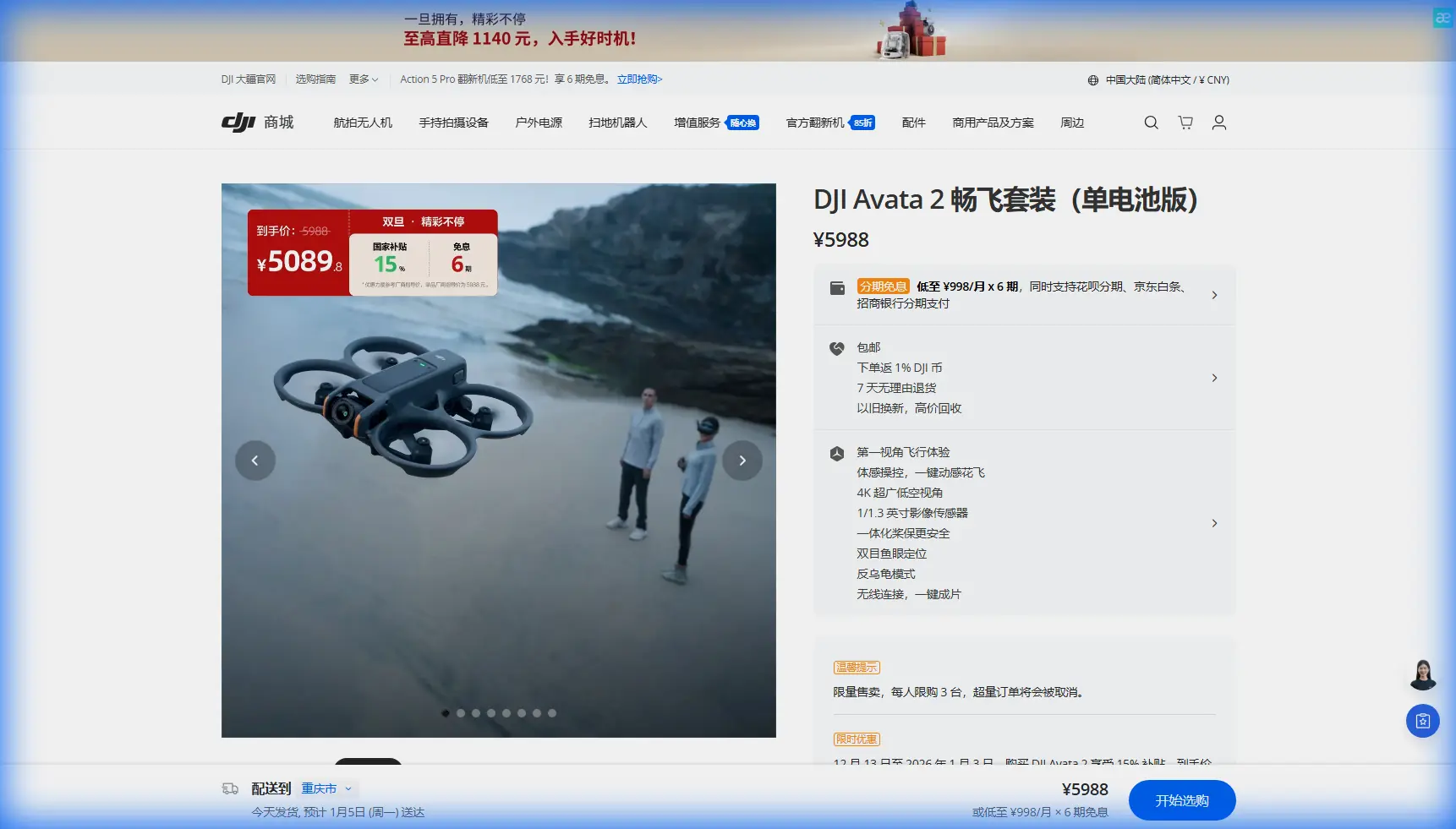
How to Survey Wildlife in Complex Terrain with Avata 2
META: A field-focused guide to using Avata 2 for wildlife surveying in rugged terrain, with practical advice on flight planning, obstacle avoidance, D-Log capture, ActiveTrack limits, and battery management.
Wildlife surveying in broken landscapes is where small aircraft either prove their worth or become a liability. Cliffs, gullies, tree canopies, uneven wind, shifting light, and the constant need to avoid disturbing animals all place real demands on both pilot and platform. For operators considering Avata 2 for this kind of work, the question is not whether it can fly through dramatic terrain. The better question is whether it can gather usable observation data, safely and repeatably, without turning the mission into a chase scene.
That distinction matters.
Avata 2 sits in an unusual place. It is agile enough to work close to terrain features that larger mapping drones may avoid, yet it also brings automated support tools such as obstacle avoidance, subject-following features, and stabilized capture modes that can help when the job is documentation rather than cinematic spectacle. If your assignment involves watching nesting areas, tracing animal movement corridors, checking water access points, or recording habitat condition through narrow ravines and forest edges, the aircraft’s strengths become clearer when you use it with restraint.
This guide is built around that practical use case: wildlife surveying in complex terrain, using Avata 2 as a low-footprint observation tool.
Start with mission design, not flight mode
A lot of wildlife work goes wrong before takeoff. The aircraft may be ready, batteries charged, and weather acceptable, but the survey plan is too vague. In complex terrain, vague planning leads to excess passes, unnecessary noise, and gaps in visual coverage.
Before launching Avata 2, define one of these mission types:
- habitat condition check
- route reconnaissance for animal movement
- repeatable visual documentation of a specific zone
- behavioral observation from a stand-off distance
- terrain-following inspection of water, vegetation, or erosion boundaries
Each mission type changes how you fly.
If you are documenting habitat condition, you want stable passes and consistent framing. D-Log can be useful here because it preserves more flexibility in grading later, especially when your scene alternates between shaded canopy and bright rock faces. In wildlife work, that extra tonal control is not a luxury. It can be the difference between clearly identifying disturbance patterns and losing fine contrast in hard midday light.
If the mission is movement observation, speed matters less than patience. That is where operators often misuse features like ActiveTrack or subject tracking. These tools are helpful, but wildlife is rarely as predictable as a cyclist on an open trail. Dense branches, sudden changes in elevation, and partial occlusion can interrupt a clean lock. Treat tracking as an aid, not as the backbone of your survey workflow.
Why obstacle avoidance changes the way you survey
In complex terrain, obstacle avoidance is not just a safety feature. It changes your route design.
When you survey a ridgeline, creek corridor, or forest edge, the operational problem is usually not open-air navigation. It is transition space. The dangerous moments happen when you move from open sky into constricted airspace near branches, rock outcrops, or broken slopes. Avata 2’s obstacle-sensing capability can help reduce the risk of minor route corrections turning into a collision, especially when you are working low and slow to keep noise and visual disturbance down.
Operationally, this means you can design survey lines that follow terrain features more naturally instead of keeping an exaggerated buffer at all times. That buffer often degrades the value of the footage. If you are too far from a cliff ledge or streambank, small indicators such as nest material, hoof paths, den entrances, water pooling, or vegetation stress can disappear.
Still, obstacle avoidance is not permission to fly carelessly. Vegetation density, fine branches, irregular rock shadows, and changing sun angle all reduce the margin for error. The best practice is to use the system to support disciplined flying, not replace it.
A useful pattern in the field is this: make the first pass high and conservative, identify choke points, then drop lower only on the second pass if the area remains clear and wildlife response appears minimal.
Use ActiveTrack carefully, and know when not to use it
The temptation with Avata 2 is to turn wildlife observation into automated pursuit. Resist that.
ActiveTrack and related subject-tracking functions can be useful in open sections of trail, shoreline, or alpine meadow where the animal is already moving in a visible corridor and you have a clear ethical basis for observation. But in forested or rocky terrain, automation can lead to unstable framing or pressure on the animal if the drone keeps trying to maintain proximity.
There is a better way to use the feature.
Instead of relying on tracking for the full observation, use it for short segments where the terrain opens up and where maintaining smooth framing would otherwise require aggressive stick inputs. This works especially well when documenting movement through a known gap, such as an entry point to a grazing area or a river crossing. You gain continuity in the footage without overcommitting the aircraft to an automated follow.
Operational significance matters here. In wildlife surveying, your job is not just to see the subject. It is to preserve context. A manually controlled wider pass often tells you more than a tightly tracked shot because it includes surrounding vegetation, escape routes, and terrain constraints.
QuickShots and Hyperlapse are not just for style
Many operators dismiss QuickShots and Hyperlapse as media tools, but in field documentation they can serve a technical role if used properly.
QuickShots can help you capture repeatable establishing views of a site. If you revisit a habitat zone over time, a consistent orbit-like visual reference can reveal vegetation loss, waterline changes, encroachment, or path widening. The key is not the effect itself. It is repeatability.
Hyperlapse has value when observing environmental change over a compressed period. For example, if you need to document how wildlife use shifts around a water source during a morning window, a carefully positioned time-compressed sequence can reveal patterns that are hard to notice in real time. You are not filming for drama. You are extracting temporal behavior from a static overlook.
Both tools should be deployed selectively. If animal sensitivity is high, shorten your flight window and prioritize one efficient sequence rather than several creative variations.
D-Log is worth using when the terrain fights your exposure
Rugged landscapes are hostile to standard capture profiles. Deep shade under trees, bright stone, reflective water, and sudden exits into open sky can all cause clipped highlights or blocked shadows. D-Log gives you more room in post-processing to recover detail across these mixed lighting conditions.
For wildlife surveys, that flexibility has direct value. You may need to inspect footage later for subtle visual indicators rather than immediate beauty. Tracks in dust, disturbed ground near burrows, feather scatter, browsing lines on shrubs, and changes in water turbidity can all sit near the edge of visibility. A flatter profile is not magic, but it gives you a better base for careful review.
The tradeoff is workflow discipline. If your team cannot reliably manage color correction and archiving, a simpler profile may produce more consistent outputs. Use D-Log when the mission justifies the extra handling.
A field battery tip that saves surveys
Here is the battery habit that has helped me most in uneven terrain: never plan your return around percentage alone. Plan it around effort.
Avata 2 can feel efficient on the outbound leg when you are descending into a valley or moving with the wind along a contour. Pilots see the remaining charge, feel comfortable, and push for one more pass. Then the aircraft has to climb out, often into a headwind, with a more power-hungry return path than the one that got it there.
My rule in wildlife terrain work is simple. If the outbound leg included sustained descent, a tailwind, or repeated acceleration to reposition, I mentally subtract a chunk of the displayed battery margin before deciding to continue. I also avoid ending a pack at the farthest or lowest point of the mission area. End your useful work slightly early, while you still have options.
That small habit reduces rushed recoveries, and rushed recoveries are where noise spikes, route mistakes, and avoidable wildlife disturbance often happen.
A second tip: label batteries by real-world behavior, not just charge cycles. Some packs hold up better in cooler morning conditions, while others show earlier voltage sag after repeated field use. If you know one battery consistently performs strongest, reserve it for the most exposed terrain section or the flight that requires the highest climb on exit.
Keep the aircraft’s role civilian and observational
This point should be obvious, but it is worth stating because drone language often gets distorted by broader aviation headlines. Some remotely operated aircraft are associated with military use, including aircraft that have been adapted for different purposes inside the United States. That fact highlights a useful distinction for wildlife teams: remote operation itself is not the issue. Mission design is.
For Avata 2 in a wildlife context, the role should remain strictly observational and conservation-oriented. The aircraft is there to document habitat, movement, and terrain conditions while reducing human intrusion into sensitive areas. That civilian use case works best when the drone behaves like a quiet stand-off sensor, not an active presence in the animals’ space.
If your team is building protocols and wants to compare notes on conservative field setups, a direct message can be easier than a long email; I usually point people to this WhatsApp line for practical mission questions.
A simple survey workflow for complex terrain
Here is a practical workflow that matches Avata 2’s strengths.
1. Observe from the ground first
Spend a few minutes reading wind direction, sun angle, and likely animal movement lines. Identify no-fly pockets such as dense canopy, snag clusters, and updraft-prone cliff faces.
2. Fly a high reconnaissance pass
Use a conservative altitude and broad route. Your goal is to map safe transitions and evaluate wildlife sensitivity before moving closer.
3. Choose one primary line
Do not try to cover every angle in a single flight. Pick the route that delivers the strongest observational value with the fewest terrain transitions.
4. Capture a stable contextual pass
This is your reference record. Keep speed modest. Let the camera show terrain relationships.
5. Add one focused segment
Use ActiveTrack only if the terrain opens up and the behavior justifies it. Otherwise, manually frame the area of interest.
6. Record one repeatable overview
This is where a QuickShot-style establishing sequence or a static Hyperlapse can earn its place for long-term monitoring.
7. Leave early enough to recover calmly
Never let the mission drift into a battery-driven exit.
Common mistakes with Avata 2 in wildlife work
The first is flying too low too soon. Animals notice pressure before pilots think they do.
The second is trusting automation in clutter. Obstacle avoidance is a support layer, not a substitute for route discipline.
The third is filming only the subject. Context often matters more than closeness.
The fourth is ignoring light range. In mixed terrain, D-Log can preserve details you will want later.
The fifth is poor battery judgment. The return leg in rugged topography is rarely equal to the outbound leg.
When Avata 2 is the right tool
Avata 2 makes the most sense when your survey area is visually complex, physically hard to access on foot, and better served by agile observation than by rigid grid mapping. It is especially useful for:
- ravines and narrow water corridors
- cliff-adjacent habitat observation
- woodland edge surveys
- visual checks of animal pathways in uneven ground
- repeatable documentation in places where larger drones would be too conspicuous or cumbersome
It is less ideal when your priority is broad-area orthomosaic mapping or highly standardized volumetric outputs. In those jobs, a different airframe may be the smarter choice.
For terrain-rich wildlife observation, though, Avata 2 can be a sharp instrument if you stop treating it like a toy for dramatic flying and start using it like a patient aerial field notebook. Obstacle avoidance supports safer terrain-following passes. ActiveTrack can help in short, carefully chosen windows. D-Log protects details in ugly lighting. And disciplined battery management keeps the mission calm enough to remain useful.
That is what good wildlife surveying looks like: less chasing, more seeing.
Ready for your own Avata 2? Contact our team for expert consultation.